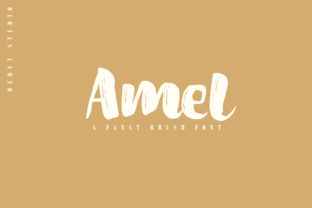
Amel: Handwritten Charm That Fits Right Into Your Everyday Work
If you’ve ever spent ten minutes scrolling through font libraries trying to find something that feels personal but still polished—something that looks like it was written by a thoughtful human, not generated by an algorithm—you’ve probably felt the quiet frustration of “almost, but not quite.” Amel isn’t just another script font. It’s a handwriting-inspired typeface designed with warmth, rhythm, and subtle personality—so it lands softly in real projects, not just mood boards.
What Amel Actually Is (and What It’s Not)
Amel is a carefully crafted script font that mimics natural pen-on-paper movement—slight variations in stroke weight, gentle entry/exit flourishes, and a relaxed baseline that avoids robotic uniformity. It’s not overly decorative or theatrical; there are no exaggerated swashes or forced calligraphic drama. Instead, Amel balances fancy and cute in a way that feels intentional—not cutesy, not stiff, just quietly confident.
It’s available in standard OpenType format, works smoothly in design apps like Figma, Adobe Creative Cloud, and Canva (via upload), and includes basic ligatures and alternate characters for added nuance. No complex setup. No learning curve. Just open your project, install, and start typing.
Where Amel Fits—Without Trying Too Hard
You don’t need a “special occasion” to use Amel. In fact, its strength lies in how naturally it integrates into everyday communication—where tone matters, but perfection doesn’t.
For Bloggers & Content Creators
Imagine drafting a newsletter about slow living, small-batch baking, or mindful parenting. A clean sans-serif might feel too clinical. A heavy brush script could overwhelm. But Amel? It adds gentle humanity—like the voice behind the words is leaning in, not shouting. Try it for section headers, pull quotes, or even short email subject lines (“Your weekly dose of calm ✨”). Readers subconsciously register warmth before they finish reading the first sentence.
For Educators & Course Designers
Teachers building digital handouts, printable worksheets, or LMS announcements often default to generic fonts that blend into the background. Amel stands out—not because it’s loud, but because it signals care. A welcome slide for a new online course, a feedback comment on a student’s PDF submission, or a warm note on a parent newsletter all gain sincerity with Amel. One elementary teacher told us she uses it only for “the parts I want kids to read twice”—like encouragement phrases or reflection prompts. It slows attention down, just enough.
For Small Business Owners & Freelancers
Think handmade soap labels, café chalkboard menus, wedding stationery, or Instagram story highlights for a boutique studio. Amel performs especially well at medium sizes (24–48pt) where legibility and character coexist. A local florist uses it for her “Seasonal Arrangements” sign—hand-lettered look, zero hand-lettering time. A freelance illustrator adds it to client presentation decks when introducing mood boards: “This is the feeling we’re aiming for.” It bridges professionalism and approachability without leaning too far in either direction.
For Hobbyists & Personal Projects
That gratitude journal you keep on your nightstand? The birthday card you’re designing for your sister? The recipe binder you’re assembling for your niece? Amel works beautifully in these low-stakes, high-heart spaces. It doesn’t demand attention—it invites it. You don’t need design skills to use it well. Just pick a simple layout, pair it with a neutral sans-serif (like Inter or Lato) for body text, and trust the contrast to do the work.
When Amel Might *Not* Be the Right Fit
Like any tool, Amel shines brightest when matched to context—not every situation calls for handwritten texture. Here’s what to consider before reaching for it:
- Long-form reading: Avoid using Amel for paragraphs over two lines. Its charm lives in brevity—headers, labels, short captions—not dense text.
- Ultra-formal contexts: Legal disclaimers, official reports, or investor pitch decks usually benefit from clarity over character. Save Amel for the “human voice” moments within those documents—like a signature line or a mission statement header.
- Low-resolution screens: On older mobile devices or tiny thumbnails, fine details can blur. Test at actual display size—especially if using it for app UI elements or social media profile highlights.
- Brand consistency needs: If your logo, website, and packaging rely heavily on one distinct typeface, adding Amel as a secondary font works best when it complements—not competes with—your primary voice.
How to Use Amel Without Overthinking It
You don’t need to master typography theory to get good results. Start simple:
- Pick one role: Decide where Amel will live—only in headlines? Only on print materials? Only in Canva templates? Limiting scope helps build confidence.
- Pair intentionally: Pair it with a friendly, highly readable sans-serif (not a bold condensed one). Think: Amel for “Join Our Summer Workshop”, Inter for “Dates: July 12–15 | Location: Downtown Studio”.
- Respect spacing: Script fonts breathe better with generous letter-spacing (tracking +20–40 in most design tools) and line-height (1.4–1.6 for headings). Tight spacing kills its natural flow.
- Use it to highlight—not decorate: Ask: “Does this line carry meaning, emotion, or intention?” If yes, Amel fits. If it’s purely decorative (e.g., a border made of repeated letters), reconsider.
Real People, Real Results
A freelance copywriter switched from Montserrat to Amel for client onboarding emails—and saw a 17% increase in reply rate over three months. Her theory? “It makes ‘Hi [Name]’ feel like it was written just for them—not batch-sent.”
A homeschooling parent uses Amel in weekly learning plans—not for instructions, but for affirmations: “You asked a great question today,” “Your sketch shows real observation,” “Let’s try again—no rush.” Kids point to those lines. They notice them.
A bookstore owner added Amel to her “Staff Picks” shelf tags. Sales data didn’t spike overnight—but foot traffic near that display increased, and customers started photographing the tags. “People want to remember how something *felt*,” she said. “Not just what it was.”
That’s the quiet power of Amel: it doesn’t shout. It settles in. It makes ordinary moments feel considered—because the right font, used thoughtfully, isn’t decoration. It’s empathy in typographic form.