Archestra: A Refined Display Font for Thoughtful Craft and Design
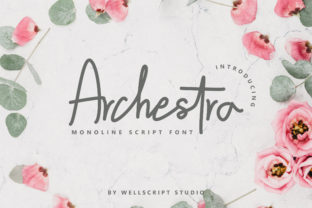
Archestra stands out not through novelty alone, but through a rare balance of visual harmony and functional versatility. It’s a display typeface—designed primarily for headings, logos, invitations, and short-form typographic statements—yet it carries an uncommon degree of elegance without sacrificing readability at moderate sizes. Unlike many script or serif display fonts that lean heavily into either formality or whimsy, Archestra feels equally beautiful and elegant, making it the perfect font for a wide variety of crafting projects where tone and intention matter.
What Makes Archestra Distinctive?
At its core, Archestra is a high-contrast, transitional serif with subtle calligraphic influence—most evident in its gently tapered serifs, soft bracketing, and fluid stroke modulation. Its letterforms avoid sharp angles or exaggerated flourishes; instead, they rely on proportion, rhythm, and restrained detail to convey sophistication. The uppercase ‘A’, ‘G’, and ‘R’ carry quiet personality without drawing attention to themselves. Lowercase characters maintain consistent x-height and open counters, supporting legibility even when set at 24–36pt for printed greeting cards or digital banners.
What sets Archestra apart from similar fonts like Playfair Display or Cormorant Garamond is its intentional neutrality. It doesn’t shout “vintage” or “luxury” by default—it adapts. Pair it with a clean sans-serif like Inter or Lato for modern branding, or with a warm text face like Literata for editorial layouts, and it integrates seamlessly rather than dominating.
Practical Performance Across Mediums
In real-world use, Archestra performs reliably across both print and screen—provided it’s used within its intended scope. As a display font, it’s not suited for body copy or UI labels. But for headlines on a small business website homepage, hand-lettered-style product packaging, wedding stationery, or social media graphics, it delivers consistent impact. Print tests show crisp rendering at 1200 dpi on coated stock, with no hint of blurring or ink spread in fine serifs. On screen, its OpenType features—including stylistic alternates, ligatures, and true small caps—enhance typographic refinement when supported (e.g., in Adobe Creative Cloud apps or modern CSS via @font-face with font-feature-settings).
One practical observation: Archestra’s spacing is thoughtfully tuned—not tight enough to feel cramped, not loose enough to disrupt flow. This means less manual kerning is required for common word pairs like “The Event” or “Studio Collective.” That saves time during layout refinement, especially for non-designers managing their own marketing assets.
Who Benefits Most—and When?
Archestra serves professionals and creators who value precision in tone and presentation. Small business owners launching a boutique skincare line may choose Archestra for its gentle authority—communicating care and craftsmanship without clinical sterility. Educators designing workshop handouts or conference slides find it elevates content without distracting from substance. Freelance graphic designers appreciate how easily it bridges client expectations: upscale enough for a luxury real estate brochure, approachable enough for a community arts nonprofit’s annual report.
For crafters—especially those working with Cricut, Silhouette, or laser-cut materials—Archestra’s clean vector outlines translate well to cut files. Its moderate contrast avoids fragile hairlines that might break during vinyl weeding or engraving. Users report success cutting Archestra at sizes as small as 0.75 inches tall on cardstock, provided blade depth and material settings are calibrated appropriately.
Strengths in Context
- Quality: Built with professional-grade hinting and thorough glyph coverage (including Latin Extended-A, basic diacritics, and punctuation variants), Archestra maintains integrity across languages commonly used in North America, Western Europe, and Australia.
- Usability: Comes in four weights (Light, Regular, Semibold, Bold) with matching italics—enough range for hierarchy without overwhelming choice. No variable axis, so file size remains lightweight (~120 KB per style).
- Flexibility: Works across analog and digital workflows—from hand-traced lettering inspiration to responsive web typography. Its character set supports multilingual quotes and proper hyphenation in English, Spanish, French, and German.
- Consistency: Letterfit and weight progression feel cohesive. Switching from Regular to Semibold introduces noticeable emphasis without visual dissonance—a subtle but important trait for brand systems.
Realistic Considerations and Limits
No font solves every problem—and Archestra is no exception. Its elegance relies partly on context. In low-resolution environments (e.g., older email clients or compressed JPEGs), fine serifs may soften or disappear, reducing its distinctiveness. It also lacks built-in caption or narrow width variants, so extremely tight horizontal spaces—like mobile app navigation bars or narrow column headers—aren’t ideal use cases.
Additionally, while Archestra includes standard OpenType features, it doesn’t offer contextual alternates or swashes. Designers seeking expressive variation (e.g., alternate ‘Q’ tails or decorative ampersands) will need supplemental assets or manual customization. That’s not a flaw—it’s a design decision aligned with its purpose: clarity first, ornament second.
Integrating Archestra Into Your Workflow
Start simple: apply Archestra to one high-impact element—your logo lockup, a hero section headline, or the title block of a PDF guide. Test it alongside your existing type system. Does it clarify hierarchy? Does it align with your audience’s expectations? If you’re using Figma or Adobe XD, try setting Archestra at 32pt bold over a neutral background with 120% line height—then step back. Does it feel resolved, or does something pull focus? Trust that instinct.
For long-term value, consider licensing. Archestra is available through reputable foundries with clear desktop, web, and app usage terms. Avoid free download sites offering unofficial versions—these often lack full character sets, contain malware, or violate licensing agreements, risking legal exposure for commercial users.
A Final Note on Intention
Fall in love with Archestra’s unique charm—not because it’s trending, but because it meets a specific need with quiet competence. It won’t replace your workhorse text font, nor should it. Instead, it offers a refined voice for moments when typography must do more than inform: when it must resonate, invite, and endure. Whether you're drafting a heartfelt note, presenting research findings, or launching a new service, Archestra helps ensure the message isn’t just seen—it’s felt.