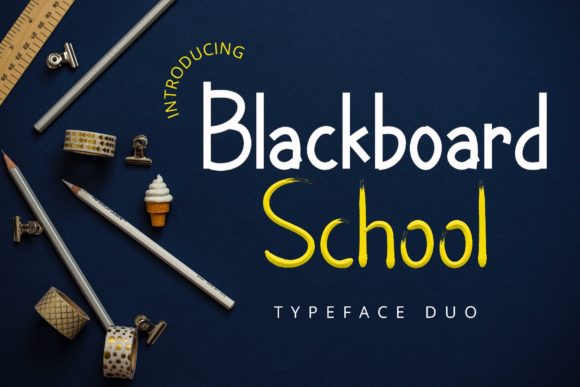
Blackboard School: A Playful Brush Font
Blackboard School isn’t just another brush font—it’s a spark of intentional joy in your design toolkit. Designed for real work and real people, it bridges the gap between expressive handwriting and professional clarity. Its two versions—regular and awesome—aren’t gimmicks; they’re deliberate choices. The regular version gives you clean, bouncy strokes with consistent spacing and legibility. The awesome version adds subtle flourishes, lifted terminals, and gentle exaggerations—ideal when you want energy without sacrificing readability.
This duality makes Blackboard School unusually versatile. It doesn’t shout “hand-drawn!” at every opportunity. Instead, it whispers playfulness while staying grounded—perfect for creators who need personality *and* polish.
Where Personality Meets Practicality
Brush fonts often struggle in real-world use: too wild for body text, too tame to stand out, or inconsistent across weights and characters. Blackboard School avoids those pitfalls by prioritizing functional rhythm. Letters flow naturally, spacing is carefully tuned, and lowercase ‘a’, ‘g’, and ‘y’ are designed for quick recognition—not just visual charm. That means it works where others falter: on social thumbnails, printed workshop handouts, email headers, or even small-screen app interfaces.
Consider how educators might use it: a science teacher creating a lab safety poster can choose the regular version for clear instructions (“Wear goggles”), then switch to the awesome variant for the bold header (“Lab Rules Rock!”). No jarring shift in tone—just smart emphasis.
Creative Uses Across Real Audiences
Different users bring different needs—and Blackboard School adapts without requiring custom tweaks or workarounds.
- Bloggers & content creators: Use the regular version for section headers in long-form posts—especially lifestyle, education, or parenting topics—where warmth builds trust. Pair it with a neutral sans-serif (like Inter or Open Sans) for body text to keep scanning effortless.
- Small business owners: A local bakery could use the awesome version on packaging tags (“Freshly Baked Today!”), then scale down the regular version for ingredient lists. Consistency comes from voice and rhythm—not identical styling.
- Educators & trainers: In slide decks or printable worksheets, Blackboard School helps signal “this part is meant to engage”—not distract. Try using only the uppercase letters for activity titles (“MATCH THE TERMS”) to add visual punch without clutter.
- Freelance designers: When presenting branding concepts to clients who value approachability (think wellness coaches or indie bookshops), Blackboard School offers a ready-made tone anchor—no need to over-design custom lettering from scratch.
Keeping It Clear, Not Cute
Playful doesn’t mean unprofessional—and Blackboard School shines when used with intention. Avoid stacking multiple decorative fonts or overloading layouts with swirls and shadows. Instead, let the font do the lifting. One well-chosen headline in the awesome version, set large and centered over generous white space, often communicates more than three competing elements.
Also: test contrast. Brush fonts can fade on light backgrounds if stroke weight is too fine. Blackboard School’s robust outlines hold up well—but always preview at actual size and on the devices your audience uses. On mobile? Try 28px minimum for headlines. For print? 14pt is usually safe for subheads.
Project Ideas You Can Start Today
You don’t need a big launch to benefit from Blackboard School. Here are three low-lift, high-impact ways to begin:
- Create a branded content series: Launch a weekly “Tip Tuesday” email for your audience. Use the regular version for the subject line (“Your Weekly Design Tip Inside”) and the awesome version for the header inside (“Tip #7: Space Is Your Secret Weapon”). Over time, readers associate that visual rhythm with your voice—not just your logo.
- Redesign one recurring asset: Pick something you update regularly—a workshop agenda, invoice footer, or Instagram Story template. Swap in Blackboard School for headings only. Keep everything else unchanged. Notice how much more distinctive it feels—without extra effort.
- Build a micro-style guide: List just three rules: (1) Use regular for all body copy and subheads, (2) Use awesome only for main headlines and call-to-action buttons, (3) Never use both versions in the same sentence. Share it with collaborators. Clarity multiplies when constraints are simple.
Why This Works Beyond Trends
Blackboard School succeeds because it respects how people actually read—and how creators actually work. It’s not built for viral reels alone. It’s built for the quiet moments: the parent printing a reading chart, the freelancer tweaking a client’s landing page, the teacher pasting a reminder on their classroom door.
Its usefulness grows when paired with thoughtful hierarchy—not flashy effects. That’s why it fits equally well in a PDF report and a Shopify product banner. It doesn’t demand attention; it earns it through consistency, warmth, and restraint.
If you’ve avoided brush fonts in the past because they felt unstable or hard to control, try Blackboard School as a reset. Load it into your design tool. Type a single sentence. Adjust tracking by +20. Then –10. See how much nuance lives in those small shifts. That’s where real creative control begins—not in complexity, but in precision.
And remember: tools like Blackboard School don’t replace judgment—they sharpen it. The most effective use isn’t the flashiest. It’s the one where your audience pauses just long enough to feel seen, understood, and invited in.