Feba: Where Typographic Experimentation Meets Everyday Legibility
Typography is rarely neutral. Even the most restrained typeface carries intention—subtle cues about tone, context, and audience. Feba stands apart not by rejecting convention, but by reimagining its boundaries: a decorative font that refuses to be confined to ornamental roles. It’s neither purely functional nor exclusively expressive. Instead, Feba occupies a thoughtful middle ground—one where experimental structure coexists with intuitive readability. This duality makes it unusually versatile across disciplines, from classroom handouts to brand identity systems, from editorial layouts to interactive interfaces.
Understanding Feba Beyond “Decorative”
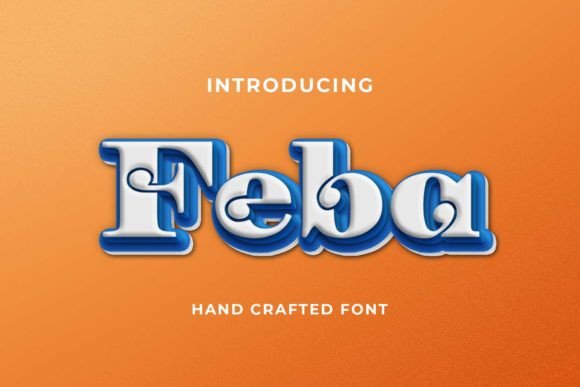
The label “decorative font” often implies limitation: reserved for headlines, logos, or short bursts of visual emphasis. Feba challenges that assumption. Its design language is deliberately layered—geometric foundations softened by organic stroke modulation, consistent x-heights paired with unexpected terminal treatments, and balanced letter spacing that supports both rhythm and clarity. These aren’t arbitrary flourishes; they’re calibrated decisions rooted in typographic history and contemporary usability research.
Consider its lowercase a and g: open counters, slightly flared apertures, and subtle contrast between thick and thin strokes. They echo humanist sans-serifs like Frutiger or contemporary interpretations like Inter—but with a distinct personality. The uppercase M and W feature gentle concave inner curves, lending warmth without sacrificing structural integrity. Even at small sizes (12–14px), Feba maintains legibility in body text settings—a rarity among fonts labeled “decorative.” That resilience stems from generous proportions, uncluttered forms, and intentional optical adjustments built into its OpenType features.
Who Benefits Most—and How
Feba’s strength lies in its adaptability across user groups, each leveraging different facets of its character.
Educators and Instructional Designers
In learning environments, typography influences cognitive load and retention. Feba’s familiar-yet-distinctive shapes support recognition without triggering fatigue. A science teacher using Feba for lab worksheet headers creates immediate visual hierarchy, while its clean lowercase forms aid scanning in student-facing instructions. Unlike highly stylized display fonts, Feba doesn’t distract from content—it frames it with quiet authority. One university writing center reported improved student engagement with revision rubrics typeset in Feba, attributing the effect to its approachable precision.
Brand Strategists and Small Business Owners
For organizations without dedicated design teams, selecting a typeface that communicates values *and* scales across touchpoints is critical. Feba conveys craftsmanship and thoughtfulness without pretension. A local ceramics studio uses Feba for packaging labels and Instagram captions—its tactile stroke variation subtly echoes hand-thrown textures, while its even color on screen ensures consistency across digital ads and printed business cards. Crucially, Feba avoids the “generic modern” feel of overused sans-serifs, helping small brands stand out without resorting to novelty that ages quickly.
UX Writers and Digital Product Teams
UI typography demands reliability first—but also opportunity for voice. Feba’s variable axis (where available) allows fine-tuning weight and width to match interface density. In dashboard headings, a semi-bold instance provides clear signposting; in empty-state illustrations, a lighter weight adds gentle emphasis without shouting. Its generous inter-character spacing reduces crowding in narrow mobile columns, and its numerals are tabular and lining—essential for data tables. Teams integrating Feba into design systems note reduced need for manual kerning overrides, thanks to its robust default spacing metrics.
Real-World Applications Across Mediums
Feba thrives where context shifts rapidly—and expectations vary widely.
- Editorial Layouts: A regional magazine uses Feba for pull quotes and section dividers. Its slight irregularity adds texture against a neutral serif body font (e.g., Adobe Garamond), creating visual interest without competing for attention. Designers emphasize that Feba’s “familiar feel” prevents reader disorientation during transitions between dense text and highlighted passages.
- Environmental Graphics: A museum’s wayfinding system employs Feba in medium weight for room titles and exhibit descriptors. Its open apertures and sturdy terminals ensure legibility under varied lighting and viewing angles—critical where signage must function at 3 meters and 30 centimeters alike.
- Academic Publishing: A journal specializing in design theory adopted Feba for article titles and contributor bios. Reviewers noted its ability to signal intellectual rigor while avoiding academic sterility—a balance achieved through restrained contrast and deliberate spacing, not austerity.
- Creative Portfolios: Freelance illustrators use Feba to title project case studies. Its experimental edge reflects creative process, yet its grounding in typographic fundamentals reassures clients about technical competence. As one designer observed: “It says ‘I understand rules’ before I even show my work.”
Practical Considerations Before Implementation
Like any tool, Feba reveals its full value only when matched thoughtfully to purpose. Three considerations consistently emerge from real-world use:
Pairing With Intention
Feba shines brightest when contrasted—not clashed—with complementary typefaces. Avoid pairing it with other decorative or high-contrast fonts, which can create visual competition. Instead, lean into harmony through counterpoint: a sturdy, low-contrast serif (e.g., PT Serif) for body text; a neutral geometric sans (e.g., Manrope) for captions and UI elements. The goal isn’t neutrality—it’s strategic resonance. Feba’s personality should enhance, not overwhelm, the surrounding typographic ecosystem.
Licensing and Technical Readiness
Feba is distributed under an OFL (Open Font License) for self-hosted web use, with commercial licenses available for embedded applications (e.g., SaaS platforms, mobile apps). When deploying via CSS, always specify fallbacks (font-family: "Feba", "Segoe UI", system-ui, sans-serif;) and test rendering across Windows, macOS, and iOS—particularly at smaller sizes where hinting behavior varies. For print workflows, confirm that your RIP (raster image processor) fully supports OpenType layout features like contextual alternates, which refine Feba’s letterfit in longer passages.
Accessibility as a Design Constraint
While Feba meets WCAG 2.1 AA contrast requirements at standard sizes, its decorative qualities warrant extra scrutiny in accessibility-critical contexts. For legal disclaimers or medical instructions, prioritize tested, high-legibility fonts (e.g., Noto Sans, Roboto). Reserve Feba for non-essential, high-signal text—headings, branding elements, or navigational landmarks—where its expressive qualities reinforce meaning rather than obscure it. Always validate color contrast using tools like axe or WAVE, especially when applying Feba to colored backgrounds.
Why Feba Endures in a Crowded Landscape
The font landscape evolves rapidly, with new releases emphasizing extremes: ultra-thin hairlines, chaotic variable axes, or nostalgic revivals pushed to caricature. Feba resists trend-chasing. Its longevity stems from a foundational commitment to *function-first experimentation*. Every curve, every weight transition, every spacing decision serves dual purposes: aesthetic coherence and practical utility.
This isn’t accidental. The designers behind Feba conducted extensive user testing—not just with designers, but with teachers grading essays, engineers reading schematics, and seniors navigating municipal websites. Feedback shaped its open counters, consistent baseline alignment, and restrained stroke contrast. The result is a font that feels simultaneously fresh and trustworthy—a rare convergence in typographic design.
For creators weighing options, Feba offers something increasingly scarce: confidence without compromise. Confidence that a headline will command attention without alienating readers. Confidence that a brand’s voice remains distinct across a social media story and a trade show banner. Confidence that a student’s presentation slide won’t sacrifice clarity for creativity. That confidence arises not from marketing claims, but from observable behavior—how Feba performs when asked to do real work, in real contexts, for real people.
Getting Started Thoughtfully
If Feba resonates with your needs, begin incrementally. Start with a single, high-impact application: redesigning a recurring template (like email newsletters or workshop handouts) using Feba for headings and a proven body font. Measure response—not just aesthetics, but engagement metrics (open rates, time-on-page, feedback quality). Then expand based on evidence, not assumption.
Explore its OpenType features deliberately. Activate stylistic sets for alternate Q or R forms in logo lockups; use discretionary ligatures sparingly in invitations or certificates where craft matters. But resist the urge to activate every feature at once—clarity emerges from restraint, not accumulation.
Finally, remember that Feba is a collaborator, not a solution. Its experimental nature invites interpretation, but its familiarity grounds that interpretation in shared understanding. Use it to ask better questions about your communication goals: What feeling should this heading evoke? Which details deserve emphasis? How does this text serve the person reading it—not just the person designing it?
In an era of algorithmic design and generative typography, Feba reminds us that enduring tools emerge not from novelty alone, but from deep attention to human perception, context, and need. It doesn’t shout for attention. It earns it—quietly, consistently, and with unmistakable purpose.