Billybond: Where Typographic Expression Meets Functional Precision
Typography is rarely just about legibility—it’s about resonance. When a font carries intention in every curve, connection, and flourish, it becomes more than a tool; it becomes a collaborator in communication. Billybond stands apart in this landscape not by rejecting utility, but by redefining how expressive typography can serve real-world needs across disciplines—from brand identity systems to academic presentations, from hand-lettered invitations to digital course materials.
More Than Swashes: The Architecture of Intentional Design
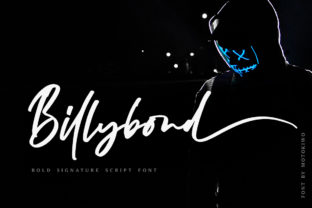
At first glance, Billybond captivates with its bold signature presence—confident strokes, generous x-height, and rhythmically balanced spacing. But its depth reveals itself upon closer inspection. This isn’t decorative excess disguised as function; it’s a carefully orchestrated system built on three interlocking pillars: ligatures, ending alternates, and PUA-encoded swashes.
The ligatures in Billybond go beyond standard “fi” or “fl” pairings. They respond intelligently to common letter combinations like “th”, “st”, “ct”, and “re”, smoothing transitions without sacrificing clarity. In body text applications—say, a printed syllabus or a long-form editorial feature—these subtle joins reduce visual friction and support sustained reading flow.
Ending alternates offer typographic nuance at sentence boundaries. Rather than truncating a word with a static terminal, Billybond provides graceful, context-aware exits—some tapered, others looping, all designed to resolve momentum naturally. This matters most in contexts where tone is paramount: a keynote slide headline, a museum wall label, or the closing line of a nonprofit’s annual report.
PUA Encoding: Control Without Compromise
One of Billybond’s most practical innovations lies beneath the surface: full PUA (Private Use Area) encoding for all swashes. Unlike fonts that rely on OpenType features requiring specialized software or manual glyph substitution, every flourish in Billybond lives at a dedicated Unicode position. That means designers using Figma, educators typing in Google Docs (with compatible font loaders), or developers embedding web fonts via CSS @font-face can access swashes directly through keyboard shortcuts or character palettes—no plugins, no scripting, no guesswork.
This accessibility bridges technical divides. A high school art teacher preparing a poster project doesn’t need to learn Glyphs app to insert a descending “y” swash. A small-business owner updating their Shopify store banner can type “&” and select the matching ornamental ampersand from a standard font menu. It democratizes expressive typography—not as a luxury reserved for expert typographers, but as a usable layer of voice available to anyone with intent.
Educators and Curriculum Designers
In learning environments, visual hierarchy supports cognitive processing. Billybond’s strong contrast and distinctive letterforms aid recognition—especially for learners developing literacy or navigating multilingual materials. Its swashes aren’t merely ornamental here; they act as visual anchors. A biology instructor might use a looping “D” swash to highlight key definitions in a study guide; a language arts teacher could apply alternate “g” and “a” forms to distinguish phonetic variants in early readers. Because each variant is PUA-encoded, swapping glyphs remains consistent across PDF exports, LMS uploads, and printed handouts.
Brand Strategists and Small Business Owners
For organizations without in-house design teams, Billybond delivers signature distinction without dependency on custom illustration. Its bold weight establishes authority in logos and signage, while its ligature-rich lowercase lends approachability in supporting copy. Consider a local bakery: the shop name in full Billybond capitals with a trailing swash “e” conveys craft and warmth; ingredient lists or seasonal menus set in the same family—using only standard characters—maintain cohesion without visual fatigue. No need to license multiple fonts or manage inconsistent weights.
Researchers and Academic Communicators
Academic publishing often prioritizes neutrality—but clarity shouldn’t mean sterility. In conference posters, data visualization annotations, or grant proposal headers, Billybond offers a rare balance: high readability at small sizes (thanks to open counters and uncluttered terminals) paired with enough personality to signal intellectual confidence. Researchers in fields like design anthropology or cultural history may choose specific ending alternates to echo manuscript traditions—subtly reinforcing thematic continuity without distracting from content.
Hobbyists and Creative Practitioners
From calligraphy journaling to vinyl decal design, Billybond serves as both inspiration and scaffold. Its swashes map intuitively to natural hand-motion arcs—descending strokes flow downward, ascending ones lift upward—making it ideal for hybrid workflows. A maker designing embroidery patterns might trace a Billybond “S” swash as a stitch guide; a poet formatting a chapbook could use ligature variants to emphasize rhythmic breaks between stanzas. Because every alternate is accessible via Unicode, these creative decisions remain editable, scalable, and reproducible.
Workflow Integration: Simplicity That Scales
Adoption hinges less on aesthetics and more on integration. Billybond works natively in Adobe Creative Cloud apps, Affinity Suite, and modern web browsers when served via variable or static WOFF2 files. For developers, CSS font-feature-settings can activate ligatures programmatically, while fallback strategies (e.g., declaring font-family: "Billybond", "Segoe UI", system-ui;) ensure graceful degradation in unsupported environments.
Importantly, Billybond avoids over-engineering. It does not include dozens of optical sizes or stylistic sets that complicate selection. Instead, it offers one robust design space—refined, consistent, and internally coherent. This restraint makes it easier to establish typographic standards across teams: marketing departments define approved swash usage in brand guidelines; engineering teams embed the same font file across documentation portals and admin dashboards; educators share template libraries knowing formatting will persist across devices.
Considerations for Thoughtful Implementation
Expressive fonts invite enthusiasm—but effectiveness depends on discernment. Billybond thrives where voice matters, yet it demands attention to context. Its boldness commands space; used at small sizes in dense paragraphs, tracking and leading adjustments become essential. Testing contrast against background colors—especially in digital interfaces—is non-negotiable for WCAG compliance.
Ligatures, while elegant, aren’t universally appropriate. Legal contracts, scientific notation, or code samples benefit from literal character representation. Similarly, swashes should enhance—not obscure—meaning. A trailing flourish on “USA” may evoke patriotism in a campaign poster but undermine clarity in a passport application form. The strength of Billybond lies not in its ability to decorate, but in its capacity to clarify intention when applied with purpose.
Why This Resonates Beyond Aesthetics
In an era of algorithmically generated templates and homogenized UI kits, Billybond represents something increasingly rare: human-centered typography with agency. Its ligatures anticipate language patterns. Its ending alternates honor syntactic rhythm. Its PUA encoding respects diverse technical environments—not as afterthoughts, but as foundational choices.
This isn’t nostalgia for analog tools. It’s responsiveness to how people actually work today: switching between tablets and desktops, collaborating across time zones, balancing creative expression with accessibility mandates, and seeking authenticity without sacrificing efficiency. Whether you’re typesetting a doctoral thesis, designing a civic engagement app, or handwriting thank-you notes for a community fundraiser, Billybond meets you where you are—with precision, flexibility, and quiet confidence.
Looking Ahead: Typography as Collaborative Language
The future of type isn’t measured in novelty, but in fidelity—to users, to content, to context. Billybond signals a shift toward fonts that assume varied roles without requiring retraining: a single family functioning equally well as a logo, a heading stack, a pull-quote accent, and a navigational label. Its ligatures don’t just connect letters—they connect intent to outcome. Its swashes don’t just embellish—they articulate emphasis, pause, and conclusion with typographic grammar.
As tools evolve and audiences diversify, the value of a font like Billybond grows—not because it shouts loudest, but because it listens most carefully to how meaning is made, shared, and remembered.