The Masquito: Where Elegant Typography Meets Modern Creative Workflow
Typography is no longer just about legibility—it’s a strategic design asset. In an era where visual differentiation drives engagement, brand recall, and emotional resonance, typefaces have evolved from functional tools into expressive collaborators. Among the newest entrants making waves across creative studios, marketing departments, and entrepreneurial ventures is The Masquito: an exceptional script font designed not for novelty alone, but for nuanced, high-impact communication.
What Is The Masquito—And Why Does It Stand Apart?
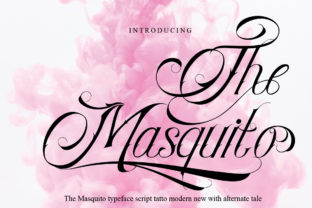
The Masquito is an elegant, hand-crafted script font that balances organic fluidity with precise typographic control. Unlike many decorative scripts that sacrifice readability for flair, The Masquito delivers both sophistication and clarity—even at smaller sizes and in digital contexts. Its defining strength lies in its thoughtfully engineered swashes and ligatures: extended flourishes that activate contextually, and character combinations that flow naturally, mimicking the rhythm of skilled handwriting.
These aren’t decorative afterthoughts. Each swash is carefully kerned and positioned to enhance—not interrupt—reading flow. Each ligature responds intelligently to adjacent characters, avoiding collisions while preserving grace. That level of craftsmanship signals something deeper: The Masquito was built for real-world use—not just for headlines or logos, but for packaging copy, email signatures, social media carousels, and even interactive web components where typographic personality matters.
Aligning With Today’s Creative and Business Priorities
Creative professionals and business owners alike are navigating a shifting landscape—one where authenticity, speed, and visual cohesion matter more than ever. Consumers scroll past generic content in under two seconds. Algorithms prioritize engagement signals tied to dwell time and interaction. And internal teams demand assets that scale across platforms without rework.
In this environment, The Masquito answers several converging needs:
- Brand humanization: As AI-generated visuals become commonplace, audiences respond more strongly to cues of human intention—like subtle variations in stroke weight or intentional asymmetry. The Masquito’s organic movement supports that perception without sacrificing polish.
- Design system efficiency: With OpenType features enabled, designers can access dozens of alternate glyphs, contextual swashes, and discretionary ligatures directly within Adobe Creative Cloud or modern CSS environments—no manual glyph substitution required. This reduces production time while increasing expressive range.
- Cross-channel consistency: Whether used in a Shopify product banner, a Canva presentation slide, or an Figma prototype, The Masquito maintains visual integrity. Its robust hinting and optimized spacing ensure fidelity across retina displays, mobile screens, and printed collateral.
A Practical Shift: From “Nice-to-Have” to “Must-Use”
Consider a freelance brand strategist preparing a pitch deck for a luxury skincare startup. A year ago, she might have defaulted to a clean sans-serif for professionalism—and added a single decorative script only for the logo. Today, she uses The Masquito across body copy in her mood board slides, subtly activating swashes on key value propositions (“Radiance,” “Balance,” “Timeless”). The result? A cohesive narrative voice—not just a visual style.
Or take an e-commerce entrepreneur launching a limited-edition candle line. Instead of commissioning custom lettering for every label variant (a costly, time-intensive process), she licenses The Masquito, then leverages its stylistic sets in Affinity Publisher to generate unique, hand-finished labels for each scent—“Amber & Moss,” “Sea Salt & Linen,” “Vanilla & Petrichor”—each with distinct, context-aware flourishes. That agility turns typography into a scalable differentiator.
Why Designers and Marketers Are Taking Notice Now
The attention around The Masquito isn’t isolated—it reflects broader industry momentum toward intelligent typography. This trend includes:
- Variable font adoption: While The Masquito is currently offered as a static OpenType font, its underlying architecture anticipates variable interpolation—meaning future iterations could offer adjustable slant, swash intensity, or baseline variation via CSS, enabling dynamic typographic responses to user behavior or device context.
- Accessibility-aware expressiveness: Leading foundries now test script fonts against WCAG contrast and readability thresholds. The Masquito meets AA contrast standards at 16px+ in standard weight, and its generous x-height and open counters support screen reader compatibility when paired with semantic HTML structure—a quiet but critical win for inclusive branding.
- Integration-ready tooling: With native support in Figma’s variable text styles, Adobe Fonts’ sync workflow, and robust CSS @font-face fallback strategies, The Masquito bridges the gap between design intent and development execution—reducing handoff friction between creatives and engineers.
Not Just for “Pretty” Projects—But for Purposeful Ones
It’s easy to assume script fonts belong only to wedding invitations or artisanal coffee bags. But The Masquito challenges that assumption by performing reliably in unexpected places: legal disclaimers styled with restrained swashes; SaaS dashboard welcome messages that soften technical interfaces; nonprofit campaign emails where warmth builds trust faster than bullet points.
One notable example: a B2B fintech startup recently deployed The Masquito in its investor-facing quarterly report—using light-weight swashes only on section headers and data callouts. Stakeholders reported the document feeling “more confident and less transactional,” despite containing the same complex metrics. That subtle shift in perception underscores typography’s underleveraged influence on credibility and tone.
Looking Ahead: Typography as Infrastructure, Not Decoration
The future of type isn’t about chasing trends—it’s about building resilient, expressive systems that serve people first. As generative AI accelerates layout production, the value of human-curated typographic nuance increases. Tools may draft a homepage; The Masquito helps it feel unmistakably *yours*.
This aligns with larger shifts in how professionals approach digital craftsmanship: fewer one-off assets, more reusable, context-aware systems; less emphasis on “what looks cool,” more on “what communicates clearly, consistently, and kindly.” The Masquito fits squarely within that ethos—not as a flourish, but as infrastructure.
For entrepreneurs launching direct-to-consumer brands, The Masquito offers immediate visual distinction without outsourcing identity to agencies. For marketers managing global campaigns, its multilingual support (including extended Latin, Vietnamese, and basic Cyrillic) enables localized elegance—not just translated text. For educators and creators building online courses, its friendly authority fosters approachability without diluting expertise.
Final Thought: Choose Type With Intention
In a world saturated with algorithmically generated visuals and templated layouts, intentional typography becomes a quiet act of authorship. The Masquito doesn’t shout—it invites. It doesn’t distract—it deepens. Its swashes aren’t ornaments; they’re punctuation for emotion. Its ligatures aren’t gimmicks; they’re grammar for gesture.
When you choose The Masquito, you’re not selecting a font. You’re choosing a collaborative partner—one calibrated for clarity, built for adaptability, and grounded in the understanding that how something is said remains inseparable from what it says.
Whether you're refining a brand voice, shipping a product launch, or designing your first client website, The Masquito offers more than beauty. It offers precision with presence—and in today’s creative economy, that balance is rare, valuable, and increasingly essential.