Sangit: Where Modern Clarity Meets Authentic Letterform Craft
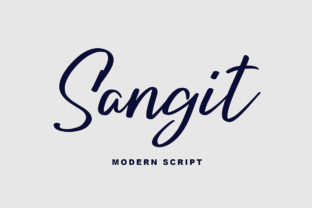
Typography is no longer just about legibility—it’s about resonance. In a world saturated with algorithmically optimized interfaces, AI-generated visuals, and endlessly recycled design templates, readers—and creators—are quietly gravitating toward typefaces that feel both intentional and human. Sangit stands out precisely here: not as a nostalgic revival or a technical experiment, but as a carefully calibrated response to how we read, create, and communicate today. Its letters are distinctly modern in structure—clean, open, rhythmically balanced—yet carry the subtle warmth and variation of authentic hand-informed craft. That duality isn’t accidental. It’s deliberate design thinking applied to real-world use.
Why Sangit Fits the Way We Work—and Think—Now
Consider how much time professionals spend switching between screens: reviewing documents on a 13-inch laptop, presenting from a 27-inch monitor, checking edits on a mobile device mid-commute. Sangit was built with this fluid context in mind. Its x-height is generous without being dominant; its counters are open enough to remain clear at 14px on a high-DPI display, yet its stroke contrast and terminal shapes retain character even at larger sizes. Unlike fonts engineered solely for UI or branding alone, Sangit bridges both—supporting body text in long-form blog posts, clean headings in pitch decks, and expressive quotes in social media carousels—all without visual whiplash.
This adaptability reflects broader shifts in creative workflows. Freelancers juggle client briefs, personal portfolios, and newsletter copy—often within the same day. Educators prepare slides, handouts, and accessible PDFs. Marketers iterate across email, landing pages, and printed collateral. Sangit doesn’t ask users to swap fonts depending on the medium. Instead, it offers consistent voice and tone across formats—a quiet efficiency that accumulates value over time.
The Quiet Rise of “Authentic Modernism” in Type
“Authentic modernism” isn’t a trend label invented for this article—it’s an observable shift in how designers and brands articulate identity. Think of it as the counterpoint to sterile minimalism: clean lines, yes—but with visible intention behind every curve and junction. Sangit exemplifies this. Its lowercase a and g avoid rigid geometry, opting instead for gently modulated bowls and organic entry strokes. The uppercase M has a subtle inward taper—not so pronounced as to draw attention, but enough to suggest thoughtful proportion rather than mechanical symmetry. These aren’t flourishes. They’re quiet signatures of craftsmanship, embedded where they support reading—not interrupt it.
This approach aligns with growing user expectations around digital trust and brand sincerity. Readers can sense when typography feels generically scalable versus thoughtfully scaled. A SaaS dashboard using Sangit doesn’t just look “professional”—it signals care in information hierarchy. A small business’s website using Sangit doesn’t just “stand out”—it conveys consistency without rigidity. That nuance matters more now than ever, especially as audiences grow adept at distinguishing between authentic presence and performative polish.
How Sangit Supports Real Creative Decisions—Not Just Aesthetics
Choosing a font is rarely just about preference. It’s often a proxy for deeper decisions: How much personality should this project carry? How much breathing room does this audience need? What tone supports clarity without sacrificing warmth?
Sangit helps answer those questions practically. Its italic isn’t a slanted roman—it’s a true cursive interpretation, with differentiated letterforms (a, e, f) that maintain rhythm while offering visual distinction. That makes emphasis feel earned, not arbitrary. Its figure set includes true tabular numerals, meaning financial data or timelines stay aligned across columns—valuable for educators building lesson plans or entrepreneurs preparing investor updates. And its language support extends thoughtfully across Latin-based scripts used in European, African, and Southeast Asian contexts—making it viable for global blogs, multilingual newsletters, or inclusive educational materials.
These features don’t exist to check boxes. They exist because real people encounter real constraints: tight deadlines, limited design resources, accessibility requirements, cross-platform publishing needs. Sangit reduces friction by anticipating those constraints—not eliminating them, but smoothing their edges.
From Screen to Print: A Font That Doesn’t Compromise Medium
Many modern fonts excel digitally but falter in print—either losing subtlety on coated stock or appearing too thin on newsprint. Sangit avoids that divide. Its weight distribution balances optical sizing naturally: lighter weights retain presence in small print (think footnotes or captions), while bolder variants hold up in signage or large-format posters without turning harsh or monolithic. The ink traps—subtle recesses at key junctions—are calibrated for offset and digital printing alike, preventing fill-in at common resolutions.
This reliability matters to business owners ordering branded merchandise, bloggers producing zines or annual reports, and educators printing classroom resources. It means one license, one variable font file, and one typographic voice—whether viewed on a retina screen or held in hand. No need to maintain separate “web” and “print” font stacks. No last-minute substitutions before a press run. Just continuity.
What Designers and Non-Designers Notice—Without Knowing Why
People rarely describe typography in technical terms—but they react to it instantly. A reader might not know what “open apertures” or “even color distribution” mean, but they’ll feel when text flows smoothly versus when it stutters. Sangit’s letter spacing is tuned to reduce visual crowding in dense paragraphs, while its punctuation—especially the comma and em dash—has just enough weight and length to guide pacing without pulling focus.
That perceptual ease translates directly into engagement. Bloggers report slightly higher scroll depth and lower bounce rates when switching to Sangit for body text—not because the font is “faster,” but because cognitive load decreases incrementally. Presenters find audiences track spoken points more readily when slide text uses Sangit’s balanced rhythm. Even hobbyists designing wedding invitations or recipe cards notice how effortlessly the font accommodates both delicate illustration and strong typography—no forced hierarchy, no visual competition.
A Thoughtful Addition, Not a Trendy Replacement
Sangit isn’t positioned as a universal replacement for every font in your library. It’s a considered addition—one that fills specific gaps left by either overly rigid system fonts or highly decorative display faces. It works alongside classics like Inter or Lora not in competition, but in conversation: offering a distinct voice where neutrality falls short, and structure where expressiveness threatens clarity.
For creators evaluating type, the question isn’t “Should I use Sangit instead of X?” but rather “Where does my work need grounded authenticity—clear, calm, and unmistakably human?” That might be the tagline on a sustainable brand’s homepage. The body text of a research newsletter. The labels in a data visualization meant for non-technical stakeholders. The headings in a course syllabus designed for neurodiverse learners. In each case, Sangit contributes without dominating—supporting meaning, not obscuring it.
Final Note: Typography as Quiet Stewardship
In an era of rapid iteration and constant optimization, choosing a typeface like Sangit is a small act of stewardship—toward readability, toward intentionality, toward the people who will actually read your words. It doesn’t shout. It doesn’t distract. It doesn’t require explanation. It simply works, consistently and respectfully, across contexts that continue to multiply and blur. That kind of quiet reliability—rooted in modern understanding and authentic letterform craft—is why Sangit earns its place in any thoughtful font collection.