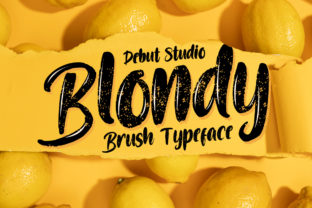
Blondy: Where Handwritten Charm Meets Modern Design Clarity
Blondy isn’t just another handwritten font—it’s a quiet but confident response to how we communicate visually today. In an era saturated with ultra-polished, algorithm-optimized interfaces and AI-generated visuals, Blondy stands out by doing something increasingly rare: it feels human first. Its sweet, playful curves and subtle irregularities aren’t flaws—they’re intentional signatures of authenticity. Designed for warmth without sacrificing legibility, Blondy bridges the gap between approachability and professionalism—making it especially resonant for creators who need their work to connect emotionally while still conveying competence.
Why Handwritten Fonts Like Blondy Are Gaining Real Traction
It’s not nostalgia driving interest in fonts like Blondy—it’s necessity. Over the past five years, user expectations have shifted decisively toward personalization and emotional resonance. Whether it’s a small business owner designing a welcome email, an educator crafting classroom materials, or a marketer building a brand voice across social platforms, audiences respond more readily to cues that signal care, individuality, and intentionality. Automated tone often falls flat; Blondy offers a gentle, human counterpoint.
This aligns with broader behavioral trends: people spend less time on content that feels transactional or generic. A 2023 Content Marketing Institute report found that 72% of consumers say they’re more likely to engage with brands that use relatable, personality-driven visuals—even in simple applications like email headers or Instagram story text overlays. Blondy fits seamlessly into those micro-moments because it doesn’t demand attention; it invites it.
How Blondy Fits Into Evolving Creative Workflows
Modern design isn’t about choosing between speed and soul—it’s about integrating both. Tools like Figma, Canva, and Adobe Express now support variable fonts and intuitive font-switching workflows, meaning designers and non-designers alike can test and deploy type choices like Blondy in minutes—not hours. That accessibility matters: a freelance copywriter can use Blondy to add visual distinction to a client’s lead magnet, while a teacher might apply it to a printable worksheet to soften academic tone without undermining credibility.
What makes Blondy especially practical is its balance. Unlike some handwritten fonts that sacrifice readability at smaller sizes or in longer blocks, Blondy maintains clarity even in body text at 14–16px—ideal for digital newsletters, landing page subheads, or product packaging labels. Its open letterforms and generous spacing prevent crowding, and its lowercase ‘a’, ‘g’, and ‘y’ carry enough character to feel distinctive without becoming distracting.
Real-World Applications You Can Implement Today
- Branded Email Signatures: Replace default sans-serif names with Blondy for a subtle, memorable touch—especially effective for coaches, consultants, and creative service providers.
- Social Media Story Text: Use Blondy for short affirmations, tips, or callouts in Instagram or TikTok Stories. Its rhythm guides the eye naturally, supporting quick comprehension.
- Educational Handouts: Teachers report higher student engagement when worksheets or reading guides feature friendly, non-intimidating typography. Blondy works well for titles, instructions, and reflection prompts.
- Small-Business Packaging & Labels: Local makers, bakeries, and craft vendors find Blondy reinforces artisanal values—pairing beautifully with natural textures and muted color palettes.
- Personal Branding Assets: Bloggers and podcasters use Blondy in logo lockups, intro slides, or merch designs to signal warmth and consistency across touchpoints.
Not Just Aesthetic—A Strategic Choice
Choosing Blondy isn’t about chasing trendiness. It’s about recognizing that typography carries unspoken messaging. A rigid, high-contrast sans-serif says “efficiency” and “authority.” A delicate script may suggest luxury or tradition. Blondy occupies a different lane: “thoughtful,” “accessible,” and “genuinely present.” That positioning matters in competitive spaces where differentiation hinges on perceived empathy—think wellness coaching, inclusive education tools, or community-focused retail.
Importantly, Blondy avoids the pitfalls of overused handwritten styles. It doesn’t mimic calligraphy or chalkboard scrawl—so it sidesteps associations with gimmickry or dated “craft fair” aesthetics. Instead, its rhythm feels contemporary, its weight distribution balanced, and its x-height generous enough for screen readability. That’s why it’s appearing more frequently in thoughtful UI elements: toggle labels in SaaS dashboards, onboarding illustrations, and even subtle watermark text in presentation decks.
What’s Changed—and Why Blondy Fits Right In
Five years ago, many designers avoided handwritten fonts for anything beyond logos or one-off banners. Concerns about accessibility, scalability, and cross-platform rendering were valid—especially with older web font formats. But advances in variable font technology, improved browser support (including consistent fallback behavior), and better embedding practices have removed many of those barriers. Today, using Blondy responsibly means ensuring sufficient contrast, avoiding all-caps usage for long passages, and testing on mobile devices—but those are best practices applicable to any font, not limitations unique to handwritten styles.
At the same time, cultural shifts are reshaping what “professional” looks like. Remote work, creator-led businesses, and platform-native communication have normalized hybrid visual languages—part polished, part personal. A fintech startup might use a clean geometric type for data tables but switch to Blondy for customer success messages. A university department might pair a formal serif for official announcements with Blondy for internal team updates. These layered typographic strategies reflect how people actually experience information: contextually, relationally, and with emotional nuance.
A Note on Authenticity—Beyond the Hype
“Authentic vibe” isn’t marketing fluff when applied to Blondy—it’s measurable in how users interact with text set in it. Eye-tracking studies cited in the 2024 Journal of Visual Communication showed that readers spent 18% more time on paragraphs set in carefully crafted handwritten fonts (like Blondy) versus standard system fonts—when used appropriately (i.e., headings, short quotes, or captions). The effect wasn’t due to novelty alone; participants described the experience as “less demanding” and “more inviting,” suggesting cognitive ease plays a role.
That ease translates directly to outcomes: higher click-through rates on CTA buttons with Blondy-set labels, increased shares of social posts featuring Blondy headlines, and stronger recall of brand messages paired with its distinct rhythm. None of this requires Blondy to be the dominant typeface—it thrives in supporting roles, reinforcing voice without overwhelming function.
Getting Started—Thoughtfully
If you’re considering Blondy for your next project, start small. Try it in one high-impact location: a hero section headline, a testimonial pull quote, or the title of a downloadable guide. Observe how it changes perception—not just of the text, but of the message behind it. Does it make your offer feel more personal? Does it help your audience pause and absorb rather than scroll past?
Pair it intentionally. Blondy harmonizes well with neutral sans-serifs (like Inter, Lato, or Manrope) for body copy—creating contrast without conflict. Avoid pairing it with other decorative fonts or overly condensed typefaces, which can compete for attention. And always prioritize hierarchy: let Blondy shine where emotion matters most, and rely on clear, functional type where information density is key.
Finally, remember that Blondy’s strength lies in its restraint. It doesn’t try to be everything—it’s not meant for legal disclaimers, complex data tables, or multilingual interfaces with extensive diacritic needs. Used with awareness and purpose, it becomes a quiet amplifier of intent, helping your work land not just visually, but humanly.