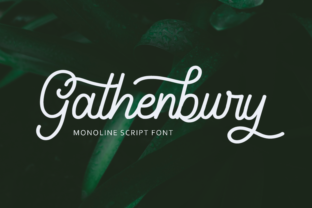
Gathenbury: Where Playful Script Meets Timeless Sophistication
If you've ever struggled to strike the right balance between warmth and authority in your design—between personality and professionalism—you’re not alone. Many designers, marketers, small business owners, and content creators face this tension daily: how to convey authenticity without sacrificing credibility, or elegance without feeling stiff. That’s where Gathenbury steps in—not as just another script font, but as a thoughtful design partner that bridges that gap with quiet confidence.
Gathenbury is a playful and fancy script font with a serious vibe. At first glance, its flowing connections and delicate swashes evoke handwritten charm—think wedding invitations, boutique packaging, or artisanal branding. But look closer: the letterforms are carefully balanced, with restrained contrast, consistent rhythm, and subtle structural discipline. It doesn’t shout; it invites. It doesn’t over-decorate; it refines. That duality makes Gathenbury uniquely suited for projects where emotional resonance matters—but so does clarity, trust, and intentionality.
Why Designers Reach for Gathenbury (and When They Should)
Design challenges often begin with mismatched expectations. A luxury skincare brand wants to feel human and approachable—but not casual. A literary journal seeks elegance—but not sterility. A local café aims for neighborhood charm—but not kitsch. In each case, typography becomes a silent ambassador. Generic scripts can feel dated or overly ornamental; modern sans-serifs may lack soul. Gathenbury answers this need by offering expressive character grounded in typographic integrity.
It works especially well when:
- You’re building a brand voice that values craftsmanship—like handmade ceramics, bespoke stationery, or slow-fashion labels;
- You're designing high-touch communications—wedding suites, editorial features, or premium product launches—where tone carries as much weight as content;
- You need visual hierarchy without sacrificing cohesion—pairing Gathenbury for headlines or logos with a clean, neutral sans-serif (e.g., Inter, Lora, or Source Serif) for body text creates contrast that feels intentional, not jarring.
Real-World Applications—and What to Watch For
Practical use starts with intention. Gathenbury shines brightest at larger sizes: headlines, logotypes, cover titles, signage, and short-form display text. Its fine details—like tapered terminals and graceful entry/exit strokes—lose impact below 24px in print or 32px on screen. So while it’s perfect for a book title or a storefront marquee, it’s not built for long paragraphs or dense UI labels.
Consider these real applications:
- Branding for wellness studios: A yoga retreat uses Gathenbury for its logo and workshop headers—evoking calm, artistry, and mindful presence—while relying on a soft, readable serif for class descriptions and schedules.
- Editorial design: A quarterly magazine on sustainable living applies Gathenbury to section dividers and pull quotes, adding moments of visual pause and sophistication amid otherwise clean, functional layouts.
- Digital product touchpoints: A premium recipe app uses Gathenbury sparingly—in hero banners and ingredient headers—to elevate everyday cooking into something ritualistic and personal, without compromising usability.
That said, context is everything. Gathenbury isn’t ideal for technical documentation, data dashboards, or multilingual interfaces where legibility across scripts or reading speeds matters most. It also benefits from generous line spacing and careful kerning—especially around letters like “f”, “j”, and “y”, whose descenders interact meaningfully with surrounding characters.
Tailoring Gathenbury to Your Role
How you use Gathenbury depends on your goals—and your constraints.
For freelance designers: Treat Gathenbury as a strategic accent—not an all-purpose solution. Present it alongside clear usage guidelines: recommended pairings, size thresholds, and examples of appropriate vs. overextended application. Clients often love its aesthetic instinctively; helping them understand *why* and *where* it works builds trust and reduces revision cycles.
For small business owners: You don’t need design expertise to benefit from Gathenbury. Start simple: use it in one high-impact place—your website hero headline, business card name, or Instagram story highlight icon. Even that small infusion adds distinction without complexity. Just avoid stretching it across every element; restraint reinforces its value.
For marketers and content creators: Think beyond visuals. Gathenbury supports storytelling by reinforcing message tone. A heartfelt email campaign about community impact gains sincerity when the subject line uses Gathenbury; a limited-edition product drop feels more curated when its launch banner does too. The font becomes part of your narrative architecture—not just decoration.
Making Gathenbury Work Well—Without Overthinking It
Success with Gathenbury comes down to three practical habits:
- Test early, test in context. Don’t judge it in isolation on a font specimen page. Drop it into your actual layout—even a rough mockup—and see how it behaves next to imagery, color, and other typefaces.
- Respect its rhythm. Gathenbury has natural pacing. Avoid forcing tight tracking or excessive all-caps usage, which disrupts its organic flow. Let words breathe.
- Pair with purpose. Choose supporting fonts that complement—not compete. A low-contrast serif or geometric sans-serif usually provides the clearest counterpoint. Avoid other decorative or high-contrast scripts unless you’re aiming for deliberate, stylized contrast (and even then, proceed with care).
And remember: typography isn’t about perfection—it’s about resonance. Gathenbury won’t fix weak messaging or inconsistent branding. But when aligned with thoughtful strategy, it amplifies what’s already meaningful. It helps audiences *feel* the care behind your work before they’ve read a single word.
So whether you're refining a logo, launching a new service, or simply reimagining how your audience experiences your voice—consider what Gathenbury offers not just visually, but emotionally and functionally. It’s more than a font. It’s a quiet assurance that charm and seriousness aren’t opposites—they’re companions.