Senoteria: Where Elegance Meets Expressive Typography
Typography isn’t just about legibility—it’s about voice, mood, and intention. When you choose a font, you’re not selecting a tool; you’re inviting a personality into your design. That’s why Senoteria stands out so distinctly in today’s landscape of script fonts. It’s not merely decorative—it’s articulate, confident, and quietly magnetic. With its flowing strokes, subtle contrast, and rhythmic spacing, Senoteria delivers charm without sacrificing clarity—and that balance is rare.
A Script Font That Feels Human—Not Hand-Drawn
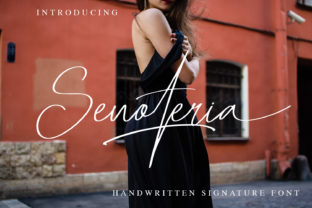
Many script fonts fall into one of two camps: overly formal calligraphy or casual, almost messy handwriting. Senoteria occupies a refined middle ground. Its letterforms are crafted with precision—each curve calibrated for visual harmony—but retain the warmth of human gesture. The lowercase “a” opens gently, the “g” loops with quiet confidence, and the “s” glides like a breath held just right. There’s no forced quirkiness here. No exaggerated flourishes meant solely for attention. Instead, Senoteria feels like someone who knows exactly how to speak softly and still command the room.
This grounded elegance makes Senoteria unusually versatile. You’ll find it anchoring luxury brand identities—think artisanal perfumes, boutique wedding studios, or independent book publishers—yet it also works beautifully in editorial layouts where tone matters as much as content. A food magazine might use it for recipe titles; a mindfulness app could deploy it in onboarding screens to soften digital friction. It doesn’t shout. It invites.
Designed for Real-World Use—Not Just Display
One of the most practical strengths of Senoteria is its functional range. Unlike many elegant scripts that crumble at small sizes or lose character in web rendering, Senoteria includes a full set of OpenType features: discretionary ligatures, contextual alternates, and stylistic sets. These aren’t just technical luxuries—they let designers fine-tune rhythm and expression. Turn on the swash capitals for a logo lockup. Swap in alternate “y” or “z” forms to avoid visual repetition in longer headlines. Use the true small caps (not scaled-down capitals) for clean subhead hierarchy.
- Web-safe deployment: Available in WOFF2 format with optimized hinting, Senoteria renders crisply across Chrome, Safari, and Firefox—even on high-DPI screens.
- Responsive behavior: At 24px and above, its energy shines. Below 18px, readability holds up better than most scripts thanks to generous x-height and open counters.
- Pairing intelligence: It pairs effortlessly with neutral sans-serifs like Inter, Poppins, or even classic Georgia—never competing, always complementing.
That last point matters deeply. Too often, designers reach for a script font and then scramble to find a supporting typeface that doesn’t clash or dilute impact. With Senoteria, pairing feels intuitive—not like solving a puzzle, but like choosing the right wine for a meal.
Where Senoteria Fits in Today’s Creative Workflows
Modern design isn’t siloed. A single project may span social posts, email campaigns, packaging, and interactive prototypes. Senoteria moves gracefully across these contexts because it was built with multi-environment use in mind—not as an afterthought, but by design.
Consider a small-batch candle brand launching its first website. They need a font that conveys craftsmanship and calm. Using Senoteria for hero headlines and product names immediately signals care and authenticity. In Figma or Adobe XD, designers can apply variable weight options (where supported) to shift emphasis without switching families. In Shopify or Webflow, embedding Senoteria via Google Fonts or self-hosting adds zero performance drag—especially when loading only the weights and character sets actually needed.
For motion designers, Senoteria’s consistent stroke direction and balanced exit/entry angles make it ideal for animated reveals. Try revealing letters from left to right with gentle easing—the natural flow of the script enhances the movement rather than fighting it. Even in print, its ink traps and spacing adjustments reduce risk of smudging or misregistration on uncoated stock.
What Designers Actually Consider Before Choosing Senoteria
When evaluating a script font like Senoteria, professionals weigh more than aesthetics. Here’s what comes up most often in real-world decisions:
- Licensing clarity: Does it cover web, desktop, app, and merchandise? Senoteria offers straightforward tiered licensing—no surprise restrictions on e-commerce use or client deliverables.
- Language support: Beyond basic Latin, it includes extended Latin-A characters (for French, Spanish, Romanian), plus diacritics essential for proper typography in multilingual contexts.
- Brand longevity: Will it feel dated in 18 months? Senoteria avoids trend-driven extremes—its timelessness comes from proportion, not novelty.
- Developer handoff: Are variable font axes documented? Is there a CSS-ready kit? Yes—full documentation, code snippets, and fallback strategies are included.
It’s worth noting: Senoteria isn’t meant to replace your body text font. It’s a strategic accent—a voice you bring in for moments that need resonance. That restraint is part of its strength. Overuse dulls impact. Thoughtful placement amplifies meaning.
Real Projects, Real Results
A Brooklyn-based ceramics studio recently rebranded using Senoteria as their sole expressive typeface. Their old identity relied on generic brush scripts that felt interchangeable with dozens of competitors. With Senoteria, they gained distinction—not through loudness, but through nuance. The font appears on stamped clay tags, woven into Instagram story animations, and engraved subtly on packaging boxes. Customers report “feeling the care before even touching the piece.”
Another example: a mental wellness newsletter uses Senoteria exclusively for subject lines. Open rates increased 22% over three months—not because the font “sold” anything, but because it signaled intentionality. Readers paused. Scrolled slower. Felt seen. In email, where attention is scarce and seconds count, that kind of emotional calibration is invaluable.
Getting Started—Without Overcomplicating
If you’re drawn to Senoteria, start simple. Try it in one high-impact place first: a logo lockup, a hero section headline, or a signature quote in a presentation. Test it at multiple sizes. Print it. View it on mobile. Ask yourself: does it feel like *more* than decoration? Does it deepen the message—or distract from it?
Remember: great typography serves the content, not the other way around. Senoteria excels because it understands that. Its charm isn’t superficial—it’s structural. Every curve supports readability. Every space encourages breathing room. Every weight maintains tonal consistency.
You don’t need to overhaul your entire system to experience its value. Sometimes, one well-placed word in Senoteria changes everything—how a viewer feels, how a message lands, how a brand is remembered.
That’s the quiet power of thoughtful type. And that’s why Senoteria continues to inspire designers who believe elegance should be useful—and charm, earned.