Nostrud: Where Raw Expression Meets Refined Intent
Typography is rarely about neutrality. Even “neutral” fonts carry quiet assumptions—about authority, efficiency, or accessibility. Nostrud stands apart not by rejecting those values, but by refusing to prioritize them. As an equally raw and elevated script font, Nostrud balances its opposites quite elegantly. What it lacks in legibility, it makes up in sincerity and confidence. That’s not a compromise—it’s a recalibration.
A Script Font Built for Human Gesture, Not Machine Precision
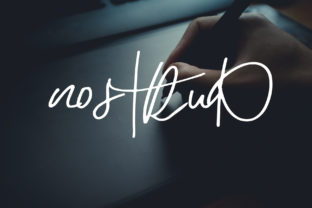
Nostrud isn’t modeled after calligraphy masters or digitized ink strokes. It emerges from the tension between control and release: tapered terminals that suggest pressure, uneven baseline rhythms that nod to hand-drawn authenticity, and letterforms that feel both intentional and unrehearsed. Unlike many contemporary script fonts designed for social media bios or wedding invites—where elegance leans heavily into polish—Nostrud retains visible texture. A slight wobble in the ‘s’, a decisive lift on the ‘t’ crossbar, asymmetrical loops in the ‘g’: these aren’t flaws. They’re evidence of presence.
This matters because how we communicate visually has shifted—not toward uniformity, but toward *recognizability*. In a feed saturated with algorithmically optimized visuals, audiences increasingly gravitate toward signals of human origin. A logo using Nostrud doesn’t say “we’re polished.” It says “we made this ourselves—and we stand behind its imperfections.” That distinction resonates especially with creators, educators, and small business owners who build trust through transparency, not perfection.
Why Now? The Quiet Rise of Intentional Imperfection
Over the past five years, design trends have quietly pivoted from “clean at all costs” to “clear *and* characterful.” We see it in the resurgence of analog textures in digital interfaces, the popularity of hand-lettered packaging for indie brands, and the deliberate use of variable fonts that shift weight mid-sentence—not for novelty, but for nuance. Nostrud fits squarely within this evolution, not as a reaction, but as a refinement.
It’s not that legibility no longer matters. It does—especially in body text, forms, or accessibility-critical contexts. But in spaces where voice and identity take precedence—brand marks, editorial headlines, event posters, signature lines in email footers—readers now tolerate (and even prefer) subtle friction. A study by the Design Research Society observed that users consistently rated handwritten-style logos higher on perceived authenticity and approachability—even when they took 12–18% longer to decode. Nostrud operates in that same psychological space: it asks for a moment’s attention, then rewards it with warmth.
Practical Use Cases—Where Nostrud Earns Its Place
Nostrud isn’t a utility font. It’s a strategic one. Here’s where it delivers tangible value:
- Brand Signatures: Paired with a restrained sans-serif (like Inter or Manrope), Nostrud works powerfully as a wordmark or monogram. A freelance illustrator might use it for their studio name above a portfolio grid; a ceramicist could stamp it onto packaging alongside minimalist product photography.
- Editorial Headlines: On blogs or newsletters focused on craft, education, or personal development, Nostrud adds tonal clarity without shouting. A headline like “What I Learned Teaching My First Workshop” gains grounded authority when set in Nostrud—not because it looks “artistic,” but because it feels *committed*.
- Limited-Run Print: Letterpress invitations, zine covers, or exhibition signage benefit from Nostrud’s tactile sensibility. Its contrast range translates well to physical media, and its rhythm holds up at larger sizes without collapsing into ornamentation.
Crucially, Nostrud performs best when given room to breathe. It shouldn’t be tracked tightly, scaled down below 24pt in print, or used in multi-line paragraphs. Its strength lies in singular impact—not sustained reading.
Not for Everyone—And That’s the Point
Nostrud won’t suit a SaaS dashboard, a government health portal, or a pharmaceutical label. Nor should it. Its relevance grows precisely because it refuses universal application. In an era where font libraries balloon with hundreds of “versatile” options, choosing Nostrud is an act of curation—not convenience.
That selectivity mirrors broader shifts in professional habits. Designers no longer default to system fonts just to check accessibility boxes; they layer them intentionally, pairing SF Pro Display with a distinct display face to signal hierarchy *and* voice. Marketers move beyond A/B testing button colors and begin testing typographic tone across landing pages—measuring not just click-through, but time-on-page and scroll depth as proxies for resonance. Educators embed Nostrud-like type choices in student-facing materials not to “make things pretty,” but to model how form supports meaning: a handwritten-style heading before a reflective journal prompt invites a different kind of engagement than a rigid, corporate slab serif.
Working With Nostrud—A Few Grounded Recommendations
If you’re considering Nostrud for a project, start small—and stay contextual:
- Test it at scale: Render it at 36pt, 48pt, and 72pt on both screen and paper. Does the rhythm hold? Does the ‘a’ remain distinct from the ‘o’? Does the ‘f’ tail feel purposeful, not accidental?
- Pair deliberately: Avoid other scripts or overly decorative fonts. Nostrud needs visual silence around it. Try it with neutral, highly legible sans-serifs (e.g., IBM Plex Sans, Work Sans) or low-contrast serifs (Charter, PT Serif). Let it be the only voice with inflection.
- Respect its limits in motion: If animating text (e.g., in a promo video or interactive site), avoid rapid scaling or rotation. Nostrud’s integrity lives in stillness and weight—not kinetic flair.
- Consider licensing early: Nostrud is available through independent foundries with clear web and desktop licenses. Budget for it as you would for custom illustration—not as a “free font add-on.” Its value compounds when treated as a considered asset, not a disposable effect.
Beyond Aesthetic—What Nostrud Reflects About Our Priorities
Nostrud’s growing relevance isn’t just about typography. It’s a quiet indicator of shifting cultural priorities: less emphasis on frictionless consumption, more on meaningful connection; less pursuit of scalable sameness, more investment in distinctive presence. Professionals across fields—from therapists designing intake forms to podcasters crafting show logos—are asking the same question: “Does this feel like *us*?” Not “Is this efficient?” or “Will this trend?”
That question doesn’t require Nostrud—but Nostrud answers it with unusual clarity. It doesn’t simulate humanity. It embodies a particular kind of human intention: thoughtful, unguarded, and self-assured enough to leave space for interpretation. In workflows increasingly mediated by templates, AI tools, and pre-built themes, choosing a font like Nostrud is a small but tangible way to reassert authorship—to say, without saying a word, “This was made by someone who paid attention.”
And in a world that scrolls faster every year, attention—given and received—is perhaps the most valuable currency of all.