Drop Swing: A Playful Font for Crafters
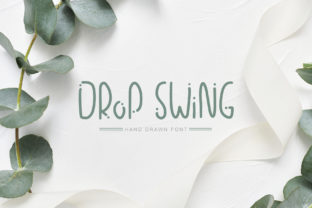
Drop Swing isn’t just another decorative typeface—it’s a small but thoughtful design tool built around charm, clarity, and quiet personality. At its heart is a clean, rounded sans-serif structure, softened with tiny, intentional dots placed at key junctions: the top of “t”, the base of “j”, the curve of “g”, and more. These aren’t random embellishments—they’re visual pauses, gentle anchors that add rhythm without clutter. For crafters especially, Drop Swing bridges function and feeling: legible enough for labels and instructions, expressive enough for greeting cards and social posts.
Why It Fits So Naturally in a Crafter’s Toolkit
Crafting isn’t one activity—it’s a spectrum. A beginner stitching their first embroidery hoop might need fonts that feel friendly and unintimidating. A small-batch candle maker designing product tags needs something readable at 8 pt on a matte sticker. An educator preparing printable classroom posters wants consistency across grade levels—and maybe a little warmth to soften academic tone. Drop Swing meets these varied needs not by trying to be everything, but by doing a few things well: it’s light on visual noise, high on character, and instantly recognizable without demanding attention.
For Beginners: Low Pressure, High Joy
If you’re new to digital design—whether using Canva, Cricut Design Space, or even Google Docs—you’ll appreciate how Drop Swing works *with* you. No steep learning curve. No confusing stylistic alternates or dozens of weights to sort through. Just one clean, single-weight file (with uppercase, lowercase, numerals, and basic punctuation) that installs like any other font. Try it on a handmade birthday card: type “Happy Birthday!” and notice how the dots subtly echo confetti or polka dots—no extra graphics needed. That kind of instant polish builds confidence fast.
For Educators & Content Creators
Teachers, homeschoolers, and workshop leaders often juggle accessibility, engagement, and time. Drop Swing’s open letterforms and generous spacing support readability for emerging readers and neurodiverse learners alike. Its soft edges reduce visual fatigue on printed handouts or digital slides. One third-grade teacher used it for a “Science Word Wall”—pairing terms like “pollination” and “habitat” with simple icons—and found students referenced the words more readily than with sharper, busier fonts. Similarly, bloggers documenting DIY projects report higher engagement on Pinterest pins when Drop Swing headlines contrast cleanly against textured backgrounds (like watercolor paper scans or linen fabric photos).
For Small Business Owners & Makers
When your brand lives on product tags, packaging, Instagram bios, and Etsy listings, consistency matters—but so does authenticity. Drop Swing avoids the overly sweet or childish vibe some “cute” fonts carry. It feels handmade, not cartoonish. A ceramicist uses it for batch numbers stamped on the bottom of mugs (“SWING-042”), while a soap maker pairs it with a neutral serif for ingredient lists—Drop Swing handles the “hand-poured” or “small-batch” tagline with sincerity, never sarcasm. And because it’s a single, lightweight file, it doesn’t slow down web stores or complicate print-ready PDF exports.
For Design-Savvy Users & Freelancers
You likely already have go-to workhorses—fonts you trust for hierarchy, spacing, and responsiveness. Drop Swing isn’t meant to replace them. Think of it as a seasonal accent: the font you reach for when a project calls for approachability without sacrificing polish. It pairs beautifully with neutral sans-serifs (like Inter or Lato) for contrast, or with gentle serifs (such as Cormorant Garamond) for layered elegance. One freelance illustrator uses Drop Swing exclusively for client-facing mood boards—its subtle dot details mirror hand-drawn sketch marks, reinforcing the “thoughtful process” narrative before a single line is inked.
What Drop Swing Doesn’t Promise (and Why That Matters)
It doesn’t come with 12 weights, variable axes, or multilingual support beyond basic Latin characters. It won’t auto-generate swashes or contextual alternates. And it’s not free—but it’s fairly priced for what it delivers: a focused, well-crafted tool, not an overstuffed toolkit. That restraint is intentional. For many users, especially those balancing multiple roles (parent + maker + marketer), fewer choices mean faster decisions and less creative friction. You’re not choosing *between* options—you’re choosing *for* a purpose.
Real-World Use Cases, Not Hypotheticals
- A hobbyist making fabric gift tags: Types names in Drop Swing at 14 pt, prints on cardstock, punches a hole, and ties with twine—the dots catch light softly, adding dimension without foil or embossing.
- A blogger writing a “Stitch-a-Long” tutorial: Uses Drop Swing for section headers (“Week 2: The French Knot”) alongside body text in a highly legible serif—readers scan easily and feel invited, not instructed.
- A nonprofit organizing a community craft fair: Applies Drop Swing to volunteer name badges and directional signs—its friendliness eases first-time attendees into the space, while its clarity ensures no one misses the “Kids’ Corner” tent.
Does Drop Swing Match Your Next Project?
Ask yourself: Is this for something seen up close (a handmade card, a printed instruction sheet) or at a glance (a social media story, a booth banner)? Does the tone lean warm, personal, and grounded—or bold, technical, or ultra-minimal? If your answer leans toward the former, and if “clarity with character” describes your goal, Drop Swing fits. It’s not for dense legal disclaimers or data-heavy reports. But for anything where human connection matters—a thank-you note, a workshop flyer, a product label, a classroom poster—it adds quiet intentionality.
And because it’s designed with crafters in mind—not as an afterthought, but as its core audience—it respects how real people work: in bursts, across devices, with varying tools and time. You don’t need advanced software to use it well. You don’t need design training to sense its fit. You just need a project where kindness in typography makes a difference—even a small one.