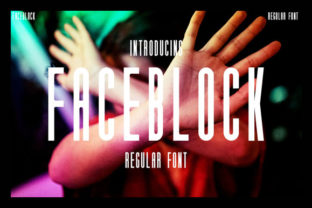
Faceblock: A Smart, Modern Sans Serif Font for Purpose-Driven Design
When you’re crafting a logo, laying out a magazine spread, or building a cohesive brand identity, typography isn’t just decoration—it’s communication. The right font conveys trust, clarity, and intention before a single word is read. Faceblock is a contemporary sans serif typeface engineered for exactly that purpose: to deliver intelligence, versatility, and quiet confidence in every use case.
Unlike generic system fonts or overused commercial alternatives, Faceblock was designed with real-world design workflows in mind—balancing strong legibility at small sizes with expressive character at display scale. Its clean geometry, subtle stroke contrast, and open apertures make it highly readable across screens and print, while its confident letterforms lend authority without stiffness. Whether you're a solo designer refining a client’s visual language or a marketing team unifying assets across digital and physical touchpoints, Faceblock supports your goals—not the other way around.
What Designers and Brands Actually Struggle With
Many professionals face recurring challenges that seem small but compound quickly: inconsistent branding due to mismatched fonts; logos that lose impact when scaled down or rendered on low-res screens; editorial layouts where body text feels either too cold or too casual; or packaging designs where hierarchy collapses under tight space constraints. These aren’t just aesthetic issues—they affect credibility, comprehension, and conversion.
Consider this: A startup launching a premium wellness app might invest heavily in illustration and color—but if their headline font feels generic or their interface labels lack rhythm, users subconsciously question professionalism. Or imagine a boutique publisher choosing a typeface for their quarterly magazine. They need something that works equally well in bold section headers, delicate pull quotes, and dense feature articles—without requiring multiple weights or optical sizes.
That’s where Faceblock steps in—not as a stylistic flourish, but as a functional solution. It’s built to reduce decision fatigue, minimize revision rounds, and uphold consistency across diverse applications—all while feeling intentional and human-centered.
How Faceblock Addresses Real Design Needs
Faceblock helps solve these problems through thoughtful design decisions—not marketing buzzwords. Its x-height is generously proportioned for screen readability, yet its ascenders and descenders retain enough personality to avoid monotony. The spacing between letters (kerning) has been carefully tuned for both headlines and running text, so you won’t need to manually adjust tracking in most cases. And because it includes a full range of OpenType features—including stylistic alternates, ligatures, and case-sensitive punctuation—it adapts gracefully whether you’re setting a minimalist tagline or a complex multilingual caption.
For branding projects, Faceblock shines in logotype development. Its balanced proportions and restrained terminals give logos presence without shouting. Try pairing its medium weight for primary wordmarks with its light italic for subtitles—it creates instant visual hierarchy without relying on unrelated type families. In UI design, its clear numerals and distinct punctuation improve scannability in dashboards and forms. And for editorial work, its robust text weight holds up beautifully in long-form reading—especially on OLED and e-ink displays where contrast and clarity matter most.
Practical Applications Across Roles
Different users leverage Faceblock in ways that match their workflow and priorities:
- Freelance designers appreciate how quickly Faceblock integrates into brand systems—often replacing three or four fonts with one cohesive family. Its licensing is straightforward, and variable font support means smaller file sizes and smoother web performance.
- In-house marketing teams use Faceblock as a “design anchor”—standardizing email templates, social graphics, and sales decks. Because it renders consistently across platforms, there’s less back-and-forth with legal or compliance reviewers about typographic legibility.
- Print publishers and editorial designers rely on Faceblock’s sharp hinting and ink-trap–informed design for crisp output—even on coated stock at 6 pt. Its true-drawn italics (not algorithmically slanted) add nuance to emphasis without disrupting rhythm.
- Product and UX designers choose Faceblock for its accessibility-first metrics: high contrast ratios in WCAG-compliant combinations, generous inter-character spacing, and glyphs optimized for assistive tech parsing.
Getting Started—Thoughtfully
Adopting a new font shouldn’t mean overhauling everything at once. Start small: replace one overused system font in your next presentation deck or redesign a single landing page headline with Faceblock. Pay attention to how it changes tone—not just appearance. Does the headline feel more grounded? Does the call-to-action button gain subtle urgency?
When pairing Faceblock, lean into contrast—not competition. Its clean neutrality makes it highly compatible with expressive serifs (like EB Garamond or Crimson Text) for editorial depth, or with geometric sans fonts (like Inter or Manrope) for modern UI stacks. Avoid pairing it with other neutral sans serifs that share similar proportions—those combinations often blur rather than clarify.
Also consider context: For digital use, enable font-display: swap in your CSS to prevent invisible text during load. For print, embed Faceblock fully in PDFs and confirm glyph coverage for special characters or localized diacritics. And always test at actual size—on the devices and paper stocks your audience will encounter.
Why Faceblock Fits Into a Larger Shift
Today’s best design work moves beyond “looking good” toward “working well.” That means fonts must serve function first—supporting accessibility, performance, localization, and scalability without compromise. Faceblock reflects that evolution: it’s not trying to be everything to everyone, but it’s built to do what matters most—clearly, reliably, and respectfully.
It’s also part of a growing recognition that typography is infrastructure. Just as developers choose frameworks for stability and maintainability, designers now select typefaces for longevity, technical soundness, and ethical licensing. Faceblock meets those criteria—not through novelty, but through care.
If you’ve ever spent hours adjusting letter-spacing only to realize the underlying font wasn’t up to the task—or delayed a launch because a logo didn’t translate well to mobile—you already know the cost of ignoring typography as a strategic tool. Faceblock removes friction. It gives you room to focus on message, audience, and impact—rather than fighting the type itself.
Ultimately, great design doesn’t shout. It listens, adapts, and endures. With Faceblock, you’re not just choosing a font—you’re choosing a foundation that grows stronger the more you use it.