Dabronx: A Workhorse Sans Serif That Fits Where Others Don’t
Let’s be real — not every font needs to make a statement. Sometimes what you need is a typeface that shows up, does its job without fuss, and looks consistently strong across screens, print, and even tiny app icons. That’s where Dabronx steps in: a classic, condensed sans serif built for clarity, flexibility, and quiet confidence.
What Makes Dabronx Stand Out (Without Shouting)
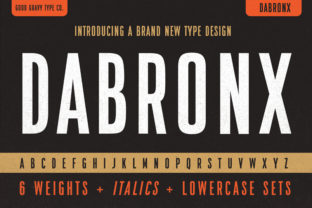
Dabronx isn’t flashy — and that’s its superpower. It’s a tightly crafted sans serif with clean lines, balanced proportions, and just enough personality to avoid feeling sterile. Its condensed nature gives it compact strength: more text fits in tight spaces without sacrificing legibility. And with 12 distinct styles — including light, regular, medium, bold, black, and matching italics across most weights — it scales effortlessly from delicate captions to commanding headlines.
Unlike many “versatile” fonts that sacrifice character at the extremes, Dabronx maintains cohesion whether you’re setting a minimalist Instagram bio or stacking layered text on a product packaging mockup. It doesn’t try to be everything — but it reliably handles almost anything you ask of it.
Branding That Breathes — But Doesn’t Blur
If your brand values precision, modernity, and restraint — think architecture studios, boutique law firms, sustainable apparel labels, or tech-adjacent consultancies — Dabronx works beautifully as a primary or secondary typeface. Its condensed structure helps logos stay legible at small sizes (like favicons or app icons), while its range of weights allows for clear visual hierarchy in brand guidelines. One designer recently used Dabronx Light + Dabronx Black to define a wellness brand’s voice: calm yet authoritative, simple but never generic.
Social Media That Scrolls — and Sticks
You’ve got three seconds to grab attention in a feed. Dabronx cuts through noise because it’s sharp, readable at thumbnail size, and pairs well with both photography and bold color blocks. Try Dabronx Medium for carousel slide titles — it holds weight without crowding. Use Dabronx Italic for subtle emphasis in captions (“Hand-poured • Small-batch • Shipped same day”). And because it’s highly legible on mobile, your message lands cleanly, even when someone’s scrolling one-handed on the bus.
Editorial Layouts With Quiet Confidence
Magazines, newsletters, and digital zines often juggle tight columns, tight deadlines, and tight budgets. Dabronx Regular and SemiBold shine here: they offer excellent x-height and open counters, so body copy remains inviting at 14–16px. Its condensed width also means fewer awkward line breaks in narrow layouts — especially helpful for sidebars, pull quotes, or bilingual content where space is precious. One independent publisher switched from a popular geometric sans to Dabronx for their quarterly print edition and reported fewer reader complaints about “eye strain” — a testament to its functional comfort.
Product Packaging That Speaks Cleanly
Shelf impact matters — but so does trust. Dabronx delivers both. Its no-nonsense structure reads as honest and considered, not cold. Food brands use Dabronx Bold for ingredient highlights (“Organic • Gluten-Free • Vegan”) because it conveys integrity without shouting. Tech accessories lean into Dabronx Black for model names on boxes — it feels technical, precise, and premium without needing extra effects. Even craft breweries have adopted Dabronx Medium Italic for batch names on limited-release cans: legible, distinctive, and quietly confident.
Who Gets the Most From Dabronx — and Why
- Freelance designers appreciate how quickly Dabronx adapts across client projects — no need to hunt for “just right” alternatives when branding, web, and social assets all need consistent typography.
- Small business owners love that it’s easy to license and works out-of-the-box in Canva, Figma, Adobe apps, and even basic email builders — no steep learning curve, no expensive plugins.
- UX writers and product teams rely on Dabronx for interface labels, tooltips, and status messages where clarity trumps decoration. Its even stroke contrast and generous spacing reduce cognitive load.
- Content creators use it for thumbnails, lower thirds, and video subtitles — it stays crisp even when scaled down or rendered over busy backgrounds.
Things to Keep in Mind Before You Commit
Dabronx excels where clarity, efficiency, and cohesion matter — but it’s not magic. Here’s what to consider:
- It’s not a display font. While bold weights hold presence, Dabronx isn’t designed for ultra-large decorative headlines or hand-drawn aesthetic campaigns. If your project leans heavily into whimsy, nostalgia, or high contrast, you’ll likely want to pair it — not replace it — with something more expressive.
- Watch letter spacing in all-caps settings. Like many condensed sans serifs, Dabronx benefits from slight tracking adjustments in uppercase logos or banners. A quick +20–40 units in design software usually makes the difference between tight and tense.
- Check language support early. Standard Dabronx covers Latin-based languages thoroughly (including extended diacritics for French, Spanish, German, etc.), but if your project requires Cyrillic, Greek, or Vietnamese, verify coverage with your vendor — some versions include expanded character sets, others don’t.
- Licensing is straightforward — but confirm usage scope. Most licenses cover desktop, web, and app embedding, but always double-check if you’re using it in a SaaS dashboard, white-labeled tool, or physical merchandise. Some foundries offer extended licenses for broader distribution — worth clarifying upfront.
Pairing Dabronx Thoughtfully (Not Just Automatically)
Dabronx plays well with others — but smart pairing multiplies its impact. Try it with a warm, humanist serif like IBM Plex Serif or Charter for editorial depth. For digital interfaces, pair Dabronx Medium with a neutral monospace (like Fira Code or JetBrains Mono) for code snippets or data labels. Avoid pairing it with other condensed or geometric sans serifs — the similarities can blur distinction rather than build contrast.
And remember: sometimes the strongest choice is using Dabronx alone. Its 12-style range means you can create rich visual rhythm without introducing another typeface — reducing complexity, speeding up decisions, and keeping your work focused on message, not mechanics.
When You Need Reliable — Not Revolutionary
Great design isn’t always about reinvention. Often, it’s about removing friction — for your audience, your team, and your timeline. Dabronx meets that need head-on. It’s the font you reach for when you need text to be understood before it’s admired, when consistency matters more than novelty, and when “it just works” is the highest compliment.
Whether you’re refining a logo lockup, drafting a LinkedIn carousel, laying out a product spec sheet, or building a Shopify store’s typography system — Dabronx fits. Not because it shouts the loudest, but because it shows up, clearly and consistently, exactly when you need it to.