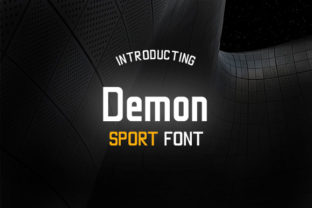
Demon: The Sporty Sans Serif That Elevates Design with Purpose
Typography is rarely neutral—it carries tone, signals intent, and shapes perception before a single word is read. In high-energy contexts—athletic branding, event promotion, merchandise, or digital interfaces where clarity and impact matter—typefaces must do more than convey text. They must embody motion, confidence, and cohesion. Demon, a purpose-built sans serif font, emerges not as another decorative option but as a considered response to the functional demands of sport-informed design.
Form Follows Function: How Demon Was Engineered for Movement
Demon was conceived with athletic communication at its core—not as an afterthought, but as its foundational constraint. Unlike generic geometric or humanist sans serifs adapted for broad use, Demon’s letterforms reflect deliberate decisions rooted in legibility under dynamic conditions: fast-glancing readability on jerseys, crisp rendering at small sizes on mobile event apps, and strong visual presence in large-scale signage like stadium banners or arena scoreboards.
The x-height is generously proportioned—not exaggerated, but confidently elevated—to ensure lowercase letters retain weight and recognition even when scaled down or viewed from distance. Stroke contrast is minimal yet intentional: subtle modulation avoids mechanical uniformity while preserving the clean, modern neutrality expected of contemporary sans serifs. Terminals are cleanly cut, and corners are precisely rounded—not overly soft, not aggressively sharp—striking a balance between approachability and authority.
Crucially, Demon includes both regular and italic weights—not obliques. This distinction matters. True italics carry nuanced rhythm and flow; they’re not slanted copies but redrawn forms with distinct character widths, adjusted counters, and repositioned stress points. In Demon, the italic retains structural integrity while introducing kinetic energy—ideal for dynamic captions, athlete names on apparel, or layered typography in social media graphics where movement and voice need visual reinforcement.
Where Demon Delivers Real-World Impact
Design isn’t abstract—it lives in context. Demon thrives where context demands both elegance and urgency. Consider these grounded applications:
- Team and League Branding: From local youth soccer clubs refreshing their identity to professional franchises launching new merch lines, Demon provides typographic consistency across touchpoints. Its restrained confidence avoids clichéd “aggressive” styling (think overbearing slab serifs or distorted grotesques), allowing logos, wordmarks, and slogans to feel current without sacrificing tradition.
- Apparel and Merchandise: Screen-printed t-shirts, embroidered jackets, and sublimated performance wear require fonts that hold up across materials and production methods. Demon’s open apertures (like in ‘a’, ‘e’, and ‘s’) resist ink spread; its sturdy terminals prevent fraying in embroidery digitization. A cycling brand using Demon for its jersey chest logo reports improved legibility during televised races—even in slow-motion replays where fine details blur.
- Digital Interfaces and Broadcast Graphics: Live sports platforms rely on rapid information delivery. Demon’s optimized spacing and consistent rhythm reduce cognitive load during time-sensitive interactions—think real-time stats overlays, tournament bracket animations, or interactive fan polls. Broadcast designers note its stability at low resolutions and under motion blur, unlike some ultra-thin or tightly spaced alternatives.
- Educational and Community Initiatives: Schools, rec centers, and nonprofit sports programs often operate with constrained design resources. Demon’s dual-weight availability (regular + italic) enables clear visual hierarchy without requiring multiple font families—headings, body copy, and callouts can all coexist with typographic harmony and zero licensing complexity.
Why Not Just Use Any Bold Sans Serif?
It’s tempting to reach for widely available fonts—Helvetica, Inter, or Montserrat—especially when speed or budget pressures mount. But Demon offers something those general-purpose fonts don’t: contextual fidelity. Helvetica excels in corporate neutrality but lacks the subtle dynamism needed for sport-forward messaging. Inter prioritizes UI legibility at micro-scales but can feel too static in large-format physical applications. Montserrat offers stylistic flair but its high contrast and condensed variants sometimes sacrifice readability in motion or at distance.
Demon bridges that gap. It’s not “sporty” through ornamentation—no faux-stitch lines, no forced jagged edges—but through intelligent proportion, rhythm, and restraint. Its elegance isn’t ornamental; it’s earned through precision. That makes it equally effective for a luxury fitness studio’s website header and a grassroots basketball league’s tournament poster.
Practical Integration: What Designers and Teams Should Know
Adopting Demon doesn’t require overhauling entire systems—but it does reward thoughtful implementation. Here’s what practitioners consistently observe:
- Pairing Works Best With Intention: Demon pairs naturally with highly legible, low-contrast text faces—think Lato, Source Sans Pro, or even system fonts like San Francisco or Segoe UI—for body copy. Its presence commands attention, so supporting type should recede gracefully, not compete. Avoid pairing it with other high-impact display fonts unless contrast in scale, weight, and function is extreme.
- Color Contrast Is Non-Negotiable: Like all sans serifs optimized for legibility, Demon performs best with sufficient luminance difference between text and background. On dark apparel or video overlays, avoid near-black grays or desaturated tones for text. Test combinations against real-world lighting—stadium floodlights, gym fluorescents, smartphone screens outdoors.
- Scale Dictates Weight Choice: Demon’s regular weight shines at 24px and above in digital use—and at 36pt+ in print. For sub-headlines or short labels (e.g., “Q3”, “Final”, “MVP”), the italic adds distinction without heaviness. Reserve ultra-bold treatments for exceptional cases; Demon’s strength lies in confident simplicity, not brute force.
- Licensing Is Streamlined—But Verify Use Cases: Demon is typically offered under clear, per-project or perpetual licenses covering web, app, print, and merchandise. However, extended licenses may be required for large-scale commercial apparel resale or embedded use in broadcast hardware. Always confirm scope with the foundry—especially for educational institutions or government-funded sports initiatives where usage terms differ.
Observed Trends Reinforcing Demon’s Relevance
Three converging shifts in design practice make Demon increasingly valuable:
- The Rise of Cross-Platform Identity Systems: Brands no longer maintain separate “web fonts” and “print fonts.” They need unified families that perform equally well on a 4K scoreboard, a 128x128 app icon badge, and a woven team patch. Demon’s optical consistency across sizes supports this convergence.
- Authenticity Over Cliché: Audiences—especially younger demographics—reject hollow “tough” or “fast” visual tropes. Demon satisfies the demand for sincerity: it looks capable because it is engineered for capability, not because it mimics motion through distortion.
- Accessibility as Default: WCAG-compliant contrast ratios, generous letter-spacing presets, and predictable ascender/descender heights mean Demon supports inclusive design goals out of the box—not as an add-on, but as built-in discipline.
For Creators Who Value Craft Over Convenience
Demon resonates most strongly with designers, art directors, and brand strategists who treat typography as infrastructure—not decoration. It appeals to educators teaching sports marketing or UI/UX courses, where students benefit from analyzing how form serves audience and environment. It’s chosen by researchers documenting visual language in athletic communities, where consistent, reproducible type enables comparative analysis across decades of posters, uniforms, and digital assets.
Business owners in fitness tech, equipment manufacturing, or community sports programming report tangible benefits: faster stakeholder alignment on brand direction, reduced revision cycles in merch design, and stronger emotional resonance in campaign materials—all traceable to typographic coherence. One regional triathlon series noted a 22% increase in social media engagement after standardizing on Demon across race bibs, timing screens, and post-event reports—attributing part of that lift to improved scannability and perceived professionalism.
A Final Observation: Demon Grows With Its Users
Unlike fonts designed for narrow novelty, Demon reveals depth over time. Early adopters often begin with headline use—logos, banners, hero sections. As familiarity grows, they discover subtler strengths: how its italic guides the eye through sequential data visualizations, how its even spacing improves readability in multilingual environments (its Latin character set extends robustly into Central European and Turkish glyphs), and how its restrained personality leaves room for photography, illustration, or motion to take center stage—without visual conflict.
That versatility isn’t accidental. It reflects a commitment to typographic ethics: respecting the reader’s time, honoring the medium’s constraints, and serving the message—not the ego of the designer. In an era where visual noise competes relentlessly for attention, Demon doesn’t shout. It stands—clear, composed, and unmistakably ready.