Mindflyers Font Overview and Evaluation
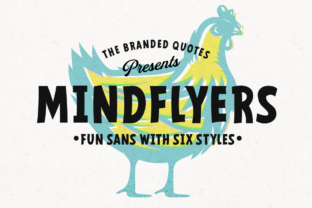
Mindflyers is a contemporary sans serif typeface distinguished by its playful yet balanced design. It features clean, rounded terminals, consistent stroke contrast, and subtle geometric influences—giving it a friendly, approachable character without sacrificing legibility or structure. Unlike highly neutral fonts such as Helvetica or Inter, Mindflyers carries a distinct visual personality: light, airy, and gently expressive. It was designed for digital-first use but performs well in both screen and print contexts when applied appropriately.
Why Designers and Developers Consider Mindflyers
Designers often seek typefaces that support brand voice while maintaining technical reliability. Mindflyers appeals to those working on projects where tone matters as much as function—such as educational apps, children’s interfaces, wellness platforms, or creative portfolios. Its “sweet and cool” aesthetic isn’t just stylistic; it reflects intentional decisions around x-height, letter spacing, and curve modulation that affect readability at smaller sizes and emotional resonance at larger ones.
Developers evaluating web fonts consider loading performance, variable font support, and browser compatibility. Mindflyers is typically available in static weights (e.g., Regular, Medium, Bold) and sometimes as a variable font. It supports Latin-based languages and includes standard OpenType features like ligatures and numeral styles. While not as widely distributed as Google Fonts’ most popular options, it’s commonly hosted via reputable foundries or licensing platforms with straightforward CSS embedding.
Practical Benefits of Using Mindflyers
One notable strength is its versatility across tone-sensitive applications. In user interfaces, Mindflyers can soften the perceived formality of forms or notifications—making interactions feel more human-centered. Its generous counters and open apertures aid legibility in UI components like buttons or cards, especially on touch devices. For branding, it provides enough uniqueness to stand out among generic sans serifs while avoiding the eccentricity that can hinder scalability.
From a production standpoint, Mindflyers tends to render consistently across modern browsers. Its hinting is optimized for clarity on screens, and its file size remains modest compared to highly decorated display fonts. When used in headings paired with a more neutral body font—like Roboto, Lato, or even system fonts—it creates effective typographic hierarchy without visual competition.
Key Tradeoffs and Limitations
Mindflyers is not designed for extended reading at small sizes. Its rounded shapes and moderate contrast reduce distinction between characters like o, c, and e in dense paragraphs below 14px. Users scanning long-form content—such as blog posts, documentation, or legal text—may experience reduced comprehension speed or increased eye fatigue over time. This makes it less suitable as a primary body font in content-heavy environments.
Another consideration is linguistic scope. While adequate for English, Spanish, French, and German, Mindflyers may lack full support for diacritics used in Vietnamese, Turkish, or Central/Eastern European languages. Designers serving multilingual audiences should verify glyph coverage before committing to it for global products.
Licensing also warrants attention. Unlike open-source fonts, Mindflyers is usually offered under commercial licenses that require attribution or subscription fees depending on usage volume (e.g., pageviews, app installs). Teams operating under strict budget constraints or open-source mandates may find this a barrier compared to freely licensed alternatives.
When Mindflyers Is a Strong Fit
Mindflyers excels in contexts where tone, identity, and moderate text volume intersect. Examples include:
- Educational tools targeting elementary or middle-school learners, where visual warmth supports engagement without distracting from content;
- Mobile-first wellness or mindfulness apps, where soft geometry reinforces calm, supportive messaging;
- Marketing landing pages for creative services (e.g., illustration studios, boutique design agencies), where headline typography must reflect personality without compromising scannability;
- Internal dashboards or admin interfaces where users benefit from a lighter, friendlier interface—but where data density remains low to moderate.
In each case, Mindflyers functions best when deployed selectively—not as an all-purpose solution, but as a deliberate choice reinforcing specific communication goals.
When Alternatives May Be More Appropriate
For projects prioritizing universal readability and broad language support, fonts like Inter or Manrope offer similar modern aesthetics with stronger typographic rigor and open licensing. These are better suited for SaaS platforms, enterprise applications, or multilingual documentation.
If brand expression demands higher contrast or more pronounced character, designers might explore Poppins (geometric with strong rhythm) or Nunito (softer, more calligraphic influence). Both provide wider weight ranges and broader language coverage than Mindflyers, albeit with different tonal implications.
For ultra-minimalist or high-performance needs—such as embedded systems or progressive web apps with strict bundle limits—system fonts or IBM Plex Sans may be preferable due to their optimization for rendering efficiency and accessibility compliance.
Making an Informed Decision
Before adopting Mindflyers, evaluate your project against three criteria: audience, usage context, and technical constraints. Ask: Who will read this? How much text will they encounter? Where and how will it appear? If your audience includes children, non-native readers, or users with visual impairments, test Mindflyers alongside alternatives using real content—not just mockups—at actual sizes and backgrounds.
Check rendering behavior across target devices. A font that looks crisp on macOS Safari may appear slightly blurred on older Android versions. Use browser dev tools to inspect font fallbacks and loading behavior. Also confirm licensing terms match your deployment model—especially if your product scales across regions or platforms.
Finally, consider pairing strategy. Mindflyers works best when contrasted with a more restrained companion. Avoid stacking it with other decorative or rounded fonts, which risks visual clutter. Instead, pair it with a neutral, highly legible sans serif for body copy—or even a well-chosen serif for editorial contrast.
Mindflyers isn’t a universal replacement for standard UI fonts—but it fills a meaningful niche. Its value lies not in replacing functional workhorses, but in enhancing moments where typography contributes meaningfully to experience. When aligned with clear intent and tested rigorously, it becomes more than a stylistic choice: it becomes part of the interface’s quiet, consistent voice.