High School Crush Font: A Practical Evaluation
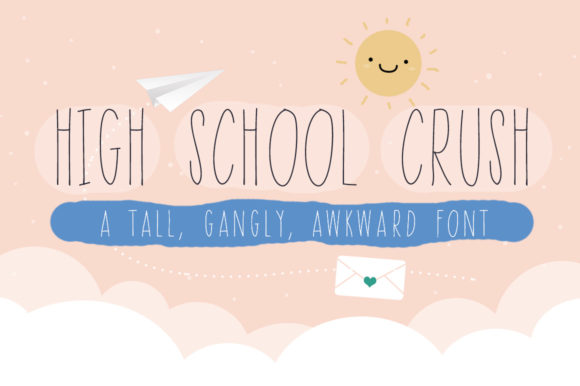
High School Crush is a distinctive sans serif typeface designed with intentional contrasts: tall x-height, narrow proportions, and subtly irregular stroke endings that lend it a hand-drawn, slightly off-kilter character. It balances childlike playfulness—evident in its uneven baseline alignment and rounded terminals—with structural maturity, thanks to its consistent spacing, vertical rhythm, and restrained weight range. Unlike many display fonts that prioritize novelty over function, High School Crush occupies a nuanced middle ground: legible at moderate sizes, expressive at larger ones, and deliberately unpolished without sacrificing coherence.
Why Designers Consider High School Crush
Designers often explore High School Crush when seeking a font that communicates authenticity, approachability, or gentle irreverence—without veering into overt whimsy or corporate sterility. Its visual tension makes it well-suited for contexts where tone matters as much as readability: editorial features targeting young adults, indie brand identities, educational materials aiming to feel inclusive rather than institutional, or digital interfaces prioritizing personality alongside clarity.
Interest in High School Crush typically arises from specific creative needs—not broad typographic trends. For example, a team developing a mental health app for teens might test it against more neutral options to assess whether its warmth and slight imperfection foster greater user trust. Similarly, an illustrator launching a zine series may evaluate how the font complements hand-lettered elements while still supporting body text in short captions.
Practical Benefits and Realistic Tradeoffs
The primary benefit of High School Crush lies in its tonal precision. Its tall, narrow structure creates generous negative space between lines and letters, improving scannability in headings and pull quotes. The slight irregularity discourages visual fatigue in short-form applications—such as social media graphics or slide titles—where uniformity can feel emotionally distant.
However, those same qualities introduce tradeoffs. Its narrow proportions reduce character width, which can lead to awkward word breaks or excessive hyphenation in justified paragraphs. Its limited weight range (typically one regular weight, sometimes with a light or bold variant) restricts typographic hierarchy options. And while its baseline variation adds charm, it can compromise alignment consistency in tightly spaced UI components like navigation bars or data tables.
Readers should also expect moderate learning curves in implementation. Kerning pairs aren’t always optimized for all language combinations, and OpenType features—such as stylistic alternates or discretionary ligatures—are sparse or absent in most versions. This means designers often need to manually adjust spacing or substitute glyphs for optimal results, especially in multilingual projects.
Where High School Crush Fits Well
High School Crush performs best in controlled, intentional settings. It excels in branding systems where voice is central: a progressive high school’s redesigned website, a podcast about adolescent development, or packaging for a stationery line targeting creative teens. In these cases, its balance of youthful energy and quiet sophistication supports messaging without overshadowing content.
It also works effectively in editorial design when used sparingly—for section headers, quote callouts, or chapter openers—paired with a highly legible, neutral text face (e.g., Inter, Lora, or Source Sans Pro). This combination leverages High School Crush’s expressive strengths while anchoring the layout in functional typography.
Another strong fit is experimental print work: limited-run posters, exhibition catalogs, or self-published books where typographic personality enhances thematic resonance. Here, the font’s handmade quality feels deliberate rather than limiting, and minor inconsistencies become part of the aesthetic narrative.
When Alternatives May Be More Appropriate
For long-form reading—especially in responsive web environments—High School Crush is rarely ideal. Its narrow letterforms and modest x-height reduce character recognition speed at smaller sizes, increasing cognitive load over time. Projects requiring accessibility compliance (e.g., WCAG 2.1 AA) should carefully test contrast, size scalability, and screen reader compatibility; many implementations of High School Crush fall short without significant customization.
Similarly, corporate or government communications—where neutrality, authority, and cross-cultural legibility are priorities—often benefit from more predictable sans serifs like Helvetica Now, IBM Plex Sans, or Noto Sans. These offer broader language support, tighter hinting for low-resolution displays, and extensive weight families that simplify visual hierarchy.
Designers working under tight technical constraints—such as embedded systems, legacy CMS platforms, or strict performance budgets—may find High School Crush less practical. Its file size isn’t unusually large, but limited browser fallback options and inconsistent rendering across older Android versions require additional testing and polyfilling.
Making a Purposeful Choice
Choosing High School Crush shouldn’t hinge on trendiness or aesthetic preference alone. Instead, ask: Does this font meaningfully reinforce the message, audience, and medium? Will its expressive traits enhance comprehension—or distract from it? Is the project scope flexible enough to accommodate manual adjustments where needed?
A practical evaluation starts with prototyping early. Set real content—not lorem ipsum—in context: a mobile article header, a printed flyer at actual scale, a form label next to an input field. Test readability at 100% zoom and 125% zoom. Check contrast ratios using free tools like WebAIM’s Contrast Checker. If the font requires more labor than it contributes in value, alternatives merit serious consideration—even if they’re less visually distinctive.
Also consider licensing. While some versions of High School Crush are available via free platforms like Google Fonts, others require commercial licenses with usage restrictions—particularly for app embedding or merchandise. Always verify permissions before finalizing a selection.
Ultimately, High School Crush is a tool with clear boundaries and distinct advantages. It shines not as a universal solution, but as a considered choice—one that serves specific communicative goals with honesty and restraint. When aligned with intention, it offers more than style: it offers clarity of voice.