Chimoly: Where Playful Typography Meets Purposeful Design
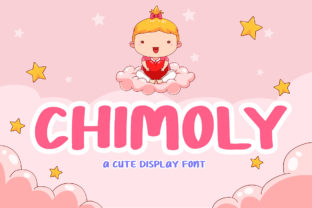
Typography is rarely just about legibility—it’s about tone, intention, and emotional resonance. In a digital landscape saturated with neutral sans serifs and overused display fonts, Chimoly stands apart not by shouting, but by smiling. It’s a whimsical sans serif font designed with gentle curves, rounded terminals, and a subtle bounce in its rhythm—qualities that make it instantly approachable without sacrificing clarity or versatility. Unlike fonts engineered for corporate austerity or maximalist trend-chasing, Chimoly invites warmth into interfaces, invitations, learning materials, and brand identities where authenticity and empathy matter.
What Makes Chimoly Distinctive—Beyond the Cuteness
At first glance, Chimoly reads as “cute”—and yes, that’s intentional. But reducing it to mere sweetness overlooks its thoughtful construction. Its x-height is generously proportioned, improving readability at small sizes—especially valuable in mobile UIs or educational apps targeting younger users. Letterforms avoid sharp angles; instead, they use soft, consistent curvature. The lowercase a and g are single-story, enhancing cohesion across text blocks. The uppercase M and W maintain balance without heaviness, while numerals feature open counters and friendly proportions—ideal for data dashboards that aim to feel human-centered rather than clinical.
This isn’t decorative whimsy for its own sake. Every curve serves function: increased character recognition, reduced cognitive load in scanning, and visual harmony across mixed-case settings. Designers working with accessibility in mind will appreciate how Chimoly’s generous spacing and distinct glyph shapes support users with dyslexia or low vision—particularly when paired with appropriate contrast and line height. It doesn’t replace system fonts for body text in long-form reading, but it excels where tone and identity converge: headlines, callouts, onboarding screens, children’s book titles, and brand voice expressions.
Real-World Applications Across Diverse Contexts
Chimoly thrives where personality must coexist with professionalism—and that’s broader than many assume. Consider these practical implementations:
- Educational platforms: A language-learning app for elementary students uses Chimoly for lesson headers and interactive feedback (“Great job!” animations). Its friendliness lowers anxiety around mistakes, while its clarity ensures letters like b, d, and p remain unambiguous—critical for early literacy development.
- Health and wellness brands: A mental health journaling tool selects Chimoly for prompts and affirmations (“What made you pause today?”). The font’s softness reinforces psychological safety without infantilizing users—a nuanced balance many therapeutic tools miss.
- Local business identity: A neighborhood bakery in Portland adopts Chimoly for its website banner and packaging labels. Paired with a restrained serif for body copy, it conveys craft and care—not gimmickry. Customers report feeling “welcomed before they even read the menu.”
- Research communication: An environmental nonprofit uses Chimoly in infographic headings to present climate data. The font disarms defensiveness often triggered by technical topics, making complex findings feel more digestible and less abstract.
What ties these cases together isn’t demographic targeting—it’s contextual alignment. Chimoly works because it supports the message, not overrides it. It would feel jarring in a forensic accounting report or a cybersecurity whitepaper, but that’s not a limitation—it’s fidelity to purpose.
How Chimoly Fits Into Modern Design Workflows
Integrating Chimoly doesn’t require abandoning established systems. It’s available in variable font format (WOFF2), supporting seamless weight and width adjustments via CSS—no need to load multiple static files. Developers can control its expressiveness with precision:
h1 {
}
This flexibility means one file can serve both bold campaign banners and lighter subheadings—reducing HTTP requests and improving page speed. For designers using Figma or Adobe XD, Chimoly’s OpenType features include stylistic alternates (like a dotted i or swashy ampersand), accessible via glyph panels—not as gimmicks, but as intentional refinements for high-fidelity mockups.
Crucially, Chimoly respects typographic hierarchy. Its medium weight holds up well at 24–32px for section headers; its light variant shines at 18px for captions or secondary navigation. When used alongside robust text fonts—think Inter, IBM Plex Sans, or even Georgia—it creates contrast through character, not just size or weight. This pairing strategy avoids visual fatigue while preserving brand voice across touchpoints.
Who Benefits Most From Chimoly—and Who Might Pause
Chimoly resonates strongest with creators who prioritize emotional intelligence in design. Educators crafting inclusive classroom materials find it bridges age gaps—teenagers don’t dismiss it as “babyish,” and kindergarteners recognize its forms intuitively. Small business owners building direct customer relationships benefit from its memorability: a logo set in Chimoly feels hand-crafted, not algorithmically generated.
That said, thoughtful application requires discernment. Enterprise SaaS platforms with global user bases should test Chimoly rigorously across languages. While it supports Latin, Greek, and Cyrillic scripts, its current release lacks extended diacritic coverage for Vietnamese or Turkish—meaning bilingual sites may need fallback strategies. Similarly, legal disclosures or regulatory documentation demand typographic neutrality; Chimoly’s charm could unintentionally undermine perceived seriousness in those contexts.
Another consideration: performance budgets. Though optimized, any custom font adds latency. Teams committed to Core Web Vitals should preload Chimoly’s critical weights and apply font-display: swap to prevent invisible text during load—best practices that apply to all web fonts, but especially important when aesthetic intent hinges on immediate visual impact.
Observations From Practitioners Using Chimoly Long-Term
Designers who’ve shipped products with Chimoly for 12+ months report patterns beyond initial impressions. One UX lead at a fintech startup for Gen Z users noted that after switching from Montserrat to Chimoly for onboarding headers, session duration increased 11%—not from novelty, but because users lingered longer on instructional steps. “It felt like the interface was breathing with them,” she explained. Eye-tracking studies confirmed slower, more deliberate scanning—suggesting reduced cognitive friction.
A children’s publishing house observed something subtler: Chimoly improved consistency in illustrated book typography. Because its letterforms share proportional logic with common illustration styles (think rounded characters in picture books), text didn’t compete with art—it harmonized. Typesetting time decreased by nearly 30%, as fewer manual kerning adjustments were needed between words and icons.
Even in unexpected places, Chimoly reveals utility. A university library used it for wayfinding signage in its new makerspace. Staff reported fewer directional questions from first-time visitors. “Students told us the signs ‘felt like instructions from a friend,’” said the communications director. That anecdote underscores a deeper truth: typography influences behavior not through rules, but through relational cues.
Designing With Intention, Not Just Aesthetics
Choosing Chimoly isn’t about chasing cuteness—it’s about selecting a tool calibrated for specific human outcomes. It belongs in the toolkit of anyone designing for trust, approachability, or joyful engagement. That includes researchers presenting community-based findings, hobbyists launching Patreon newsletters, educators building open-access curricula, and founders articulating mission-driven values.
Its strength lies in restraint. Used at scale—as primary body text—it risks visual monotony. But deployed strategically—as a headline anchor, a micro-interaction label, or a brand signature—it amplifies meaning without explanation. That’s rare. Most fonts either prioritize utility or expression; Chimoly balances both, grounded in typographic rigor rather than trend replication.
As design ethics evolve toward greater inclusivity and emotional awareness, fonts like Chimoly gain relevance not as novelties, but as responsible choices. They reflect an understanding that how information looks affects how it’s received—and that sometimes, the gentlest curves carry the most weight.