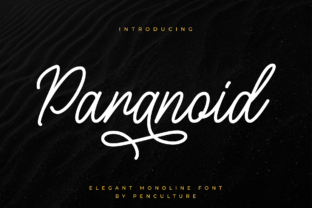
Paranoid: A Refined Mono Line Font for Precision and Personality
Paranoid is a carefully crafted mono line font—meaning every stroke maintains a consistent, uniform thickness throughout each character. Unlike many monoline fonts that lean toward geometric austerity or minimalist neutrality, Paranoid balances structural clarity with subtle expressive nuance. Its elegance emerges not from ornamentation, but from intentional spacing, refined proportions, and a cohesive rhythm across uppercase, lowercase, numerals, and punctuation.
What Sets Paranoid Apart
At first glance, Paranoid resembles other modern monoline typefaces—but closer inspection reveals thoughtful differentiation. Its letterforms avoid rigid symmetry; instead, they incorporate gentle optical corrections. For example, the lowercase a and g feature open counters and softened terminals, improving legibility at small sizes without sacrificing stylistic cohesion. The uppercase M and W use slightly tapered verticals—not true serifs, but quiet visual anchors that prevent visual heaviness.
What truly distinguishes Paranoid is its built-in alternates. It includes multiple stylistic sets: simplified glyphs for clean digital interfaces, more calligraphic-inspired variants for hand-crafted warmth, and condensed versions for tight layout constraints. These aren’t decorative add-ons—they’re functionally integrated options, designed to adapt Paranoid’s voice without switching fonts entirely. That flexibility makes it unusually versatile for a single-family design.
Where Paranoid Fits in the Broader Landscape
Monoline fonts occupy a distinct niche between high-contrast serif families (like Didot or Bodoni) and variable-weight sans-serifs (like Inter or Roboto Flex). They’re often chosen when designers need consistency across weights—something traditional serif or sans-serif families handle via optical scaling—but don’t want the mechanical uniformity of early digital monolines like Helvetica Neue Thin or Futura PT Light.
Compared to other contemporary monoline fonts, Paranoid avoids two common pitfalls: excessive rigidity and over-stylization. Some monoline designs prioritize mathematical precision to the point of coldness; others introduce so many swashes and ligatures that they become impractical for body text or multi-line layouts. Paranoid lands between those extremes—structured enough for professional branding systems, yet humanized enough for editorial or artisanal applications.
Practical Strengths—and Realistic Tradeoffs
Paranoid excels in contexts where tone matters as much as function. It works especially well for craft-based brands—think ceramic studios, independent book publishers, botanical illustration labels, or boutique stationery lines. Its mono line quality ensures crisp reproduction on laser-cut wood, embossed paper, or vinyl decals. Because stroke weight remains constant, it scales predictably from 8 pt caption text to 72 pt display headlines without distortion.
Its alternates also support nuanced storytelling. A wedding invitation might use the standard set for names and dates, then switch to the rounded alternate for “forever” or “together”—a subtle emotional cue rather than a stylistic gimmick. Similarly, a product label could use the condensed variant for ingredient lists while keeping the standard version for the brand name—maintaining hierarchy without introducing a second font family.
That said, Paranoid isn’t universally optimal. It lacks true optical sizes—so extended body copy at 10–12 pt may feel slightly less comfortable for long-form reading than fonts specifically engineered for text (e.g., Charter or Adobe Text). It also doesn’t include extensive language support beyond Latin-based scripts, limiting suitability for multilingual publishing or global-facing interfaces. And while its alternates are useful, they require manual activation in design software—so teams without consistent typography workflows may underutilize them.
When Paranoid Is Likely the Right Choice
- You’re designing for tactile or physical media: Laser engraving, foil stamping, screen printing, or hand-lettered signage benefit from Paranoid’s even stroke weight and clean terminals.
- Your project balances minimalism with personality: You need typographic restraint but want to avoid sterility—Paranoid delivers structure with quiet character.
- You’re working across multiple output formats: From web CSS
@font-faceembedding to print-ready PDFs, its consistent metrics simplify QA and reduce rendering surprises. - You value typographic control without complexity: Rather than managing three separate fonts (display, text, caption), Paranoid’s alternates let you adjust tone within one file.
When Another Option Might Serve Better
- You’re typesetting long-form editorial content: If your primary need is readability across thousands of words—especially on screens—a dedicated text face with optimized x-height, generous counters, and varied stroke contrast will likely perform better.
- You require broad language coverage: Projects targeting Eastern European, Turkish, Vietnamese, or Baltic languages may need a font with expanded OpenType features and glyph sets beyond Paranoid’s current scope.
- You’re building a highly dynamic interface: While Paranoid works well in static UI elements (buttons, cards, headings), it lacks variable-axis interpolation—so responsive weight or width adjustments must be handled manually, unlike variable fonts such as Commissioner or Manrope.
- Your team relies heavily on auto-layout tools: Some design systems depend on automatic font fallbacks or weight-matching algorithms that assume traditional weight naming (Light, Regular, Bold). Paranoid’s approach—relying on stylistic sets rather than weight tiers—may require extra configuration.
Real-World Use Cases and Subtle Comparisons
A local apothecary rebranding their packaging used Paranoid for both product names and ingredient lists. They selected the standard set for the front label (“Lavender & Chamomile Tincture”) and activated the rounded alternate only for the tagline (“calm • clear • grounded”). This created visual hierarchy and emotional resonance without complicating production files—unlike switching to a second font, which would have required additional licensing, testing, and vendor coordination.
In contrast, a university press evaluating fonts for a new series of scholarly monographs tested Paranoid alongside several text-optimized serifs. While Paranoid performed admirably in chapter titles and front matter, reviewers consistently preferred a higher-contrast serif for body text—citing improved word recognition during sustained reading. In that context, Paranoid became the display font only, paired with a complementary text face. That hybrid approach highlights its strength: not as a universal solution, but as a precise tool within a considered system.
Making an Informed Decision
Choosing a font like Paranoid isn’t about finding the “best” option—it’s about matching typographic behavior to functional and expressive needs. Ask yourself: What’s the primary medium? Who is the audience—and how will they interact with the text? How much control do you have over implementation, and how much flexibility does your workflow allow?
If your work involves crafting tangible objects, communicating quiet confidence, or balancing simplicity with sophistication, Paranoid offers a rare combination of discipline and delicacy. Its mono line construction ensures technical reliability; its alternates provide expressive range. But if your priorities center on linguistic inclusivity, dynamic responsiveness, or extended readability, it’s worth exploring alternatives with different architectural foundations.
Ultimately, the value of Paranoid lies not in replacing other fonts—but in filling a specific, well-defined role: the elegant mono line font that supports intentionality, whether you’re etching a name onto glass or setting poetry in soft-bound chapbooks.