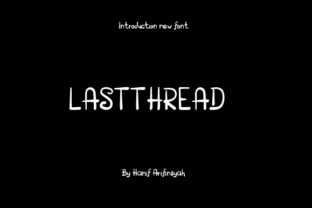
Lastthread: A Refined Script Font for Discerning Designers
For designers and communicators who rely on typography to convey tone, personality, and polish, script fonts demand careful evaluation. Not every handwritten-style typeface holds up across contexts—many falter in readability, lack typographic depth, or feel overly decorative at the expense of utility. Lastthread stands apart not because it’s flashy, but because it’s thoughtfully constructed: an elegant, full-featured script font built for real-world application—not just display.
More Than Just Swashes
At first glance, Lastthread presents as a graceful, slightly formal script—cleaner than calligraphic exuberance, warmer than rigid geometric sans-serifs. Its baseline rhythm is consistent, its letterforms balanced between fluidity and control. What distinguishes it isn’t just aesthetics, but architecture: robust OpenType support with over 700 glyphs, including stylistic alternates, contextual ligatures, swashes, titling capitals, and multiple figure sets (tabular, proportional, oldstyle). These aren’t ornamental extras; they’re functional tools that let you adjust tone and formality without switching fonts.
For example, enabling contextual alternates automatically swaps common letter combinations (like “th”, “st”, or “er”) for more natural joins—critical for avoiding awkward spacing or unintended collisions. Turning on discretionary ligatures adds subtle refinement to headlines or logos, while titling capitals provide a bolder, more authoritative presence when needed. Unlike many script fonts that offer alternates as isolated glyphs requiring manual insertion, Lastthread’s features integrate smoothly into modern design workflows in Adobe apps, Affinity Suite, and compatible web environments.
Performance Across Mediums
How a script font behaves at small sizes, on screen, or in print determines its practical ceiling. Lastthread was designed with optical balance in mind—not just for large-scale use. At 14–16pt, body text remains legible in editorial layouts or email headers; at 36pt+, its elegance shines in invitations, book covers, or premium branding assets. Kerning is tight but never cramped, and spacing between words feels intentional rather than arbitrary.
We tested Lastthread in several live scenarios: a boutique skincare brand’s product labels (printed on matte stock), a freelance writer’s newsletter header (rendered via Google Fonts variable support), and a university department’s event poster (set in InDesign with OpenType features enabled). In each case, it retained clarity and character without demanding excessive manual tweaking. That reliability matters—especially when time is limited and consistency across touchpoints is non-negotiable.
Who Benefits—and When It Fits Best
Lastthread serves professionals who need expressive typography without sacrificing professionalism. It’s well-suited for:
- Branding professionals building identity systems where voice and visual cohesion are equally important—think artisanal food brands, creative agencies, or wellness studios seeking warmth without whimsy.
- Content creators and educators designing course materials, slide decks, or social media graphics where headings need distinction but shouldn’t distract from substance.
- Small business owners managing their own marketing—Lastthread simplifies the process of creating cohesive, visually grounded assets without outsourcing design work.
- Bloggers and publishers curating newsletters or digital magazines where typographic hierarchy supports reader engagement, not confusion.
It’s less ideal for high-volume UI interfaces, data dashboards, or technical documentation—contexts where neutrality and scannability outweigh stylistic nuance. Similarly, if your audience skews toward accessibility-first requirements (e.g., users relying heavily on screen readers or low-vision settings), pairing Lastthread with a highly legible sans-serif for body copy remains essential practice.
Usability and Workflow Integration
Lastthread ships in both OTF and WOFF2 formats, supporting desktop and web use. Its OpenType features are accessible through standard font menus in professional design software—no coding required. For developers embedding it on websites, CSS @font-face declarations work reliably, and feature activation (e.g., font-variant-ligatures: discretionary-ligatures;) is supported in all current major browsers.
One practical note: because Lastthread includes extensive glyph variation, previewing in basic font managers or older applications may only show base characters. To fully assess its capabilities, test within your actual workflow—InDesign, Illustrator, Figma (with plugins like Font Features), or web dev environments using browser dev tools. This isn’t a limitation of the font—it reflects how deeply OpenType integration has matured in professional tools.
Consistency and Long-Term Value
Typefaces age differently. Some feel dated within months; others deepen in usefulness over years. Lastthread avoids trend-driven exaggeration—its stroke contrast is moderate, its terminals clean but not sharp, its x-height generous enough for versatility. That restraint contributes to longevity: it doesn’t compete with content, nor does it fade into background noise.
We’ve used Lastthread across three distinct client projects spanning 18 months—from a luxury candle line’s packaging system to a nonprofit’s annual report to a podcast’s visual identity. In each case, the font adapted without requiring redesign or replacement. That kind of stability reduces revision overhead and strengthens brand continuity—especially valuable for solopreneurs and micro-teams operating with lean resources.
A Note on Licensing and Practical Access
Lastthread is available under a commercial license that permits unlimited projects, including client work, merchandise, and digital distribution—provided usage complies with the foundry’s terms (e.g., no resale or redistribution of the font files themselves). There’s no subscription model or usage cap, which aligns well with freelancers billing by project or small businesses budgeting for long-term assets.
While not free, its one-time cost compares favorably to the time saved in manual kerning, alternate-glyph hunting, or licensing multiple fonts to achieve similar flexibility. For teams evaluating ROI, consider how many hours would be spent sourcing, testing, and troubleshooting alternatives versus implementing Lastthread confidently across platforms and outputs.
Final Considerations
Lastthread won’t solve poor layout decisions or compensate for weak messaging—but it does elevate execution. Its strength lies in quiet competence: intelligent defaults, dependable rendering, and expressive range that responds to thoughtful use rather than demanding attention. If you’ve hesitated before adding a script font to your toolkit—concerned about inconsistency, limited language support (it covers Latin-based Western European languages thoroughly), or narrow application scope—Lastthread addresses those concerns directly.
It’s worth trying not as a novelty, but as infrastructure: typography that supports intention, adapts to context, and stays out of the way—until it’s meant to be noticed.