Mirinia: The Hand-Lettered Script Font That Brings Warmth to Digital Design
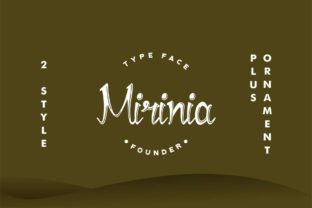
There’s a quiet shift happening across design studios, branding agencies, and even solo creators: a growing hunger for authenticity in typography. In a world saturated with polished, algorithmically refined fonts, designers are turning to typefaces that feel human—imperfect, expressive, and unmistakably hand-crafted. Enter Mirinia: a gorgeous script font born from real pen strokes, not vector points generated by software. It doesn’t just look handwritten—it is handwritten, authentically lettered and thoughtfully refined for versatility without sacrificing soul.
What Makes Mirinia Feel So Uniquely Human?
At its core, Mirinia isn’t built on uniformity. Its charm lives in subtle variations—the slight tilt of an “s”, the gentle swell of a lowercase “g”, the soft pressure shifts in each stroke that mimic ink bleeding just slightly into paper. These aren’t flaws; they’re intentional signatures of the hand. Unlike many “script” fonts that rely on rigid alternates or mechanical ligature systems, Mirinia’s rhythm flows naturally, like someone writing with confidence and ease—not performing for a camera.
Each character was drawn with a flexible nib pen, then digitized with precision that preserves texture, weight transitions, and organic spacing. That means when you type “hello” in Mirinia, the letters don’t just connect—they converse. The “l” leans gently into the “l”, the “o” opens wide enough to breathe, and the terminal of the final “o” curls with quiet intention. It’s this attention to micro-behavior—how letters relate in context—that gives Mirinia its uncanny sense of life.
Where Mirinia Shines: Real-World Use Cases
Mirinia thrives where personality matters more than predictability. It’s rarely the right choice for dense body text or technical documentation—but it excels precisely where you want eyes to pause, smile, and lean in.
- Wedding stationery: Invitations, menus, and signage gain instant elegance and intimacy. A couple’s names in Mirinia feel like a whispered promise—not a corporate announcement.
- Small-batch product packaging: Think artisanal honey, ceramic mugs, or handmade soaps. Mirinia signals care, craft, and connection—qualities consumers actively seek in local and independent brands.
- Branding for creative professionals: Photographers, florists, calligraphers, and yoga instructors use Mirinia in logos or wordmarks to reflect their personal voice—not a stock aesthetic.
- Digital storytelling: On Instagram carousels, email headers, or portfolio hero sections, Mirinia adds warmth to otherwise flat interfaces. It softens the digital edge without compromising clarity.
One designer recently shared how she used Mirinia for a boutique bakery’s rebrand: “The owner wanted customers to feel like they were being handed a note from the chef—not reading a menu. Mirinia gave us that handwritten sincerity, but with the polish needed for print and web.” That balance—handmade heart with professional execution—is Mirinia’s superpower.
How Mirinia Fits Into Modern Design Workflows
Worried about compatibility or technical friction? Mirinia is built for today’s tools. It includes full OpenType support, standard and discretionary ligatures, stylistic alternates, and multilingual characters covering Western European languages. Whether you’re working in Adobe Illustrator, Figma, Affinity Designer, or even Canva (via upload), Mirinia behaves predictably—and beautifully.
It also scales gracefully. At 16px, it reads cleanly as a headline on mobile. At 72pt, it commands attention on a poster without losing nuance. And because its x-height is generous and its counters open, it remains legible even when used at smaller sizes in tight layouts—unlike many delicate scripts that vanish into blur at under 24pt.
Pro tip: Pair Mirinia with a clean, neutral sans-serif (think Inter, Poppins, or Montserrat) for contrast that feels intentional, not jarring. Use Mirinia for names, taglines, or short quotes; let the sans-serif handle descriptions, specs, or navigation. This duo creates visual hierarchy while keeping tone cohesive.
What to Consider Before Choosing Mirinia
Mirinia isn’t a universal solution—and that’s part of its strength. Before licensing or downloading, ask yourself a few practical questions:
- Is legibility critical for long-form text? If your project relies heavily on paragraphs, captions, or interface labels, Mirinia should be reserved for accents—not foundations.
- Does your brand voice lean formal, playful, or somewhere in between? Mirinia skews warm, approachable, and quietly confident—not stiff, not cartoonish. It won’t suit a fintech startup aiming for razor-sharp authority, but it’s perfect for a wellness coach launching a mindful journaling app.
- Do you need extensive language support? Mirinia covers major Latin-based languages well, but doesn’t include Cyrillic, Greek, or extended Vietnamese diacritics. Check the character map before committing to global campaigns.
- Are you using it for motion or animation? Yes—Mirinia holds up beautifully in After Effects or Lottie animations. Its stroke consistency and clear entry/exit points make it ideal for animated reveals or typewriter effects.
Also worth noting: Mirinia comes in one carefully tuned weight—neither ultra-thin nor overly bold. That singular focus is deliberate. It avoids diluting the voice with unnecessary variants and ensures every use feels cohesive and considered.
Why Designers Are Choosing Mirinia Over Generic Alternatives
Scroll through any font marketplace, and you’ll find dozens of “handwritten” scripts. Many rely on randomized swashes, over-engineered alternates, or exaggerated flourishes that distract rather than delight. Mirinia stands apart by prioritizing readability within expression.
It doesn’t shout. It invites. It doesn’t mimic chaos—it channels calm intention. That restraint makes it more versatile than flashier peers. You can use Mirinia on a minimalist linen tote bag or a vibrant festival poster and it will feel equally at home—because its foundation is authenticity, not ornamentation.
And in an age where AI-generated design floods feeds and inboxes, Mirinia offers something increasingly rare: proof of human presence. When a client sees Mirinia in their brand kit, they’re not just seeing a font—they’re sensing care, time, and craftsmanship. That emotional resonance translates directly into trust, memorability, and differentiation.
Getting Started With Mirinia—Simple, Seamless, Satisfying
Licensing Mirinia is straightforward: most vendors offer one-time desktop + web licenses, with optional extended rights for apps or merchandise. No subscriptions. No monthly fees. Just clean access to a tool that works immediately.
Once installed, start small. Try it on a social media quote graphic. Replace the default heading font in your next newsletter template. Print a single line on textured paper and hold it up to the light—notice how the curves catch shadows differently than geometric fonts do. That tactile awareness is where Mirinia begins to reveal its depth.
You’ll likely find yourself reaching for it more often than expected—not because it’s trendy, but because it solves real problems: How do we make digital feel personal? How do we signal quality without shouting? How do we honor tradition while staying utterly current?
Mirinia doesn’t answer those questions with words. It answers them with shape, flow, and quiet confidence—one beautifully imperfect letter at a time.