Chubby Cheeks: Why This Hand-Lettered Font Is Reshaping Creative Workflows Across Industries
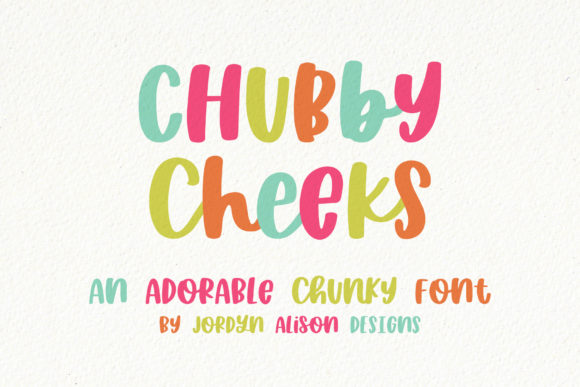
Typography isn’t just about legibility—it’s about resonance. When a font carries personality, texture, and tactile warmth, it becomes more than a tool for communication; it becomes a collaborator in storytelling. Chubby Cheeks exemplifies this shift. It’s not another sleek sans-serif or minimalist script—it’s a joyful, thick, hand-lettered handwritten font designed with physicality in mind. Its generous weight, rounded terminals, and playful irregularities make it instantly recognizable—and deeply functional across contexts where digital precision meets analog charm.
The Anatomy of a Purpose-Built Font
At first glance, Chubby Cheeks looks deceptively simple: bold, bouncy, and full of whimsy. But its design decisions are highly intentional. Each glyph is drawn by hand—then carefully digitized—not to mimic perfection, but to preserve the subtle variations that signal human authorship: slight inconsistencies in stroke thickness, gentle asymmetry in letterforms, and soft, organic curves instead of geometric arcs. This isn’t “imperfect” typography; it’s authentically imperfect, calibrated to feel inviting rather than sterile.
What truly distinguishes Chubby Cheeks from other playful fonts is its structural integrity. Its high x-height, generous counters (the enclosed spaces inside letters like ‘a’ or ‘e’), and wide letter spacing ensure clarity even at small sizes—yet its thickness shines brightest when scaled up. That duality makes it unusually versatile: equally effective on a tiny Instagram story sticker and a 48-inch vinyl wall decal.
Where Physical Craft Meets Digital Flexibility
One of Chubby Cheeks’ most practical strengths lies in its compatibility with cutting machines. Because its strokes are consistently thick—no hairline serifs, no delicate connectors, no overlapping paths—it converts flawlessly into clean vector paths. Whether you’re using Cricut Design Space, Silhouette Studio, or Adobe Illustrator’s Image Trace, Chubby Cheeks renders predictable, cut-ready outlines every time. Hobbyists report significantly fewer “weeding” frustrations when applying vinyl lettering to mugs, tote bags, or nursery walls. Educators preparing classroom signage find that printed and cut letters hold up through repeated handling. Small business owners launching limited-run merchandise appreciate how quickly Chubby Cheeks transitions from concept to physical product—no font substitution, no tracing corrections, no last-minute redesigns.
This reliability extends beyond craft cutting. In print production, Chubby Cheeks performs well on both coated and uncoated stocks—even at lower resolutions—because its mass prevents ink spread from blurring character definition. For screen-based use, its strong silhouette ensures readability on mobile devices without relying on anti-aliasing tricks that sometimes distort delicate scripts.
Real-World Applications Across Diverse Roles
Different users leverage Chubby Cheeks not just for aesthetics—but for alignment with values, workflows, and audience expectations.
- Small business owners use Chubby Cheeks to signal approachability without sacrificing professionalism. A bakery’s chalkboard menu, a boutique’s packaging stamp, or a wellness coach’s workshop banner all benefit from its warm, unhurried rhythm—communicating care and craft over corporate polish.
- Educators and curriculum designers integrate Chubby Cheeks into visual aids, flashcards, and student-facing worksheets. Its friendly weight supports early literacy development by reducing visual strain, while its clear letter shapes aid letter-sound recognition—especially for learners with dyslexia or visual processing differences.
- Social media managers rely on Chubby Cheeks for branded quote graphics, Reels captions, and Pinterest pins. Its thickness holds up against busy backgrounds, and its handwritten quality increases perceived authenticity—a measurable factor in engagement metrics across platforms like Instagram and TikTok.
- SVG designers and digital crafters build layered, multi-color cut files using Chubby Cheeks as a base layer. Its uniform stroke weight allows for precise shadow offsets, contour outlines, and split-color treatments—making complex designs reproducible with minimal manual adjustment.
- Nonprofit communicators apply Chubby Cheeks to campaign materials where warmth and inclusivity matter—think community event posters, donor thank-you cards, or advocacy infographics. The font subtly signals that the organization values connection over hierarchy.
Strategic Considerations: When (and When Not) to Choose Chubby Cheeks
Like any expressive typeface, Chubby Cheeks thrives within thoughtful constraints. Its strength is presence—not neutrality. That means it excels in roles where emphasis, emotion, or identity is central—but may fall short in contexts demanding strict neutrality or dense information delivery.
For example, pairing Chubby Cheeks with a clean, highly legible sans-serif (like Inter or Open Sans) creates effective typographic contrast: Chubby Cheeks handles headlines, logos, and callouts, while the secondary font manages body text, captions, or data tables. This combination satisfies both aesthetic cohesion and functional hierarchy—critical for accessibility compliance and long-form readability.
It’s also worth noting how Chubby Cheeks interacts with color. Its thickness absorbs saturated tones beautifully, making it ideal for bold brand palettes. However, when used with low-contrast combinations (e.g., light gray on white), its impact diminishes. Designers working in accessible environments test contrast ratios rigorously—tools like WebAIM’s Contrast Checker confirm that Chubby Cheeks meets WCAG 2.1 AA standards at 18pt or larger, especially with dark-on-light pairings.
Workflow Integration: From Concept to Output
Chubby Cheeks fits naturally into modern creative pipelines—not as an afterthought, but as a deliberate asset. Here’s how professionals embed it meaningfully:
- Branding exploration: Designers begin mood boards with Chubby Cheeks alongside tactile references—crayon drawings, stamped labels, fabric swatches—to ground visual identity in sensory experience before committing to final logo lockups.
- Social content calendars: Teams pre-load Chubby Cheeks into Canva brand kits or Figma libraries, ensuring consistent tone across weekly posts—especially for quote-driven formats where voice matters more than formal structure.
- Educational resource development: Teachers generate customizable worksheet templates in Google Slides using Chubby Cheeks for instructions and headers—then export as PDFs optimized for black-and-white printing without losing shape fidelity.
- Merchandise prototyping: Product developers mock up t-shirt prints, enamel pin layouts, and sticker sheets in vector editors, leveraging Chubby Cheeks’ native OpenType features (including stylistic alternates and ligatures) to add subtle variation without switching fonts.
- Community signage systems: Municipal planners and nonprofit staff use Chubby Cheeks in bilingual wayfinding signage—its open forms improve recognition for non-native readers, while its friendly tone reduces perceived institutional distance.
Beyond Aesthetics: The Human-Centered Logic of Thick Handwriting
There’s a deeper reason Chubby Cheeks resonates across such varied domains: it mirrors how people actually engage with handmade, human-scaled communication. Think of a child’s birthday invitation drawn in marker, a café’s daily special board scrawled in chalk, or a teacher’s encouraging note written in pen. These aren’t “designed”—they’re made. And Chubby Cheeks carries that same sense of intentionality and care.
Research in cognitive psychology supports this intuition. Studies on visual processing show that moderately irregular, high-contrast letterforms trigger greater attention retention than perfectly uniform ones—particularly in emotionally charged or memory-linked contexts. That’s why Chubby Cheeks appears so often in therapeutic tools, memory aids, and early childhood materials: its form supports function at a neurological level.
Moreover, its popularity reflects a broader cultural pivot away from algorithmic perfection toward tactile authenticity. In an era of AI-generated imagery and templated interfaces, choosing Chubby Cheeks is a quiet act of human curation—a reminder that clarity need not come at the cost of warmth, and utility need not erase individuality.
Future-Ready Adaptability
As design tools evolve, Chubby Cheeks continues to demonstrate surprising adaptability. Its vector foundation integrates smoothly with generative design plugins, allowing creators to animate letterforms with physics-based bounce or apply procedural texture overlays without distortion. SVG animations built with Chubby Cheeks maintain crisp edges across device sizes—unlike raster-based handwriting fonts that pixelate on high-DPI screens.
Looking ahead, its role in inclusive design is expanding. Some educators are adapting Chubby Cheeks-based letter cards for AAC (Augmentative and Alternative Communication) devices, citing its distinct shape differentiation and stroke consistency as advantages for motor planning. Meanwhile, open-source contributors have begun developing localized language extensions—including extended Latin, Greek, and Cyrillic character sets—ensuring its utility grows alongside global creative communities.
In essence, Chubby Cheeks isn’t just a font you choose for a project. It’s a decision point—a moment to consider how tone, touch, and technology intersect. Whether you’re cutting vinyl for a local shop, designing a university’s welcome campaign, or illustrating a children’s book, its thick, hand-drawn honesty offers something increasingly rare: confidence without coldness, playfulness without pretense, and utility rooted in humanity.