Fooland: A Friendly, Contemporary Script Font That Brings Warmth to Modern Design
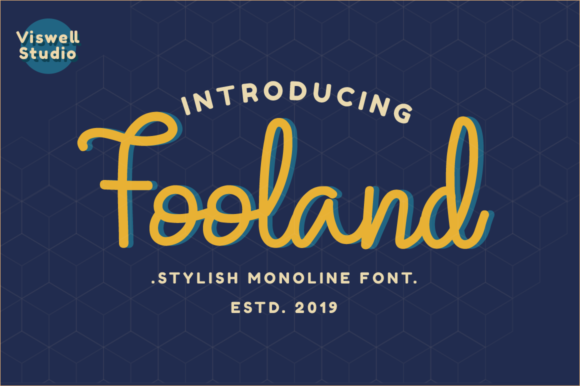
When you’re designing a brand identity, crafting an invitation, or refining a digital product’s interface, typography isn’t just about legibility—it’s about tone, trust, and emotional resonance. Fooland is a beautiful monoline script font defined by its friendly curves, balanced rhythm, and contemporary coolness. It doesn’t shout; it smiles—gently, confidently, and with quiet sophistication. For adults juggling real-world creative tasks—whether launching a small business, updating a portfolio, or preparing client-facing materials—Fooland offers more than aesthetic appeal. It delivers practical versatility grounded in human-centered design.
What Makes Fooland Stand Out—Without Standing Out Too Much
Fooland is a monoline script, meaning every stroke carries consistent weight—no thick-and-thin contrast like traditional calligraphy. This gives it exceptional clarity at smaller sizes and smooth scalability across screens and print. Its curves are soft but intentional, avoiding cutesy exaggeration while preserving approachability. Unlike many script fonts that feel either overly formal or distractingly decorative, Fooland strikes a rare middle ground: modern enough for a tech startup’s landing page, warm enough for a handmade soap label or a wedding suite.
That balance matters—especially when your goal isn’t to impress typographers, but to connect with people. You’re not choosing a font to check a box. You’re selecting a voice—one that reflects care, authenticity, and quiet confidence. And Fooland does that without demanding extra design labor.
Real Challenges—Where Fooland Fits Naturally
Many professionals face overlapping pressures: tight deadlines, limited design experience, budget constraints, and the need to communicate clearly *and* memorably. Consider these common situations:
- A solopreneur launching a wellness coaching service needs branding that feels nurturing—not clinical or cold—but also avoids looking unprofessional or “trend-chasing.”
- A designer building a SaaS dashboard wants subtle personality in headings or onboarding messages—without sacrificing readability or accessibility.
- An educator or nonprofit staff member creating workshop handouts or donor thank-you notes seeks warmth and sincerity, not sterile corporate fonts.
- A wedding stationer balancing elegance with intimacy—where formality shouldn’t feel distant, and friendliness shouldn’t read as casual.
In each case, the challenge isn’t just “what font looks nice?” It’s “what font helps me say what I mean—clearly, kindly, and consistently—across formats and audiences?” That’s where Fooland becomes a practical tool, not just a stylistic choice.
How Fooland Solves Problems—Not Just Adds Style
Fooland supports usability first. Its open letterforms and generous spacing improve scannability, especially in digital contexts. The lowercase a, e, and s are highly distinguishable—reducing misreading in body text or short headlines. Its x-height is generous, so it remains legible even at 14–16px in UI elements or email headers.
Because it’s monoline, Fooland pairs effortlessly with clean sans-serifs (like Inter, Lato, or Montserrat) for hierarchy and contrast—no clashing energy. Use Fooland for logos, quotes, section headers, or signature lines; pair it with a neutral workhorse font for paragraphs and data. This pairing strategy reduces cognitive load for readers and streamlines your own design process.
And unlike many script fonts, Fooland includes full Latin language support, standard ligatures, and OpenType features like stylistic alternates—so you can refine tone without switching fonts. A slightly bolder weight option (if available in your license) adds presence for buttons or banners without losing its core friendliness.
Practical Applications—From Concept to Click
Here’s how different users can apply Fooland thoughtfully:
- Small business owners: Use Fooland in your logo and social media bios to signal approachability—then switch to a readable sans-serif for service descriptions and pricing tables. Even a single line of Fooland in an Instagram Story highlight cover builds instant recognition.
- UX/UI designers: Apply Fooland sparingly—to welcome messages (“Welcome back, Alex!”), empty-state illustrations (“Let’s get started”), or microcopy that benefits from emotional nuance (“You’re all set ✨”). Avoid using it for navigation labels or form fields—clarity still comes first.
- Educators and creatives: Embed Fooland in printable PDFs for course syllabi or resource guides. Its gentle rhythm makes dense information feel less intimidating—ideal for onboarding materials or community newsletters.
- Print designers: Leverage Fooland’s smooth curves in foil-stamped business cards or letterpress invitations. Its consistency ensures crisp output across substrates—and because it’s well-hinted, it renders cleanly on low-res printers too.
Smart Considerations Before You Commit
Fooland shines brightest when used with intention—not abundance. Overuse dilutes its impact and risks visual fatigue. As a rule of thumb: if a block of text takes more than two seconds to scan comfortably, it’s time to switch fonts.
Licensing matters. Fooland is typically offered under commercial licenses—verify usage rights for web embedding (WOFF/WOFF2), app integration, or merchandise. Some versions include variable font capabilities (weight or width axes), which can reduce HTTP requests and increase design flexibility—worth checking if performance is a priority.
Also consider audience context. While Fooland resonates strongly with Gen X and younger millennials who value authenticity over polish, it may feel less aligned with industries requiring gravitas—like legal, finance, or enterprise B2B—unless carefully contextualized (e.g., used only in brand storytelling assets, not compliance documents).
Getting Started—Simple, Sustainable, Human-Centered
You don’t need advanced design training to use Fooland well. Start small: replace one generic heading on your website homepage. Try it in a Canva template for your next newsletter. Test it alongside your current body font—does the contrast feel supportive, not jarring?
Then observe. Does your audience linger longer on pages using Fooland? Do clients comment on the “warmth” or “calm” of your materials? These aren’t vanity metrics—they’re signals that your typography is doing quiet, meaningful work.
Fooland doesn’t promise viral virality or overnight conversions. What it offers is reliability with heart: a tool that helps you show up as who you are—capable, kind, and quietly confident—without needing to explain yourself in every pixel.
If your goal is to communicate with clarity *and* compassion—if you value efficiency without sacrificing humanity—Fooland isn’t just another font. It’s a thoughtful ally in the everyday work of making things that matter.