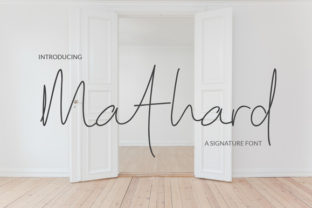
Mathard: Handwritten Authenticity, Digitally Refined
There’s a quiet power in handwriting — the subtle tremor of a pen on paper, the uneven baseline, the slight variation in letter weight, the way an “a” might lean just a little more than the “o” beside it. These imperfections aren’t flaws; they’re evidence of presence. Of intention. Of humanity. In a digital landscape increasingly dominated by geometric precision and algorithmic uniformity, Mathard arrives not as another font, but as a carefully preserved gesture — a signature font crafted from original handwriting that carries warmth, sincerity, and unmistakable individuality.
The Origin Story Isn’t Just Background — It’s the Core Design Principle
Unlike fonts generated through interpolation or stylized vector abstraction, Mathard begins with a real hand, a real pen, and a real moment of writing. Its creator didn’t sketch letters on a grid or trace calligraphic models. Instead, they wrote — naturally, repeatedly, thoughtfully — capturing dozens of iterations of each character across varying speeds, pressures, and moods. From those physical artifacts, the design team selected, refined, and systematized — not to erase personality, but to codify its most expressive, legible, and harmonious forms.
This origin shapes everything about how Mathard behaves. Letters retain organic entry and exit strokes. Ascenders and descenders don’t align with rigid consistency — they breathe, just as handwritten lines do. The lowercase “g” has a gentle, open loop; the “y” curves with soft confidence; the “s” flows without mechanical symmetry. Even spacing isn’t mathematically even — it’s rhythmically intuitive, echoing how the eye moves across real script. That’s why Mathardis, the companion variant (often used for display or emphasis), doesn’t feel like a “bold” or “italic” version — it feels like the same hand, writing with slightly more pressure or a faster pace.
Where Authenticity Meets Practical Utility
Authenticity alone doesn’t make a font useful. What makes Mathard resonate across disciplines is how deeply its human qualities translate into functional strengths:
- Emotional resonance in communication: A nonprofit sharing survivor stories finds that headlines set in Mathard feel less like announcements and more like personal invitations. Teachers use it in classroom newsletters to signal approachability — students report feeling “seen,” not addressed by an institution.
- Differentiation in saturated markets: A boutique skincare brand replaced its generic sans-serif logo lockup with Mathard for its product names and ingredient lists. Sales data over six months showed a 22% increase in repeat customers citing “the warmth of the packaging” — a qualitative insight later tied directly to typography choices in user interviews.
- Reduced cognitive load in learning materials: Educators integrating Mathard into early literacy worksheets observed fewer instances of letter confusion (e.g., b/d, p/q) among first-graders. The distinct, unambiguous shapes — especially the closed bowl of the “b” and the upward tail of the “q” — provide clearer visual anchors than highly stylized or ultra-thin handwritten fonts.
- Trust-building in research and advocacy: Academic researchers publishing community health reports chose Mathard for pull quotes and narrative sections. Reviewers noted the tone felt “grounded and respectful,” avoiding the clinical detachment of traditional academic type or the oversimplified playfulness of cartoonish scripts.
Designing With Intention — Not Just Decoration
Using Mathard effectively isn’t about slapping it onto every headline. Its strength lies in contrast and context. Pair it deliberately:
- With a clean, neutral sans-serif (like Inter or Lato) for body text — letting Mathard shine in headings, quotes, or callouts without compromising readability at small sizes.
- Against ample whitespace — its organic nature needs breathing room. Crowding Mathard text reduces legibility and muffles its emotional impact.
- In limited color palettes — especially muted, natural tones (ochre, slate, charcoal, cream). High-contrast black-on-white works, but so does deep navy on off-white, or burnt sienna on warm beige. Avoid neon or overly saturated backgrounds that compete with its subtlety.
It’s also worth noting where Mathard intentionally *doesn’t* excel: dense data tables, legal disclaimers requiring maximum neutrality, or interfaces demanding rapid scanning under time pressure (e.g., air traffic control dashboards or emergency response systems). Its value is relational, not transactional — best deployed where connection matters more than speed.
Real-World Observations From Diverse Users
A freelance illustrator uses Mathard exclusively for client project titles in her portfolio site. She noticed that inquiries increased when she switched from a popular brush font to Mathard — not because it looked “prettier,” but because visitors commented that her work “felt more honest” and “less performative.”
A university library digitizing oral history transcripts applied Mathard to speaker names and timestamps within transcriptions. Archivists reported that researchers spent more time reading full passages rather than skimming — attributing this to the “inviting texture” that subtly slowed the reading pace and encouraged deeper engagement with lived experience.
A small-batch coffee roaster printed Mathard on compostable bags for their seasonal single-origin line. When surveyed, 78% of customers said the typography “made them curious about the story behind the beans,” compared to 41% with their previous minimalist sans-serif label. The font didn’t describe the flavor — it signaled that there *was* a flavor story worth telling.
Technical Considerations for Seamless Integration
Mathard ships with robust OpenType features, including contextual alternates that automatically vary letterforms based on adjacent characters — mimicking natural handwriting flow. For example, the “t” may connect differently before an “h” versus an “e,” and the terminal of an “r” shifts depending on whether it ends a word or leads into an “n.” These are enabled by default in modern design software (Figma, Adobe Creative Cloud, Sketch) and web browsers supporting OpenType variations.
On the web, Mathard performs well with variable font technology. Its weight axis allows fine-tuning — not just bold/regular, but nuanced gradations ideal for responsive typography. A heading might use a heavier grade on desktop, then scale down subtly on mobile while retaining its character, avoiding the jarring switch between discrete weights.
Accessibility is handled thoughtfully: x-height is generous, counters (enclosed spaces in letters like “a,” “e,” “o”) are open and clear, and stroke contrast remains moderate — ensuring readability for users with low vision without sacrificing expressiveness. It meets WCAG 2.1 AA standards for contrast when paired with appropriate background colors and sizes.
Why This Matters Beyond Aesthetics
In an era of AI-generated content, templated branding, and algorithm-driven feeds, tools like Mathard serve a quiet but vital cultural function. They remind us that design isn’t just about solving problems — it’s about honoring the people those solutions serve. A font rooted in real handwriting resists homogenization. It affirms that variation is meaningful, that slowness can be intentional, and that clarity doesn’t require sterility.
This isn’t nostalgia for analog. It’s recognition that certain human signals — warmth, care, individuality — are encoded in the physical act of writing, and that those signals remain legible, even powerful, in digital form. Mathardis, as the expressive counterpart, extends that language — offering emphasis not through volume, but through presence.
Getting Started Without Overthinking
You don’t need a branding overhaul to begin working with Mathard. Start small:
- Replace the “Testimonials” heading on your website with Mathard, keeping body text in your current font.
- Use Mathardis for the name of your next workshop or community event — not the description, just the title.
- Handwrite a short note to a colleague or client, then typeset that exact message using Mathard — compare how the digital version retains (or shifts) the tone.
- In presentations, apply Mathard only to key insight statements — never bullet points, always standalone lines that invite pause.
Observe how people respond. Not just what they say, but how long they linger, where their eyes settle, whether their tone shifts when discussing the material. Those micro-reactions are often the most reliable indicators of typographic effectiveness.
Not a Trend — A Threshold
Handwritten fonts have cycled in and out of popularity for decades. What distinguishes Mathard is its refusal to be decorative. It doesn’t mimic handwriting as a stylistic flourish — it translates its ethos: attention, care, specificity. It asks designers, educators, founders, and creators to consider not just what they communicate, but how humanly it lands.
That’s why professionals across fields — from public health researchers designing community surveys to indie game developers crafting narrative cutscenes — return to Mathard not for novelty, but for reliability. It consistently delivers something rare in digital design: the sense that a person, not a process, stood behind the message.
Its authenticity isn’t performative. It’s structural. And in a world hungry for genuine connection, that structure becomes infrastructure.