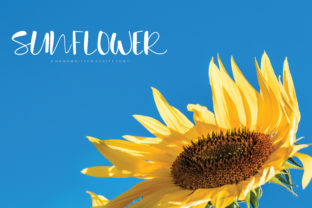
Sunflower: Handwritten Charm, Digitally Refined
There’s something quietly powerful about handwriting—the slight tremor in a curve, the uneven pressure of a downstroke, the warmth of imperfection. Sunflower captures that essence not as a nostalgic echo, but as a living, breathing font designed for today’s digital landscape. It’s not just “handwritten-looking.” It’s authentically handwritten—crafted with intention, refined for clarity, and built to feel human in every pixel.
More Than Just a Script: What Makes Sunflower Stand Out
Unlike many script fonts that rely on symmetry or exaggerated flourishes, Sunflower embraces organic asymmetry. Its lowercase letters tilt with gentle confidence; its capitals carry weight without stiffness. The spacing breathes naturally—not too tight, not too loose—and the stroke contrast is subtle, never mechanical. You’ll notice how the “g” loops low and relaxed, how the “s” curves like a sigh, and how the “t” crossbar sits slightly off-center—tiny details that signal authenticity, not algorithmic perfection.
This isn’t accidental charm. The designer spent months refining each glyph to preserve the rhythm of real pen-on-paper motion—without sacrificing legibility at small sizes or on screens. That balance is rare. Many handwritten fonts blur into abstraction at 14px; Sunflower remains distinct and readable even in body text on mobile devices.
Who Finds Sunflower Most Useful?
- Creatives building brand identity: Illustrators, lettering artists, and indie product designers use Sunflower to anchor visual systems with warmth—pairing it with clean sans-serifs for contrast that feels intentional, not forced.
- Small business owners crafting authentic messaging: A café owner adding a chalkboard-style menu, a ceramicist labeling handmade packaging, or a therapist designing a calm, approachable website—all benefit from Sunflower’s grounded, unhurried tone.
- Educators and content creators: Teachers using digital worksheets or educators producing accessible learning materials appreciate how Sunflower supports readability while softening the clinical edge of traditional educational fonts.
- Developers and UI designers: When used sparingly—for callouts, testimonials, or hero section headlines—Sunflower adds emotional resonance without compromising interface clarity.
Where Sunflower Shines (and Where It Pauses)
Sunflower excels in contexts where connection matters more than uniformity. Think: email headers that feel personal, Instagram story text overlays that don’t shout, wedding invitations that whisper elegance, or podcast episode titles that invite curiosity instead of demanding attention.
But it’s not a universal replacement. It’s intentionally *not* suited for dense paragraphs, legal disclaimers, data tables, or multilingual interfaces requiring extensive character sets (it currently supports Latin-based languages with standard diacritics—no Cyrillic or Arabic variants). That’s not a flaw—it’s fidelity to its purpose.
Consider this practical litmus test: if your goal is to convey trust through consistency and neutrality (e.g., banking dashboards or technical documentation), Sunflower may soften the message more than intended. But if you’re aiming to say, “We see you, we’re real, and this was made with care,” then Sunflower becomes a quiet ally.
Real-World Uses That Feel Effortlessly Right
- Local bakery website headline: “Fresh sourdough, baked daily” in Sunflower over a photo of golden crust—immediately signals craft and care, no adjectives needed.
- Product label for small-batch skincare: Ingredient lists stay in a neutral sans-serif, but the brand name “Wildroot Apothecary” appears in Sunflower, reinforcing hand-mixed, small-batch values.
- Nonprofit campaign banner: “Your support grows change” set in Sunflower beside a photo of community gardeners—softens urgency into invitation.
- Personal portfolio footer: A short signature line—“Made with patience & coffee”—in Sunflower adds humility and humanity without gimmickry.
Pairing Sunflower Thoughtfully
Because Sunflower carries expressive weight, pairing it well is less about rules and more about intention. Here’s what works—and why:
- With geometric sans-serifs (like Inter or Poppins): Creates dynamic tension—modern structure meets organic flow. Ideal for editorial layouts or startup landing pages seeking both clarity and personality.
- With warm, low-contrast serifs (like Literata or PT Serif): Enhances readability in long-form content while keeping tone inviting—great for blogs, newsletters, or digital zines.
- With itself—via weight variation: Sunflower includes regular and bold weights. Use bold for emphasis within a sentence (“This matters deeply”), not for full headings—its strength lies in nuance, not dominance.
- Avoid pairing with other decorative scripts or high-contrast fonts (e.g., Bodoni or Didot). The result can feel cluttered or theatrical rather than sincere.
Technical Notes Every User Should Know
Sunflower is open-source and free for personal and commercial use under the SIL Open Font License—a major plus for freelancers and startups watching budgets. It’s available in WOFF2 format for optimal web performance and includes basic OpenType features like standard ligatures and stylistic alternates (accessed via CSS font-feature-settings).
For developers: it loads quickly, renders crisply across browsers, and scales gracefully from 16px up to display sizes. No JavaScript dependencies. No complex setup—just link, declare, and go.
One gentle caveat: because it’s hand-drawn, some glyphs (like the ampersand “&” or the slashed zero “0”) are stylized—not utilitarian. If your project requires absolute typographic neutrality in symbols, preview those characters first. Most users find them charming; mission-critical systems may prefer fallbacks.
Evaluating Whether Sunflower Fits Your Project
Ask yourself three questions before committing:
- Does this project benefit from warmth over formality? If yes, Sunflower is likely a strong candidate.
- Will it appear mostly in short bursts—or extended text? It thrives in headlines, quotes, logos, and labels—not novels or reports.
- Does your audience respond to human-centered cues? Research shows handwritten elements increase perceived sincerity and approachability—especially among Gen X, millennials, and younger Gen Z audiences who value authenticity over polish.
If two out of three resonate, Sunflower is worth testing—not as decoration, but as voice.
A Font That Grows With You
Fonts are tools—but great ones become collaborators. Sunflower doesn’t shout for attention. It doesn’t chase trends. Instead, it offers something increasingly rare online: presence without pretense. It reminds us that digital design doesn’t have to feel sterile to be effective—or professional to be kind.
Whether you’re sketching a logo on paper, coding a responsive site, or drafting a heartfelt newsletter, Sunflower invites you to slow down, lean into texture, and trust that sometimes, the most powerful statement is written—not with precision, but with presence.
And if you’ve ever paused mid-scroll because a single line of text felt like it was speaking directly to you? That’s Sunflower working—not as a font, but as a quiet, confident handshake across the screen.