Rotten Brothers
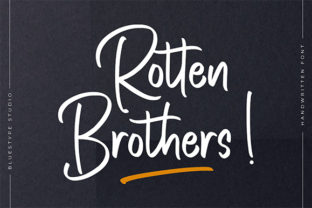
Rotten Brothers is a script font designed with expressive, hand-drawn characteristics. It features flowing connections, subtle irregularities, and a slightly distressed texture that evokes artisanal lettering—without relying on excessive ornamentation. As a display typeface, it is intended for short-form use: headlines, logos, packaging accents, or social media graphics where visual distinction matters more than extended readability.
Why Designers Consider Rotten Brothers
Designers often seek fonts that reinforce brand personality or elevate a specific mood—especially in creative industries like fashion, beauty, food, or independent publishing. Rotten Brothers stands out among script fonts for its balance of legibility and character: the letterforms are distinct enough to read at moderate sizes, yet retain organic movement that feels human-made rather than digitally generated.
Its appeal lies not in versatility but in intentionality. When a project calls for warmth, authenticity, or a touch of rebellious charm—think an indie coffee shop’s menu board, a boutique skincare line’s product label, or a music festival poster—Rotten Brothers offers a cohesive stylistic anchor. It communicates craft and individuality without requiring custom illustration.
Key Benefits and Practical Strengths
- Distinctive voice: Unlike many script fonts that default to elegance or romance, Rotten Brothers carries a grounded, slightly irreverent tone—ideal for brands avoiding cliché.
- Strong visual hierarchy: Its weight and contrast hold up well against photography or textured backgrounds, making it effective in digital and print layouts alike.
- Minimal learning curve: No complex OpenType features or alternate glyphs to manage—just one clean, consistent style that works predictably across platforms when properly embedded.
- Good licensing clarity: Available through reputable foundries with straightforward desktop and web licenses, reducing administrative friction for small teams or freelancers.
Tradeoffs and Realistic Expectations
Rotten Brothers is not built for body text. Its connected letters and variable stroke widths reduce readability below ~24px, especially in long paragraphs or low-resolution contexts. Users expecting multilingual support should verify coverage: while it includes Latin-based languages (English, Spanish, French, German, etc.), it lacks extended Cyrillic, Greek, or Asian language sets.
The font’s deliberate imperfection—its “rotten” quality—is both its strength and limitation. In highly formal or corporate environments (e.g., financial reports, legal disclaimers, enterprise SaaS interfaces), its informality may clash with audience expectations. Similarly, accessibility considerations matter: users relying on screen readers won’t benefit from its visual qualities, and designers must ensure sufficient color contrast and provide fallback text alternatives where needed.
Also note: because it’s a single-style script (no bold, italic, or condensed variants), pairing it with supporting typefaces becomes essential. A neutral sans serif—like Inter, Lato, or Montserrat—typically serves well as a functional counterpart for captions, subheads, or interface labels.
When Rotten Brothers Is a Strong Fit
Rotten Brothers performs best in focused, high-impact applications where tone and identity drive decisions more than functional flexibility. Examples include:
- Branding systems for lifestyle or creative businesses launching with limited assets—where one strong font can unify business cards, Instagram posts, and website headers.
- Editorial design projects with short, thematic copy—such as magazine feature titles, book cover typography, or exhibition signage.
- Digital campaigns targeting younger, design-savvy audiences who respond to visual authenticity over polished uniformity.
- Print collateral where tactile quality matters—letterpress stationery, vinyl record sleeves, or artisanal product packaging.
When Alternatives May Be More Appropriate
If your use case requires extended reading, multilingual support, or strict accessibility compliance, Rotten Brothers is unlikely to meet core requirements. In those cases, consider alternatives based on your priority:
- For improved readability in script form: Fonts like Playlist Script or Brittany Signature offer smoother connections and higher x-heights, easing comprehension at smaller sizes.
- For broader language coverage: Great Vibes or Shadows Into Light (both Google Fonts) include extended Latin and basic diacritics, though with less distinctive personality.
- For accessibility-first design: Prioritize system fonts or highly legible display faces like Manrope or Lexend, then introduce decorative elements through iconography or layout—not typography alone.
- For scalable branding systems: If you anticipate needing multiple weights or optical sizes (e.g., for responsive web use), a versatile superfamily like Neue Haas Grotesk paired with a custom-drawn wordmark may offer more long-term adaptability.
Making a Practical Decision
Evaluating Rotten Brothers isn’t about whether it’s “good”—it’s about whether it solves your specific problem. Start by clarifying your primary goal: Are you reinforcing a brand voice? Solving a hierarchy challenge? Differentiating a product in a crowded market? If yes, test it early—not just visually, but contextually. Place it beside real content, on actual devices, and alongside your chosen supporting typeface.
Check technical constraints: Does your CMS or design tool support custom font uploads? Will your web host allow self-hosting, or do you need a service-compatible version? Confirm licensing covers your distribution method—especially if embedding in mobile apps or PDFs.
Finally, assess longevity. A trend-driven font may feel fresh today but dated in two years. Rotten Brothers avoids extreme novelty; its roughness reads as timeless rather than temporal. That said, consistency matters more than novelty—so ask whether using it across all touchpoints strengthens recognition, or dilutes clarity through overuse.
In summary, Rotten Brothers serves a clear niche: expressive, short-form typography where authenticity and attitude align with strategic goals. It is neither a universal solution nor a passing fad—but a purpose-built tool. Its value emerges not in isolation, but in how deliberately it’s applied.