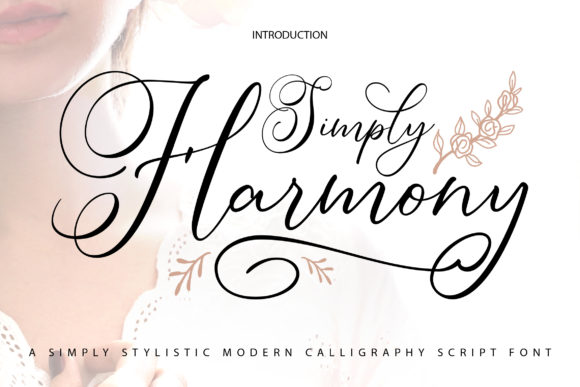
Simply Harmony
Simply Harmony isn’t just another handwritten font—it’s the kind of typeface that makes people pause mid-scroll. You know the feeling: you’re designing a wedding invitation, tweaking your Etsy shop banner, or sketching a mood board for a new blog rebrand—and suddenly, something clicks. That’s Simply Harmony. It’s soft, intentional, and full of quiet confidence—like ink drawn slowly by hand, with graceful swashes that don’t shout but still command attention.
Where It Fits Naturally—Not Just Where It *Could* Fit
People reach for Simply Harmony when authenticity matters more than polish. Think of it as the font equivalent of wearing your favorite sweater to an important meeting—not because you’re underdressing, but because comfort and sincerity build trust faster than perfection ever could.
A freelance graphic designer used Simply Harmony for a local florist’s seasonal menu—hand-lettered headers paired with clean sans-serif body text. The result? Customers lingered longer on the printed menu at the counter, and Instagram stories featuring the design got 3x more saves. Why? Because the font didn’t just say “flowers”—it whispered “carefully chosen,” “thoughtfully arranged,” “grown with attention.”
In education, a high school art teacher printed Simply Harmony onto student feedback cards—“Your color choices show such thoughtful harmony” or “I love how your composition flows.” Students responded differently than they did to typed comments. One told her, “It feels like you actually wrote it just for me.” That’s not magic—it’s legibility fused with warmth, and it works because Simply Harmony carries emotional weight without sacrificing clarity.
Real Moments, Not Just Mockups
You’ll find Simply Harmony in places where tone is part of the message:
- Wedding stationery—especially for couples who want elegance without formality. Its swashes add movement to monograms and envelope liners, but it stays legible at small sizes (down to 14pt for body text in print).
- Small business branding—a ceramicist uses it for her logo lockup and workshop titles; a wellness coach pairs it with open sans for email headers to soften clinical topics like stress management or habit building.
- Digital content—blog banners, Pinterest quote graphics, Canva templates for educators. It converts well on screens because its letterforms have consistent spacing and generous x-height—no awkward gaps or cramped ascenders that blur on mobile.
- Personal keepsakes—a mom hand-lettered her daughter’s first-day-of-school sign using Simply Harmony in Procreate, then printed it on matte cardstock. She didn’t need calligraphy training—just the right tool to make a simple moment feel tender and intentional.
Who Benefits—and How It Shifts Their Work
For entrepreneurs, Simply Harmony shortens the gap between “I have a vision” and “people get it instantly.” A candle maker switched from a generic script font to Simply Harmony for her product labels—and saw repeat customers mention “the handwriting” unprompted in reviews. That’s social proof built into typography.
Bloggers and content creators use it to differentiate their visual voice. One food writer layers Simply Harmony over rustic food photos for recipe titles—never for full posts, but always where she wants readers to pause and feel invited in. It doesn’t compete with imagery; it complements it.
Educators and coaches lean into its approachability. A yoga instructor uses it in her weekly newsletter subject lines (“Breathe deeper this week 🌿”)—not because it’s “pretty,” but because it signals gentleness before the reader even opens the email. In learning materials, it reduces cognitive load: students associate its rhythm with calm focus, not pressure.
Even developers and designers appreciate its technical reliability. It includes OpenType features like contextual alternates and swash variants—so when you type “&” or “Q,” it swaps in elegant flourishes automatically. No manual glyph hunting. And it’s web-safe when self-hosted (WOFF2 included), so no loading delays or fallback surprises.
What to Consider Before You Use It
Simply Harmony shines brightest when it has room to breathe. Don’t cram it into tight navigation bars or tiny app buttons. Its charm lives in medium-to-large applications—headers, quotes, logos, packaging, signage. If your project demands ultra-thin weight options or extensive language support (e.g., Vietnamese diacritics or Arabic glyphs), check the character map first—it covers Latin-based languages thoroughly, but stops short of extended Cyrillic or Indic scripts.
Also: swashes are optional, not mandatory. You can disable them in design apps like Illustrator or Figma via the OpenType panel—or choose the “Standard” version if you prefer cleaner lines. Some users start with swashes turned off, then enable them selectively for initials or decorative accents. That flexibility means it grows with your skill level.
And while it’s friendly, it’s not casual. Avoid pairing it with overly playful fonts (think cartoonish rounded sans) or ultra-minimalist typefaces with zero contrast—it needs balance, not contrast extremes. Try it with Roboto, Lora, or even Inter for grounded, readable pairings that let Simply Harmony lead without overwhelming.
More Than a Font—A Quiet Shift in How You Show Up
Using Simply Harmony isn’t about chasing trends. It’s about choosing to communicate with care—whether you’re naming a baby blanket, launching a Shopify store, drafting a heartfelt thank-you note, or designing a community garden sign. It reminds us that typography isn’t neutral. It carries subtext: urgency or ease, distance or intimacy, authority or invitation.
One small business owner told us she stopped using stock fonts after switching to Simply Harmony because “my customers started saying things like ‘your brand feels like a conversation.’ I hadn’t realized how much tone lived in the letters themselves.”
That’s the quiet power here. Not flash. Not novelty. Just harmony—between intention and execution, message and medium, creator and audience. It doesn’t solve every design problem, but it solves a specific, human one: how to make something feel made *for* someone—not just *at* them.
If you’ve ever hesitated before hitting “publish,” wondering whether your work feels warm enough, personal enough, or true enough—Simply Harmony won’t fix the idea, but it might help the idea land exactly as you meant it to.