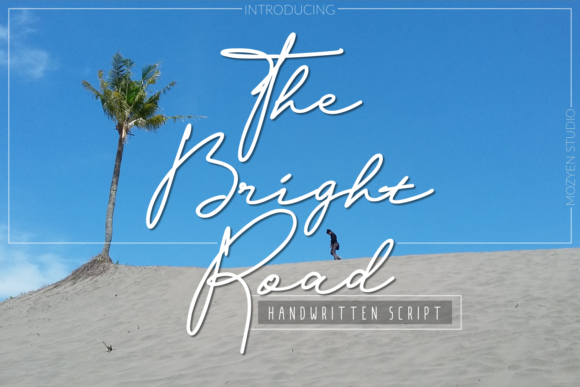
The Bright Road
There’s a quiet confidence in The Bright Road—not the kind that shouts, but the kind that holds space. It’s a stunning and bold script font that radiates authenticity, built for designers and non-designers alike who want modern charm without sacrificing legibility or intention. Whether you’re crafting a wedding invitation, branding a small business, designing social media graphics, or adding personality to an educational handout, The Bright Road stands out—not because it’s flashy, but because it feels human, intentional, and grounded.
Why people reach for The Bright Road (and why some regret it)
Many choose The Bright Road thinking it’ll instantly elevate their project—adding warmth, sophistication, or a handmade touch. And it can. But here’s where things go sideways: script fonts are not universal tools. Unlike versatile sans-serifs or reliable serifs, scripts like The Bright Road carry strong tonal weight and functional constraints. Using it without understanding those limits often leads to poor readability, inconsistent hierarchy, or unintended informality.
For example, a freelance educator once used The Bright Road for an entire course syllabus—headings, body text, even footnotes. The result? Students scrolled past key deadlines because the dense script overwhelmed the content. Another small business owner applied it across their Shopify store: logo, navigation, product titles, and checkout buttons. Customers hesitated at checkout—not because of price, but because the “Continue to Payment” button looked more like a flourish than a call to action.
Mistake #1: Assuming it works everywhere
The Bright Road shines in short-form, high-impact contexts: logos, headlines, quotes, monograms, or hero section text. It’s not built for paragraphs, data tables, or mobile navigation menus. Its connected letters and variable stroke contrast demand generous spacing, ample line height, and careful sizing—especially on screens smaller than 768px.
Before dropping it into your design, ask: Is this text meant to be read—or felt? If the answer is “read,” step back and consider pairing The Bright Road with a clean, neutral companion font (like Inter, Lora, or Montserrat) for body copy. That contrast isn’t a compromise—it’s clarity.
Mistake #2: Skipping the licensing check
Not all versions of The Bright Road are created equal—and not all are legal to use. You’ll find free downloads labeled “The Bright Road” on sketchy font aggregator sites. These are often outdated, modified, or outright pirated. Worse, they may lack OpenType features (like ligatures or alternate characters) that give The Bright Road its expressive rhythm—or worse, contain malware.
Always source The Bright Road from the original designer or an authorized platform like Creative Market, MyFonts, or the foundry’s official site. Check the license terms explicitly: Does it cover web use? Commercial projects? App embedding? One client assumed their desktop license covered their WordPress site—only to receive a polite but firm notice after launch. A few minutes upfront saves hours of rework (and potential legal friction).
Mistake #3: Ignoring context and audience
A font doesn’t exist in a vacuum. The Bright Road reads as warm and approachable—but that warmth lands differently depending on who’s seeing it. A tech startup targeting enterprise clients might unintentionally signal “casual” instead of “trusted” if The Bright Road dominates their investor pitch deck. Conversely, a ceramicist launching an online shop gains instant resonance using it for her “About” page headline—paired with soft photography and natural textures.
Ask yourself: What impression do I want this text to leave *before* anyone reads a word? If the answer includes “professional,” “authoritative,” or “cutting-edge,” lead with structure first—then bring in The Bright Road selectively, like a signature at the end of a thoughtful letter.
How to use The Bright Road well—without overthinking it
You don’t need advanced typography training. Start with these practical checks:
- Test at real size: Preview The Bright Road at the exact size and weight you plan to use—not just in your font menu. Zoom out. Scroll. View on phone and tablet.
- Limit its roles: Assign it one primary job (e.g., logo + H1s) and stick to it. Avoid using it for captions, form labels, or pricing tables.
- Adjust tracking deliberately: Scripts benefit from slightly increased letter spacing—especially in all-caps or tight layouts. Don’t rely on auto-kerning alone.
- Respect its rhythm: The Bright Road has natural entry and exit strokes. Let them breathe. Avoid cramming words together or stretching them unnaturally.
A better alternative isn’t always another font
Sometimes the best choice isn’t swapping The Bright Road for something “safer”—it’s using it more thoughtfully. One blogger switched from using it for every blog post title to reserving it only for personal essays and interviews. Suddenly, readers began associating that script with intimacy and reflection—not noise. The font didn’t change; the strategy did.
Another small bakery tested two versions of their holiday menu: one with The Bright Road for all headings and prices, another using it only for the seasonal special (“Spiced Pear & Honey Loaf”) and a clean sans-serif elsewhere. Orders for that item increased 32%—not because the font sold the loaf, but because it quietly signaled “this is special.”
Final thought: Authenticity starts with honesty
The Bright Road earns its name—not because it’s easy, but because it asks you to be deliberate. It invites warmth, yes, but only when paired with care. It offers boldness, but only when balanced with restraint. It feels authentic because it refuses to blend in—and that’s powerful, as long as you meet it halfway.
So before you install, embed, or export: pause. Ask what role this font truly plays in your message—not just how it looks, but how it serves the person reading it. That’s where modern charm becomes meaningful communication.