Asem: A Natural Brush Font for Authentic, Hand-Drawn Expression
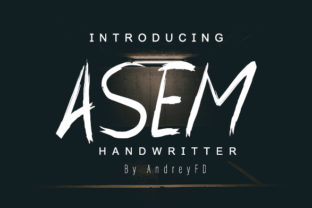
Asem is a natural brush font designed to evoke the spontaneity and tactile warmth of hand-painted lettering. Unlike tightly kerned, digitally refined script fonts, Asem embraces subtle inconsistencies—varied stroke weight, organic tapering, and slight irregularities in baseline alignment. These aren’t flaws; they’re intentional cues that signal human presence, making Asem especially effective where authenticity matters more than precision.
What Sets Asem Apart From Other Brush Fonts
Many brush fonts prioritize either legibility or texture—but Asem balances both. Its lowercase ‘a’, ‘g’, and ‘y’ feature open, airy counters and soft terminals that maintain readability at medium sizes (16–24pt), while its uppercase letters retain expressive flourishes without sacrificing clarity. This middle ground makes Asem versatile across contexts where other brush fonts often fall short: product packaging labels need to be scannable on shelf, editorial headlines benefit from visual rhythm, and social media graphics demand quick recognition amid scrolling.
Compared to ultra-rough, high-contrast brush fonts, Asem’s pressure variation feels controlled—not mechanical, but not chaotic either. It avoids the “overworked” look that can come from excessive texture overlays or simulated ink bleed. Instead, Asem uses carefully calibrated vector paths to suggest brush movement, preserving crisp edges when scaled up and avoiding pixelation when rendered on screen.
Where Asem Fits in the Broader Typeface Landscape
Brush fonts sit between formal scripts and casual handwritten styles. Asem leans toward the latter—but with more structural intention than fully improvised handwriting fonts. That distinction matters when evaluating fit. For example, a wedding invitation might call for a more formal, connected script like Playfair Display Italic or Great Vibes, where elegance and tradition take priority. In contrast, Asem suits branding for artisanal coffee roasters, independent bookshops, or wellness studios—contexts where approachability, craft, and groundedness are central values.
It also differs meaningfully from dry-brush or chalk-style fonts. Those often rely on grain, noise, or eroded edges to imply texture. Asem achieves character through form alone: the way a stroke swells mid-character, how an exit stroke lifts slightly before ending, or how the ‘s’ curves with gentle asymmetry. That makes it more adaptable to clean layouts—no need to compensate for visual noise elsewhere in the design.
Practical Strengths in Real Use Cases
- Brand voice consistency: Asem holds up well across touchpoints—logo lockups, website headers, Instagram story text, and printed hang tags—without requiring heavy customisation or fallback adjustments.
- Readability at scale: Tested across devices, Asem remains legible down to 18px in body copy (when used sparingly, e.g., pull quotes) and comfortably clear at 36px+ for display settings.
- Design system compatibility: It pairs predictably with neutral sans-serifs (e.g., Inter, Manrope, or Clash Grotesk) without visual competition. The contrast feels intentional, not jarring.
- Production efficiency: As a single-weight, OpenType font with standard Unicode coverage, Asem integrates smoothly into Figma, Adobe Creative Cloud, and web projects using
@font-faceor variable font hosting services.
Tradeoffs to Consider Before Choosing Asem
No brush font excels in every scenario—and Asem is no exception. Its naturalism comes with boundaries. For long-form editorial use (e.g., blog posts or magazine articles), Asem isn’t suitable as a body typeface. The variation in stroke rhythm and spacing, while expressive at a glance, introduces cognitive load over extended reading. Similarly, data-heavy interfaces—dashboards, financial reports, or technical documentation—benefit from monospaced or highly legible grotesques, not expressive brush forms.
Another consideration is multilingual support. Asem covers Latin-based languages comprehensively (including extended diacritics for French, Spanish, German, and Scandinavian languages), but does not include Cyrillic, Greek, or extended CJK glyphs. If your audience spans multiple major language families—or if translation is part of your roadmap—you’ll need to plan for typographic fallbacks or supplemental fonts.
Also worth noting: Asem is intentionally offered as a single weight. There’s no light, bold, or italic variant. That simplifies licensing and file management but means designers must rely on size, colour, or layout hierarchy—not weight contrast—to create emphasis. In some branding systems, that limitation may require thoughtful pairing or strategic use of letter-spacing and line-height instead.
When Asem Is Likely the Right Choice
Asem shines in situations where emotional resonance matters more than absolute uniformity. Consider it when:
- You’re building a brand identity for a small business rooted in craft—think ceramic studios, local bakeries, or handmade skincare lines—and want typography that reflects care, materiality, and human effort.
- Your design goal is to soften digital interfaces—landing pages, email headers, or app onboarding screens—without resorting to stock illustrations or decorative elements.
- You need a distinctive yet accessible headline font for editorial work—such as food blogs, indie publishing, or cultural newsletters—where tone and personality drive engagement.
- You’re designing physical collateral (posters, zines, or event signage) and value how Asem interacts with print textures—letterpress impressions, uncoated paper grain, or hand-applied foil accents.
When You Might Look Elsewhere
Asem may not serve you well if:
- Your project requires strict accessibility compliance (e.g., WCAG AA/AAA for public sector or education sites), where high-contrast, highly legible typefaces with generous x-heights and open apertures are strongly preferred.
- You’re developing a scalable design system for a growing SaaS platform—where consistency, internationalisation, and responsive behaviour across dozens of components outweigh expressive nuance.
- Your audience skews heavily toward mobile-first users in low-bandwidth regions, and font-loading performance is critical; Asem is lightweight (~80 KB WOFF2), but still larger than system UI fonts or ultra-lean variable sans-serifs.
- You need tight typographic control—for example, aligning text precisely along curved paths, fitting long headlines into narrow containers, or animating individual letter strokes—where Asem’s organic flow may complicate timing or spacing logic.
Comparing Fit, Not Just Features
Choosing Asem isn’t about whether it’s “better” than other brush fonts—it’s about whether its particular balance of texture, structure, and restraint matches your project’s goals. A designer selecting a font for a heritage tea brand might test Asem alongside options like Brotherhood (more rustic), Lavanderia (more fluid), or Amatic SC (more playful). Each communicates something different—not just “handwritten,” but how handwritten, and by whom.
In practice, that means testing Asem in context: set real copy, at real sizes, against real background colours and imagery. Does it feel like a natural extension of your voice—or does it distract? Does it hold attention without demanding it? Does it support the message, or compete with it?
That kind of evaluation rarely happens in isolation. It benefits from side-by-side comparison—not just with other brush fonts, but with alternatives that solve similar problems differently: a minimalist serif for quiet authority, a geometric sans for modern clarity, or even a thoughtfully chosen system font for speed and familiarity. Asem earns its place not by being universally applicable, but by being unmistakably itself—when that self aligns with what your work needs to say and how it needs to feel.