Bahenoja: A Handwritten Font Built for Human Connection in Digital Spaces
In a world saturated with geometric sans-serifs and algorithmically optimized UIs, something quietly powerful is happening: people are choosing authenticity over polish. Not as a trend—but as a response. Bahenoja arrives at that precise moment—not as nostalgia bait, but as a fresh, intentional handwritten font designed for clarity, warmth, and real-world usability.
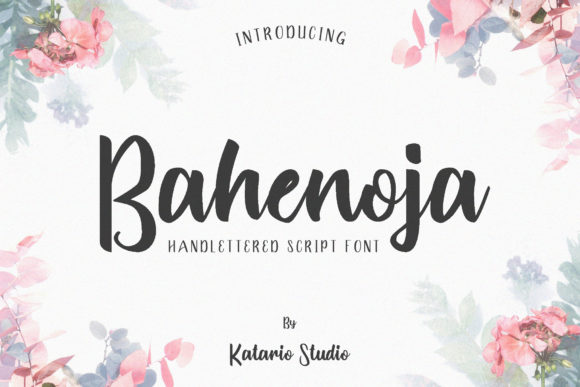
Bahenoja isn’t “quirky” or overly decorative. It’s legible at small sizes, balanced in weight distribution, and carefully spaced to avoid visual clutter—qualities often missing in hastily digitized script fonts. Its lowercase ‘a’, ‘g’, and ‘y’ carry subtle variation without sacrificing consistency; its capitals sit comfortably alongside lowercase text rather than dominating it. That balance makes Bahenoja work where many handwritten fonts fail: in live environments—on Instagram Stories, Shopify product tags, classroom handouts, or a café’s chalkboard-style menu board.
Why Handwritten Fonts Are No Longer Just for “Craft” Brands
A decade ago, a handwritten typeface signaled “artisanal,” “small-batch,” or “homemade.” Today, it signals something more nuanced: intentionality. Audiences—especially adults aged 20–50—are increasingly skeptical of corporate tone and generic visuals. They respond not to perfection, but to cues of human presence: a slight tilt in letterforms, uneven baseline rhythm, or the gentle taper of a stroke. These aren’t flaws—they’re anchors of relatability.
This shift isn’t about rejecting digital tools—it’s about humanizing them. Marketers no longer need to choose between “professional” (read: sterile) and “friendly” (read: unpolished). Bahenoja bridges that gap. A freelance educator can use it in a workshop slide deck without seeming unserious. A local bakery can apply it to both their Instagram bio and printed loyalty cards—and maintain cohesion across touchpoints. That cross-medium reliability is rare among handwritten fonts.
From Social Feeds to Physical Signage: Where Bahenoja Fits Naturally
Consider how people consume content today: scrolling fast, multitasking, switching devices mid-task. Legibility under constraint matters more than ever. Bahenoja was drawn with that reality in mind. Its x-height is generous. Its counters—the enclosed spaces in letters like ‘o’ or ‘e’—are open enough to remain distinct even at 14px on mobile. And unlike many script fonts, it avoids excessive ligatures or discretionary alternates that break in basic CMS fields or email clients.
That practicality extends offline too. Print designers report success using Bahenoja for event posters where readability from 6 feet matters—and where a rigid sans-serif would feel cold next to hand-painted signage or illustrated graphics. Similarly, educators building printable resources appreciate that Bahenoja renders cleanly on laser printers without ink bleed or stroke collapse, even in lighter weights.
How Bahenoja Supports Real Creative Workflows
Creators don’t just pick fonts—they adopt tools that reduce friction. Bahenoja integrates smoothly into common workflows without requiring special software or licensing gymnastics. It supports Latin-based languages out of the box and includes standard OpenType features like true small caps and proportional figures—meaning numbers align naturally in body copy, not just headings.
For freelancers managing multiple client projects, Bahenoja’s versatility saves time. One license covers web, desktop, and app use—no need to calculate pageviews or install separate webfont kits. Its file size is lean, so embedding it in a portfolio site doesn’t slow load times. And because it pairs well with neutral sans-serifs (think Inter, Manrope, or even system fonts like Segoe UI), designers can build typographic hierarchies quickly—no trial-and-error pairing needed.
Practical Pairings That Actually Work
- For branding systems: Bahenoja headlines + Inter body text creates contrast without tension—warmth up top, clarity below.
- For social media: Use Bahenoja for short quotes or callouts over muted photo backgrounds; its soft edges prevent visual competition with imagery.
- For presentations: Apply it to section headers only—its personality shines without overwhelming data-heavy slides.
- For packaging or labels: Set at 18–24pt with tight tracking for impact, especially on matte or recycled paper stocks where sharp serifs might look harsh.
The Evolution Beyond “Hand-Drawn” Aesthetics
Early digital handwritten fonts often prioritized visual mimicry over function—reproducing shaky lines or ink blots for effect. Today’s expectations are different. Users want handwriting that feels *authentic*, not *imitative*. Bahenoja reflects that evolution: its strokes are confident, not tentative; its spacing is considered, not arbitrary. It doesn’t try to replicate a specific pen or brush—it suggests the ease and rhythm of skilled handwriting, refined for consistent performance.
This reflects broader shifts in design thinking: away from ornamentation for its own sake, toward typography that serves communication first. You’ll see it in updated brand guidelines from companies that once relied solely on custom wordmarks—now opting for flexible, expressive type systems instead. Bahenoja fits squarely in that space: distinctive enough to stand out, disciplined enough to scale.
Realistic Expectations—And What Bahenoja Isn’t
It’s worth naming what Bahenoja doesn’t do—so users can make informed choices. It’s not a display font meant for giant billboards or ultra-thin fashion layouts. It doesn’t include Cyrillic, Arabic, or Devanagari character sets—so global multilingual brands will need supplemental typefaces. And while it handles light emphasis well (via weight contrast), it’s not built for heavy typographic hierarchy—like complex legal disclaimers or dense technical documentation.
That’s not a limitation—it’s focus. Bahenoja excels where human voice matters most: invitations, testimonials, mission statements, course titles, community announcements. In those contexts, its quiet confidence builds trust faster than a perfectly aligned but emotionally neutral alternative.
Choosing Type in an Age of Attention Scarcity
We’re not selecting fonts to fill space—we’re selecting them to hold attention, convey values, and support understanding. Bahenoja does that by honoring two simultaneous truths: people crave efficiency (fast loading, easy implementation, broad compatibility), and they also crave resonance (tone, warmth, individuality).
That duality is why Bahenoja resonates with educators designing inclusive learning materials, entrepreneurs launching service-based businesses, and marketers building community—not campaigns—and why it’s appearing in thoughtful places: a nonprofit’s annual report cover, a therapist’s website hero section, a podcast’s episode title cards. It doesn’t shout. It invites.
If you’ve hesitated to use handwritten type before—worried it might seem unserious, inconsistent, or hard to manage—you’re not alone. But Bahenoja redefines what handwritten can mean in professional practice: grounded, adaptable, and quietly confident. It doesn’t ask you to compromise clarity for character—or vice versa.
Try setting a short sentence in Bahenoja beside your current go-to heading font. Notice where your eye rests first. Notice whether the tone shifts—not toward informality, but toward approachability. That’s not accidental. It’s by design.