Cathea: A Bold Curvy Script Font
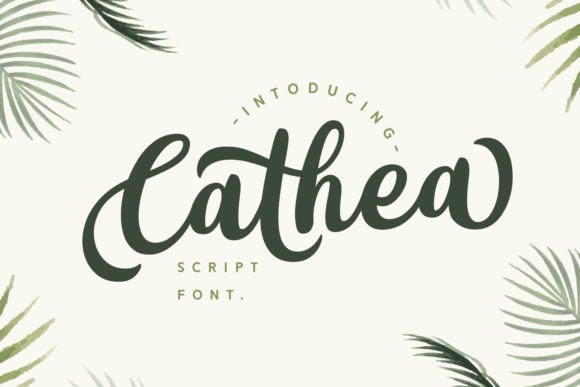
There’s a quiet confidence in Cathea — not loud, but unmistakable. It’s a bold curvy script font with generous letterforms, lively rhythm, and subtle bounce in its baseline. Unlike many scripts that prioritize flourish over function, Cathea balances personality with clarity. Its lowercase ‘a’, ‘g’, and ‘y’ have open counters; its capitals stand tall without stiffness; and its consistent stroke weight holds up beautifully at both small sizes (like captions or labels) and large ones (think signage or hero headers). That rare combination — friendly appearance, strong presence, and real-world legibility — makes Cathea more than just decorative. It’s a tool for expression that works.
Why Designers Reach for Cathea First
When you need warmth without softness, energy without chaos, or personality without pretense, Cathea fits. Its curves are intentional, not arbitrary — each one supports readability while inviting the eye to linger. Designers use it for brand identities where approachability matters: bakeries, wellness studios, handmade goods, indie publishers, and creative agencies. But it’s also showing up in unexpected places: slide decks for educators explaining complex topics, newsletter headers for freelance writers, and even UI elements in apps targeting empathetic, values-driven users.
What sets Cathea apart isn’t just how it looks — it’s how it behaves. It pairs cleanly with neutral sans-serifs like Inter, Poppins, or Lato. No awkward contrast in x-height or tone. And because its spacing is well-considered out of the box, it rarely needs heavy manual kerning for common word combinations. That saves time — especially when iterating fast across mockups, social posts, or email templates.
Real Projects, Real Results
A small pottery studio in Portland used Cathea for their new logo and product tags. They paired it with a light gray geometric sans for body text. The result? Warmth on the shelf, clarity online, and instant recognition at local markets. Their Instagram Stories — using Cathea for short quotes over clay textures — saw a 22% increase in saves and shares over three months.
A freelance educator building an online course on mindful communication chose Cathea for section headers and worksheet titles. She kept all body copy in a highly readable serif (Crimson Text), but let Cathea carry emotional tone — “Pause,” “Listen Deeply,” “Try This Today.” Students reported the material felt more inviting and less clinical, without sacrificing structure.
A children’s book illustrator used Cathea for character speech bubbles in a self-published picture book. Not for every line — just key moments where voice mattered most. Parents told her the font helped kids distinguish dialogue from narration, especially for early readers who rely on visual cues.
How to Use Cathea Thoughtfully
Like any expressive typeface, Cathea shines brightest when guided by intention — not impulse. Here’s how to keep your work clear and audience-friendly:
- Limit scope: Use Cathea for headlines, logos, pull quotes, or short calls-to-action — not long paragraphs or data tables.
- Respect contrast: Pair it with a clean, low-contrast sans-serif or a sturdy serif. Avoid other scripts or overly decorative fonts nearby — they’ll compete, not complement.
- Test at scale: Try it at 16px on mobile, 36px on desktop banners, and 72pt on printed posters. If it reads comfortably across all three, you’ve got a solid foundation.
- Check color contrast: Its bold weight means it often works well on lighter backgrounds, but avoid thin light-on-dark combos unless you’re using a heavier weight variant.
Ideas Across Roles and Platforms
For marketers: Use Cathea in email subject lines (where preview text supports meaning) or as dynamic text in animated social ads. Its rhythm draws attention without shouting — ideal for nurturing campaigns focused on trust and connection.
For bloggers and content creators: Apply it selectively — a custom “quote card” template for Pinterest, chapter dividers in long-form newsletters, or signature section headers in Substack posts. Consistency here builds visual recognition over time.
For educators and trainers: Try Cathea for workshop handout titles, learning objective headers, or reflection prompts on worksheets. Its friendliness lowers perceived barriers — helpful when introducing new concepts or sensitive topics.
For small business owners: Print it on simple packaging (sticker labels, thank-you cards, menu boards) or embed it thoughtfully in Canva templates for recurring social posts. One local florist replaced generic script fonts with Cathea across all touchpoints — customers began commenting on how “real” and “human” the branding felt.
Keeping It Original (Without Overcomplicating)
You don’t need custom ligatures or alternate glyphs to make Cathea feel fresh. Small, smart choices do more: adjust letter-spacing slightly tighter for impact in headlines; use it only in one color (not gradients or outlines) to maintain focus; or combine it with hand-drawn icons or subtle texture overlays — not as decoration, but as reinforcement of tone.
One designer working with a nonprofit reimagined Cathea as part of a “voice-first” identity system. Instead of changing the font itself, she built a set of reusable phrase templates (“We believe…”, “Here’s how you can help”, “Meet the team”) — all set in Cathea, always in the same size and weight, always with the same left margin alignment. That repetition created cohesion across dozens of volunteers’ social posts, donor emails, and event flyers — no design skills required.
Final Thought: Type With Purpose
Cathea doesn’t ask you to be louder or trendier. It asks you to be clearer about what you want people to feel — and then gives you a reliable way to express it. Whether you’re launching a side project, redesigning a client’s website, or simply choosing a font for your next presentation, start by asking: What emotion or idea should this text carry? If the answer is warmth, confidence, or gentle energy — and you need it to remain legible, adaptable, and human — Cathea is worth your attention. Not as a shortcut, but as a thoughtful choice.