Goldbery: The Vintage Script Font That Elevates Craft, Branding, and Personal Expression
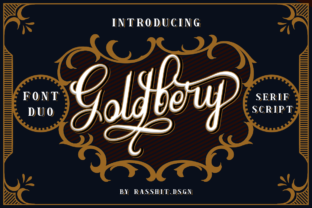
Goldbery isn’t just another script font—it’s a quiet statement of refinement. With its graceful, high-contrast letterforms, subtle flourishes, and balanced rhythm, Goldbery carries the warmth of hand-lettered elegance from the early 20th century—but rendered with modern precision. It’s not overly ornate, nor is it minimalist; instead, Goldbery sits in that sweet spot where vintage charm meets clean legibility. Whether you’re designing wedding stationery at home or refining a boutique brand identity, Goldbery offers a tactile sense of luxury without shouting for attention.
Where Goldbery Fits Naturally—Not Just as Decoration
Fonts live through use—and Goldbery thrives where intention and emotion matter most. Think beyond “pretty text.” Consider these everyday moments where Goldbery quietly transforms the ordinary:
- Wedding invitations and vow books: Couples choosing Goldbery for their names or ceremony quotes often tell us it feels “like something passed down”—not trendy, but timeless. Its soft terminals and gentle slant evoke handwritten love letters, yet it scales beautifully on foil-stamped paper or digital RSVP cards.
- Small-batch product labels: Artisanal soap makers, small-roast coffee roasters, and handmade candle brands use Goldbery for ingredient lists or origin stories—not as a headline, but as a whisper of care. One lavender-scented candle label used Goldbery for “Hand-poured in Portland” beneath a serif body font, and customers repeatedly mentioned how “the text felt like part of the experience.”
- Personalized gifts: Engraved wooden cutting boards, leather-bound journals, or ceramic mugs gain quiet sophistication when Goldbery is laser-etched or stamped. Its even weight distribution ensures crisp results even at smaller sizes (down to 14pt), unlike many delicate scripts that blur or lose definition.
- Local business signage (interior only):strong> A neighborhood bakery might pair Goldbery with a warm sans-serif for its chalkboard menu header—“Today’s Special” in Goldbery, then daily items in Montserrat. It adds personality without sacrificing readability, especially under ambient lighting.
Who Benefits Most—and How Their Needs Shape Usage
Goldbery doesn’t serve every user the same way—and that’s by design. Here’s how different creators lean into its strengths:
Crafters & DIY Enthusiasts
If you cut vinyl decals, layer resin charms, or stamp greeting cards, Goldbery works reliably across cutting machines (Cricut, Silhouette) and print-on-demand platforms. Its consistent stroke width prevents “ghost cuts” or thin-line breakage during intricate weeding. Bonus: it pairs intuitively with neutral palettes—think cream cardstock, charcoal ink, or matte gold foil—so you spend less time adjusting contrast and more time creating.
Independent Designers & Brand Consultants
When working with local studios, wellness practitioners, or heritage-inspired retailers, Goldbery becomes a subtle storytelling tool. One designer used it exclusively for client monograms within a larger branding system—never for body copy, never for navigation—but always for the “signature moment”: embossed business cards, the closing line of a welcome email, or the footer of a service page. Clients reported feeling “recognized, not branded.”
Photographers & Content Creators
For photographers building mood-driven galleries or Instagram story templates, Goldbery overlays beautifully on textured backgrounds—linen, watercolor paper scans, or softly blurred bokeh. Its open counters (the enclosed spaces inside letters like ‘e’ or ‘a’) hold up well over busy imagery, unlike tightly spaced scripts that visually collapse. Try it at 24–36pt with 85% opacity over a sunlit portrait—it reads as intentional, not intrusive.
What to Keep in Mind Before You Use Goldbery
Like any thoughtful tool, Goldbery shines brightest when matched to the right context. A few grounded considerations help avoid missteps:
- It’s not built for long-form reading. Goldbery excels in short bursts—names, titles, quotes, labels. Avoid using it for paragraphs, blog intros, or pricing tables. Your audience will appreciate the clarity of pairing it with a friendly, highly readable companion font (like Lora, Cormorant Garamond, or even Inter for digital interfaces).
- Web performance matters. Goldbery is available in variable and static webfont formats—but if you’re embedding it on a small business site, stick to the WOFF2 version and limit it to two weights (Regular and Bold). Loading multiple stylistic sets slows down perceived performance, especially on mobile.
- License scope affects real-world use. The desktop license covers personal craft projects and client work where you retain full creative control (e.g., designing a logo for a friend’s pottery studio). But if you’re building a Shopify theme or SaaS dashboard where Goldbery appears dynamically in user-generated content, you’ll need an extended or custom license. Always check the vendor’s terms—not just the price tag.
- Contrast is your co-pilot. Goldbery’s elegance relies on contrast—both typographic (pairing it with a sturdy sans or slab) and visual (light text on dark backgrounds, or vice versa). Avoid mid-tone greys or low-saturation pastels unless you test print/digital output first. What looks soft on screen can read as muddy on matte paper.
Why It Stands Out Among Script Fonts
In a landscape crowded with exaggerated swashes and dramatic ligatures, Goldbery’s restraint is its strength. It doesn’t demand attention—it invites closeness. Unlike scripts that prioritize flair over function, Goldbery maintains strong x-height proportions and generous spacing, so letters breathe rather than crowd. That means fewer kerning adjustments, fewer “uh-oh” moments when scaling down for social avatars or embroidery digitizing.
And while many vintage-inspired fonts skew either too formal (think engraved diplomas) or too casual (think café chalkboard scrawls), Goldbery walks the middle path with confidence. It feels appropriate whether you’re naming a slow-fashion clothing line or labeling heirloom tomato seeds—because it speaks to care, continuity, and quiet confidence.
Getting Started—Without Overcomplicating It
You don’t need a design degree or expensive software to bring Goldbery into your work. Start simple:
- Download a trial or purchase directly from a reputable foundry (avoid free “Goldbery-style” knockoffs—they lack language support, hinting, and proper spacing).
- Type out a phrase you love—a family motto, a shop name, a favorite line of poetry—and set it in Goldbery at 36pt on plain white paper. Print it. Hold it in natural light. Does it feel like *you*?
- Try one practical application this week: engrave it on a gift tag, add it to a Canva invitation template, or use it in a single Instagram highlight cover. Notice how it changes the tone—not the message, but the feeling behind it.
Goldbery won’t solve every design challenge—but when the goal is warmth, legacy, or understated distinction, it often says exactly what words alone cannot.