Sidenotez: The Casual Script Font That Fits Modern Branding Like a Well-Worn Jacket
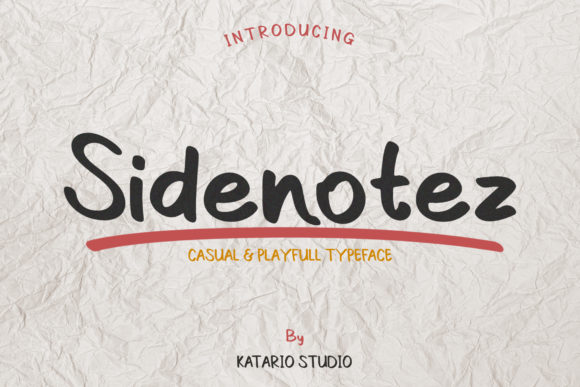
Typography isn’t just about legibility—it’s about tone, trust, and texture. In a digital landscape saturated with geometric sans-serifs and minimalist monotones, Sidenotez arrives not as a rebellion, but as a quiet, confident recalibration. It’s a casual script font—fluid, approachable, and intentionally imperfect—with rhythm in its curves and warmth in its contrast. Designed for real use, not just display, Sidenotez thrives where personality matters most: logos that feel human, quotes that land with sincerity, brand assets that breathe instead of broadcast.
Why a Casual Script Font Makes Strategic Sense—Right Now
Consumer attention hasn’t just shortened—it’s become more selective. People scroll past polished, corporate-feeling visuals without hesitation. What stops them? Authenticity cues. A handwritten note on a coffee sleeve. A chalkboard menu with slight variations in letter weight. A logo that looks like it was drawn by someone who knows the brand’s voice—not just its mission statement. That’s where Sidenotez fits: not as a novelty, but as a functional tool for signaling approachability without sacrificing polish.
This aligns with observable shifts—not just in design trends, but in behavior. Small business owners increasingly handle their own branding, often starting with tools like Canva or Figma. Educators create classroom posters that need to feel inviting, not institutional. Freelancers pitch services with visual identity kits that must communicate both competence and relatability. In each case, a rigid, ultra-structured typeface can unintentionally widen the emotional gap between creator and audience. Sidenotez closes it—subtly, consistently, and without gimmick.
More Than “Handwritten”: The Craft Behind the Casual Feel
Sidenotez isn’t mimicking handwriting—it’s interpreting its logic. Its lowercase a and g carry gentle terminals, not sharp flicks. Its connecting strokes vary in thickness, echoing natural pen pressure. Uppercase letters retain presence without dominance; they don’t shout, but hold space with quiet confidence. And crucially, it’s carefully kerned and spaced for screen readability—even at smaller sizes in mobile interfaces or social thumbnails.
This balance—casual yet controlled—is what separates Sidenotez from fonts that lean too far into “rough sketch” territory (hard to scale or pair) or overly formal scripts (which lose their warmth in digital contexts). It works because it’s designed for application, not just admiration. You’ll find it used effectively in podcast cover art where intimacy matters, on product packaging for artisanal goods, and even in email headers for newsletters aiming to feel like a note from a trusted colleague—not a marketing blast.
Where Sidenotez Fits Naturally—And Where It Doesn’t
Like any strong typographic choice, Sidenotez gains power through context and contrast. It shines when paired with a clean, neutral sans-serif—think Inter, Lato, or even system fonts like San Francisco or Segoe UI. That pairing creates visual hierarchy without tension: the script carries voice, the sans carries structure.
- Logos: Especially for service-based businesses—coaches, therapists, boutique studios, local cafes—where warmth and individuality are part of the value proposition.
- Quotes & Social Snippets: Pull quotes in blog posts, Instagram carousels, or presentation slides benefit from Sidenotez’s expressive flow. It guides the eye and adds emotional resonance without demanding attention.
- Branding Collateral: Letterheads, thank-you cards, limited-edition packaging, or workshop handouts—all gain tactile appeal when Sidenotez appears alongside thoughtful layout and restrained color use.
- Educational Materials: Teachers use it for bulletin board titles or reading challenge trackers—not for body text, but to signal encouragement, creativity, or personal connection.
It’s less effective—and potentially distracting—in dense UI elements, legal disclaimers, data tables, or multilingual environments requiring extensive character sets. Sidenotez is purpose-built, not universal. That’s a strength, not a limitation.
Evolving Expectations, Evolving Tools
Fifteen years ago, using a script font professionally often meant licensing expensive desktop fonts, managing file compatibility, or relying on web font services with limited support. Today, variable font formats, improved browser rendering, and cloud-based design platforms have lowered the barrier—not just to access, but to *intelligent usage*. Designers and non-designers alike can now preview, test, and deploy Sidenotez across devices with greater confidence.
That accessibility has also shifted expectations. Audiences no longer assume “casual” means “unprofessional.” They recognize intentionality: choosing Sidenotez signals care—not just about aesthetics, but about how a message lands emotionally. A freelance graphic designer might use it in a brand style guide to reinforce a client’s “thoughtful but unstuffy” positioning. A nonprofit might apply it to campaign headlines to soften urgency without diluting impact.
Practical Tips for Getting Started—Without Overthinking It
You don’t need a full rebrand to begin exploring Sidenotez. Start small, observe response, and iterate:
- Swap one element: Replace the header font on your portfolio homepage or newsletter signup banner. Keep everything else identical—then check bounce rates, time-on-page, or even informal feedback (“Did this feel different to you?”).
- Test contrast deliberately: Use Sidenotez for a short headline (e.g., “Your Ideas, Thoughtfully Shaped”) over body text in a neutral sans-serif. Avoid pairing it with other decorative fonts—let it breathe.
- Respect hierarchy: Never use Sidenotez for long paragraphs or interface labels. Its strength is emphasis, not endurance. Reserve it for moments where you want the reader to pause, connect, or remember.
- Consider weight and size: Sidenotez includes multiple weights. Lighter versions work beautifully in print or high-res displays; medium weights hold up better on mobile screens or projected slides.
And if you’re evaluating fonts for a new project, ask not “Does this look nice?” but “Does this make the message easier to receive?” Sidenotez earns its place when the answer is yes—especially in spaces where people crave clarity wrapped in kindness.
Not Just a Font—A Subtle Shift in How We Present Ourselves
In an era where AI-generated content floods feeds and templated designs dominate dashboards, intentional human touches matter more—not as decoration, but as differentiation. Sidenotez doesn’t replace strategy or substance. It supports them. It’s the visual equivalent of making eye contact during a video call, pausing before answering a tough question, or signing a thank-you note by hand.
Its relevance grows not because script fonts are trending, but because our relationship with digital communication is maturing. We’re learning that efficiency and empathy aren’t opposites—they’re interdependent. A well-chosen casual script font like Sidenotez helps bridge that space: professional enough to be taken seriously, warm enough to be trusted.
For creators launching their first course, for marketers refining a brand voice, for educators building inclusive classrooms—Sidenotez offers a low-risk, high-resonance way to say, “I’m here, I’m human, and what I offer is worth your attention.” That’s not nostalgia. It’s nuance. And in today’s landscape, nuance is quietly becoming essential.