Marxellina: A Typeface That Balances Elegance, Charm, and Command
Marxellina is a contemporary serif typeface designed with deliberate attention to contrast, rhythm, and expressive nuance. It belongs to the transitional serif category—sitting between the high-contrast, sharp geometry of modern serifs and the softer, more organic forms of old-style fonts—but it carves out its own identity through refined proportions and subtle idiosyncrasies. Its letterforms combine crisp vertical stress with gently flared serifs, modest bracketing, and a warmth that avoids austerity without sacrificing clarity. What makes Marxellina stand out isn’t just visual polish—it’s how consistently it sustains presence across sizes and contexts, from delicate captions to commanding headlines.
What Sets Marxellina Apart
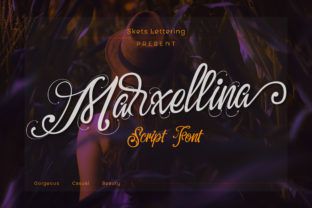
At first glance, Marxellina looks elegant, charming, beautiful and formidable—not as separate qualities, but as interwoven traits. Its elegance emerges in the graceful curvature of the lowercase a, e, and s; its charm lies in small humanist touches, like the slightly asymmetrical bowl of the g or the tapered terminal on the f. Beauty here is functional: generous x-height and open apertures support legibility at smaller sizes, while its formidable quality comes from strong verticals, confident stroke modulation, and a sense of structural confidence that holds up in demanding layouts.
Unlike many transitional serifs optimized for narrow text columns or digital interfaces alone, Marxellina was developed with cross-medium versatility in mind. Its optical sizing variants—Text, Display, and Caption—aren’t afterthoughts; they reflect intentional design decisions about ink spread, screen rendering, and reading distance. The Display cut emphasizes fine detail and contrast for large-scale use, while the Text version subtly rounds terminals and widens spacing to improve flow in dense paragraphs.
How Marxellina Fits Within Broader Typographic Contexts
When evaluating typefaces for editorial, branding, or long-form digital content, designers often weigh readability against distinctiveness. Marxellina occupies a middle ground where neither trait overshadows the other. Compared to highly engineered workhorses like Charter or Utopia, Marxellina offers more personality—its italics, for instance, are true cursive interpretations rather than slanted romans, with flowing entry and exit strokes that feel hand-informed. Against more decorative transitional options (think Mrs Eaves or Canela), Marxellina maintains tighter spacing control and greater neutrality in tone, making it less likely to distract in extended reading.
It also diverges meaningfully from contemporary reinterpretations of Didone serifs. Where those often push contrast to dramatic extremes—thin hairlines next to thick stems—Marxellina moderates that contrast just enough to preserve texture without compromising robustness. This makes it more adaptable for mixed-media projects: a magazine might use Marxellina Display for section headers, Marxellina Text for body copy, and its Caption variant for photo credits—all while sustaining visual cohesion.
Strengths in Practice
- Consistent voice across weights and widths: Its regular, medium, semibold, and bold weights share the same underlying skeleton, so switching between them doesn’t disrupt rhythm or hierarchy.
- Thoughtful language support: Includes full Latin-1 and Latin-Extended-A coverage, plus carefully drawn diacritics that maintain proportion and spacing integrity—even in stacked accents.
- Responsive behavior on screen: Hinting and variable axis tuning ensure clean rendering down to 14px on standard resolution displays, and the variable font version allows fine-grained control over weight and width without loading multiple files.
Tradeoffs and Considerations
No typeface excels universally—and Marxellina is no exception. Its strengths lie in measured expression, not maximal impact. For applications requiring high-energy immediacy (e.g., event posters, social media banners, or experimental UI), its restrained demeanor may feel too composed. Similarly, while its italics are richly detailed, they’re not intended for heavy emphasis within running text; overuse can slow reading pace. In ultra-narrow columns or tight mobile interfaces, its moderate x-height and serif length may require slight tracking adjustments to avoid crowding.
Another practical consideration is licensing scope. Marxellina is available in both desktop and web font formats, but its web implementation benefits most from self-hosting or a trusted CDN with proper subsetting—especially for multilingual sites. Default webfont services sometimes serve unoptimized subsets, which can mute some of its finer distinctions, like alternate numerals or discretionary ligatures.
Where Marxellina Shines—and Where It Might Not Be the Best Fit
Marxellina performs especially well in environments where tone matters as much as function: literary journals, cultural institution identities, academic publishing, and premium editorial websites. A university press using Marxellina for book covers and chapter headings gains gravitas without coldness; a boutique design studio applying it to client reports conveys precision and care without rigidity.
Real-world examples illustrate this fit. One independent publisher switched from a generic Garamond derivative to Marxellina for their quarterly review and reported improved reader engagement metrics—particularly in longer essays—attributed to reduced visual fatigue and stronger typographic hierarchy. Another brand used Marxellina Display alongside a neutral sans-serif for product packaging: the serif provided warmth and distinction on shelf, while the sans handled technical specs cleanly.
Conversely, Marxellina may be less optimal when speed or stark contrast dominates the priority list. For fast-paced news sites needing maximum scannability, a more open, monolinear serif—or even a well-tuned sans—might serve better. Likewise, if your project relies heavily on expressive display typography (e.g., hand-lettered quotes, kinetic animations), Marxellina’s grounded structure could feel limiting next to more fluid script or geometric alternatives.
Making an Informed Choice
Choosing a typeface involves weighing aesthetics, performance, compatibility, and long-term maintainability—not just initial impression. Marxellina rewards close evaluation: test it in your actual content, not just specimen pages. Try it in real paragraph lengths, at expected sizes, and across devices. Compare how it behaves beside supporting fonts—does its italic complement your chosen sans? Does its bold hold weight in headings without overwhelming body text?
Also consider workflow integration. If you rely on design systems with strict token-based typography scales, verify whether Marxellina’s optical sizing aligns with your breakpoints. If you use variable fonts extensively, explore how its weight and width axes interact with your responsive rules—not all variable implementations expose the same level of control.
Finally, reflect on longevity. Marxellina avoids trend-driven quirks—no exaggerated ink traps, forced irregularity, or artificial distressing. Its design logic is rooted in enduring principles of proportion and contrast. That doesn’t guarantee it will feel “timeless” to every viewer, but it does suggest resilience across evolving platforms and audience expectations.
In summary, Marxellina is worth serious consideration when you need a serif that communicates thoughtfulness without pretension, authority without severity, and beauty that serves function first. It won’t solve every typographic challenge—but for readers, writers, editors, and designers who value coherence, nuance, and quiet confidence in their tools, Marxellina offers a rare balance: elegant, charming, beautiful and formidable, all at once.