Myristica: A Purpose-Built Rough Script Font for Authentic Visual Identity
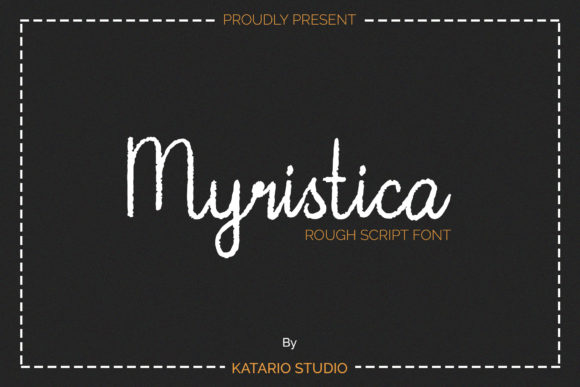
Myristica stands out not because it’s trendy or technically complex, but because it fulfills a specific, recurring need in visual communication: the desire for warmth, humanity, and tactile authenticity—without sacrificing legibility or professional polish. It’s a rough script font designed with intention, not just texture. Unlike many decorative scripts that prioritize flourish over function, Myristica balances expressive character with structural clarity, making it a reliable tool rather than a one-off stylistic flourish.
What Makes Myristica Distinctive—Beyond the “Rough” Label
The term “rough” is often misapplied to fonts with uneven edges or inconsistent stroke weight—but Myristica’s roughness is deliberate and controlled. Its letterforms feature subtle irregularities in baseline alignment, slight variations in stroke thickness, and organic terminals that mimic hand-drawn ink on textured paper. These details aren’t random; they’re calibrated to avoid visual noise while reinforcing a sense of craft. You’ll notice how lowercase a, g, and y retain open counters and generous spacing, preventing crowding at smaller sizes—a common pitfall in script fonts intended for display use only.
Myristica includes standard OpenType features like ligatures and contextual alternates, which activate automatically in compatible software (e.g., Adobe Illustrator, Affinity Designer, or modern web browsers via variable font support). These features prevent awkward letter collisions—especially in words like “flow,” “script,” or “wedding”—and add natural rhythm without manual intervention. That level of typographic intelligence elevates Myristica beyond a static decorative asset into a responsive design element.
Where Myristica Delivers Real-World Value
Professionals consistently reach for Myristica in contexts where tone and trust matter as much as aesthetics:
- Branding for small businesses and creative studios: A local ceramics studio, independent bookstore, or wellness practice can use Myristica for logotypes to signal approachability and artisanal care—without appearing unpolished. Its restrained energy avoids the dated “handwritten” clichés that undermine credibility in competitive markets.
- Wedding stationery: When paired with a clean serif or sans-serif for body text, Myristica adds personality to names and headings without overwhelming delicate layouts. It scales well from digital save-the-dates to letterpress-printed menus, retaining its integrity across substrates and output methods.
- Posters and event graphics: Its strong x-height and open forms ensure readability even at a distance or in lower-resolution environments (e.g., social media banners or printed flyers in transit hubs). Designers report fewer revisions when using Myristica for headline hierarchy—its voice is distinct but never disruptive.
- Digital interfaces with personality: While not suited for UI body copy, Myristica works effectively in hero sections, email headers, or branded micro-interactions where a human touch reinforces brand voice—think a newsletter subject line or an onboarding illustration caption.
Performance Across Mediums and Workflows
Myristica performs reliably in both print and digital environments. In print, its rough texture translates authentically to uncoated papers and letterpress, gaining depth rather than losing definition. On screen, hinting and optimized outlines maintain crisp rendering down to 24px in most browsers—though below 18px, some detail softens, as expected with any expressive script. For web use, it’s best deployed via @font-face with fallback strategies (e.g., font-display: swap) to balance performance and aesthetic fidelity.
From a workflow perspective, Myristica integrates smoothly into vector-based design tools. Its consistent metrics mean scaling, kerning adjustments, and alignment remain predictable—unlike some script fonts that shift dramatically in proportion or spacing when resized. Designers using Figma or Sketch appreciate its stable bounding box behavior, reducing time spent repositioning elements across artboards.
Who Benefits Most—and When to Pause
Myristica serves creators who value intentionality over ornamentation: freelancers building brand identities for clients who emphasize craftsmanship; educators designing workshop materials that feel inviting, not institutional; bloggers curating newsletters where voice matters more than uniformity; and small business owners crafting packaging that communicates values before a single word is read.
It’s less suitable for applications demanding neutrality or high-speed scanning—legal disclaimers, data dashboards, technical documentation, or multilingual interfaces with complex scripts. Its character set covers Latin-based languages (including extended diacritics for French, Spanish, German, and Scandinavian languages), but lacks Cyrillic, Greek, or Asian language support. Users working globally should verify coverage for their target audience before committing to Myristica as a primary branding font.
Also worth noting: Myristica’s strength lies in contrast. It shines when paired—not isolated. Using it alone for full paragraphs or long headlines risks visual fatigue. Successful implementations almost always pair it with a grounded, highly legible companion: a warm neutral sans-serif like Inter or Lato for UI and body text, or a refined serif like Merriweather or Crimson Text for editorial layouts. This pairing strategy extends Myristica’s versatility far beyond what its standalone appearance might suggest.
Practical Considerations for Long-Term Use
Licensing is straightforward: Myristica is available under standard desktop, web, and app licenses, with clear terms around usage volume and redistribution rights. There are no hidden fees for commercial projects, and updates are provided free of charge for licensed users—a practical advantage for teams maintaining evolving brand systems over time.
In terms of longevity, Myristica avoids fleeting stylistic trends. Its roughness nods to analog tradition without mimicking vintage artifacts, and its proportions align with contemporary typographic standards. Designers revisiting projects after 12–18 months consistently find Myristica still feels current—not nostalgic, not dated, but quietly confident in its role.
One limitation worth acknowledging: Myristica doesn’t include true small caps, stylistic sets beyond basic alternates, or extensive figure options (tabular vs. proportional numerals). If your project requires granular typographic control—say, financial reports or academic citations—you’ll need to supplement with a secondary typeface. But for its intended scope—logos, invitations, posters, and expressive branding—it delivers focused, dependable utility.
Making the Call: Does Myristica Fit Your Next Project?
If your goal is to communicate sincerity, care, or individuality—not just decoration—Myristica earns consideration early in the type selection process. It’s not a default choice, nor is it meant to be. Instead, it’s a considered response to questions like: “How do we make this feel human, not automated?” or “What typeface supports our values without explaining them?”
Try it in context before deciding. Set a headline in Myristica alongside your existing brand colors and imagery. Print it at actual size. View it on a mobile screen. Ask a colleague unfamiliar with the project what tone it conveys. More often than not, users report that Myristica lands with quiet confidence—not shouting, but holding space for meaning.
Ultimately, Myristica succeeds because it respects both the designer’s intent and the viewer’s perception. It doesn’t ask you to work around its limitations; it invites you to work within its thoughtful boundaries. And in an era where authenticity is increasingly hard to simulate, that kind of reliability isn’t just useful—it’s essential.