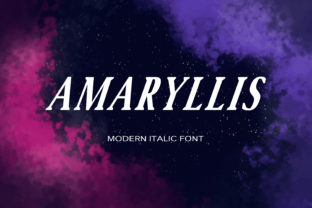
Amaryllis: Timeless Serif Confidence
There’s a quiet authority in Amaryllis — not loud, not flashy, but unmistakably present. It’s the kind of serif font that feels both familiar and distinctive: crisp enough for clarity, warm enough for character. If you’ve ever seen elegant book covers, refined stationery, or boutique packaging where the type seems to hold its ground without shouting, there’s a good chance Amaryllis was behind it.
What Makes Amaryllis Stand Out Visually
Amaryllis is a premium serif font with strong calligraphic roots — subtle stroke contrast, graceful bracketed serifs, and a rhythm that guides the eye naturally across lines of text. Its letterforms balance tradition and modernity: the uppercase A has a confident apex, the lowercase g features a looping double-story form, and the italics aren’t just slanted — they’re thoughtfully drawn with fluid, expressive curves. Unlike some high-contrast serifs that can feel fragile at small sizes, Amaryllis maintains legibility from 12pt body copy up to bold display headlines.
Its personality sits comfortably between classic and contemporary — think editorial design meets small business branding. It doesn’t try to be everything; instead, it delivers consistency, polish, and a gentle sense of intention. That’s why designers reach for Amaryllis when they want typography that supports voice rather than competes with it.
Where Amaryllis Fits Best (and Where It Doesn’t)
Amaryllis shines in contexts where tone, trust, and craftsmanship matter. It’s frequently used in logo design for artisanal brands — bakeries, ceramic studios, independent publishers — where warmth and authenticity are part of the brand identity. In packaging design, it adds quiet sophistication to apothecary labels, wine bottles, or handmade soap wraps without overwhelming the product itself.
You’ll also find it anchoring editorial design projects: magazine mastheads, chapter openers, pull quotes, and even short-form web copy on portfolio sites or creative agency landing pages. Its readability holds up well in print and on screen — especially in medium-weight styles at 16–18px for body text on light backgrounds.
That said, Amaryllis isn’t built for dense UI interfaces, data dashboards, or fast-scrolling social media feeds where immediate scannability is critical. It’s not a sans serif font optimized for microcopy or a script font meant for decorative flourishes alone. It works best as a primary display font or carefully curated body face — never as filler.
How It Shapes Perception and Engagement
Typeface choice quietly influences how people interpret your message before they read a single word. Amaryllis signals care: attention to detail, respect for craft, and confidence in the subject. When used consistently across a brand identity, it reinforces recognition — not through repetition alone, but through tonal alignment. A wellness coach using Amaryllis in their newsletter, workshop handouts, and Instagram graphics feels cohesive because the font carries the same grounded, nurturing energy in each context.
In publishing, Amaryllis improves visual hierarchy by giving headings presence without dominance. Pair its Bold weight with a clean, neutral sans serif for subheads or captions, and the contrast does the work for you — no extra styling needed. Readers don’t pause to decode the type; they settle into the content. That’s real engagement — earned through clarity, not decoration.
Practical Tips Before You Use It
Start by checking what styles are included. Most Amaryllis licenses offer Regular, Italic, Bold, and Bold Italic — enough for basic typographic structure. Some versions include Light or Extra Bold variants, which expand flexibility for layered layouts or responsive web use. Always verify whether your license covers web design, social media graphics, or embedded PDFs — commercial fonts vary widely here.
Test early and often. Drop Amaryllis into your actual layout — not just a mockup. Try it at intended sizes on the devices your audience uses. Does the Regular weight hold up in a mobile email? Does the Bold feel balanced next to your logo? Print a sample page if it’s for physical materials. Small details like ink spread on uncoated paper can soften contrast in ways screens won’t show.
Pairing matters. Amaryllis pairs well with humanist sans serifs like Lato, Poppins, or Work Sans — fonts with similar x-heights and open counters. Avoid overly geometric or monoline sans serifs (think Helvetica Neue or Montserrat) unless you’re aiming for deliberate tension. For contrast, try a restrained handwritten font — not for body text, but for short accents like “hand-poured” or “locally sourced.” Keep it minimal: one accent font, used sparingly.
Real-World Observations From Design Practice
A local bookstore rebranded using Amaryllis for their logo and event posters. Within three months, customers began commenting on how “inviting” the signage felt — not because of color or layout alone, but because the type softened the space while still feeling authoritative. Another example: a freelance editor switched her website’s headline font from a generic serif to Amaryllis. Her inquiry rate didn’t spike overnight, but client feedback shifted — phrases like “you seem experienced” and “this feels professional” appeared more often in discovery calls.
These aren’t magic outcomes. They’re the result of aligning design assets with intent. Amaryllis doesn’t replace strategy, but it does make execution feel intentional — and that builds credibility faster than most people realize.
Final Thought: Choose With Purpose
Amaryllis isn’t about trend-chasing. It’s about choosing a typeface that reflects how you want your work to be received — thoughtfully, respectfully, and with quiet confidence. Whether you’re designing a wedding invitation, launching a blog, refining your Shopify store, or laying out a zine, ask yourself: does this font serve the message, or distract from it? With Amaryllis, the answer is usually yes — as long as you give it room to breathe, pair it wisely, and use it where its strengths align with your goals.
If you value craftsmanship over convenience, clarity over clutter, and timelessness over novelty, Amaryllis is worth your attention. Not as a shortcut — but as a thoughtful tool in your creative toolkit.