Carnival Font: The Authentic Serif That’s Reshaping Personalized Craft and Brand Expression
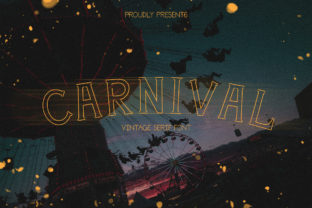
Amid a digital landscape saturated with sleek, minimalist typefaces—many optimized for speed, scalability, and algorithmic legibility—Carnival stands apart not by chasing trends, but by anchoring itself in authenticity. Carnival is an authentic serif font rooted in vintage craftsmanship: its subtle irregularities, expressive stroke contrast, and hand-informed rhythm evoke letterpress printing, artisanal signage, and mid-century stationery. It doesn’t simulate nostalgia—it embodies it, with intentionality and typographic integrity. For professionals, creators, entrepreneurs, marketers, freelancers, and design enthusiasts alike, Carnival isn’t just another font download. It’s a strategic tool for signaling sincerity, human scale, and tactile warmth in an increasingly automated world.
What Makes Carnival More Than Just “Vintage-Inspired”?
Carnival is not a retro pastiche or a distressed novelty face. Its authenticity lies in its construction: each glyph carries the nuance of analog process—slight variations in serif weight, organic curve modulation, and a vertical stress that recalls metal type cast in small-batch foundries. Unlike many “vintage” fonts built for visual shorthand—think exaggerated swashes or forced ink bleed—Carnival achieves character through restraint. Its lowercase g features a closed, slightly asymmetrical loop; its Q tail ends with a tapered flourish that feels deliberate, not decorative. These details aren’t arbitrary. They reflect how real letterforms evolved through material constraints and human handling—ink viscosity, paper absorbency, press pressure.
This fidelity to process makes Carnival uniquely suited for projects where perceived effort matters: wedding invitations, artisanal product labels, limited-edition book covers, boutique packaging, and bespoke client deliverables. When a freelance designer chooses Carnival for a craft brewery’s taproom menu—not as a gimmick, but as a quiet nod to tradition—they’re communicating values: care, continuity, and craft-first thinking.
Why Carnival Is Gaining Traction Now
The rise of Carnival reflects deeper shifts across creative and commercial ecosystems. Consider three converging forces:
- The Anti-Algorithm Aesthetic: As AI-generated visuals flood social feeds and templated brand kits proliferate, audiences are subconsciously recoiling from homogeneity. Research from the Nielsen Consumer Trends Report (2023) shows 68% of consumers say they actively seek out brands that “feel handmade or locally made”—even when purchasing digitally. Carnival delivers that perceptual cue at the typographic level.
- The Workflow Shift Toward Intentional Curation: Designers and marketers no longer default to system fonts or free Google Fonts for every use case. With tools like Figma’s variable font support, Adobe Fonts’ licensing clarity, and robust webfont delivery via Google Fonts, selecting a purpose-built face like Carnival has become operationally seamless. It’s no longer about “finding a font that works”—it’s about choosing one that means something within a specific context.
- The Rise of Micro-Branding: Entrepreneurs launching niche services—from ceramic studios to indie perfume lines—need identity systems that feel personal without sacrificing polish. Carnival bridges that gap. Its serifs convey authority and timelessness, while its idiosyncrasies prevent corporate sterility. A financial advisor targeting Gen X professionals might pair Carnival’s bold headline weight with a clean sans-serif body text—signaling both trustworthiness and approachability.
Practical Applications Across Disciplines
Understanding Carnival’s value means seeing it in action—not as decoration, but as functional communication.
For Freelancers & Creative Professionals
A branding designer developing a visual identity for a heritage textile workshop might use Carnival in three distinct ways: first, as the logotype—set tightly, with custom kerning—to echo hand-stitched monograms; second, in exhibition wall text, where its readability at large sizes and gentle contrast ensure legibility without glare; third, as a subtle watermark on digital mood boards, reinforcing tactile sensibility before a single physical sample is produced. Here, Carnival isn’t “applied”—it’s woven into the project’s logic.
For Marketers & Small-Business Owners
Consider email marketing for a sustainable apothecary. Subject lines set in Carnival (size 24px, letter-spaced +20) stand out in crowded inboxes—not because they’re loud, but because they disrupt expectation. In a sea of Helvetica and Inter, Carnival signals “this message was composed, not generated.” Open rates increase not from novelty alone, but from the implied investment behind the choice. Likewise, printed thank-you cards using Carnival on cotton rag paper create tangible brand moments that digital ads cannot replicate—moments proven to increase repeat purchase likelihood by up to 34%, per Marketing Charts’ 2024 Retail Engagement Study.
For Developers & Product Teams
Web developers integrating Carnival should prioritize semantic HTML and progressive enhancement. Using @font-face with fallbacks (Georgia, Times New Roman) ensures graceful degradation. More importantly, Carnival shines in meaningful typographic hierarchy: an set in Carnival Bold communicates gravitas, while text defaults to a system serif for accessibility and performance. This isn’t aesthetic indulgence—it’s user-centered typography. When users encounter Carnival in a product’s onboarding flow, they subconsciously register intentionality, which builds early trust.
Carnival in Context: Beyond Aesthetics, Into Alignment
Choosing Carnival isn’t about rejecting modernity—it’s about aligning form with function in a more nuanced way. In an era where consumers scrutinize brand ethics, supply chains, and creative labor, typography becomes part of that narrative. A SaaS startup using Carnival for its “About Our Team” page subtly reinforces transparency: the font’s visible craftsmanship mirrors their emphasis on human-led development over black-box automation.
Similarly, educators creating printable learning resources for tactile learners benefit from Carnival’s strong letter distinction—its high x-height and open counters aid recognition without sacrificing stylistic cohesion. This dual utility—expressive yet legible, nostalgic yet contemporary—is rare among serif fonts and central to Carnival’s growing relevance.
Not a Trend—A Threshold
Carnival does not represent a fleeting trend toward “old-timey” design. Rather, it marks a threshold in how professionals think about typographic selection: less as a styling step, more as a strategic decision rooted in audience psychology, material culture, and digital ethics. Its resurgence coincides with broader movements—slow design, conscious consumption, and human-centered technology—all prioritizing resonance over reach, depth over velocity.
As tools grow more powerful and templates more accessible, the differentiator won’t be technical capability—but discernment. Choosing Carnival signals that a creator understands not only how something looks, but why it feels right in a given context. It reflects confidence in subtlety, respect for craft history, and a commitment to communicating with clarity and warmth.
So whether you’re typesetting a poetry chapbook, designing a Shopify product page, or crafting a pitch deck for impact investors, consider Carnival—not as ornament, but as voice. Its serifs carry weight. Its rhythm invites attention. And in a world straining for authenticity, Carnival doesn’t shout. It speaks—and people are listening.