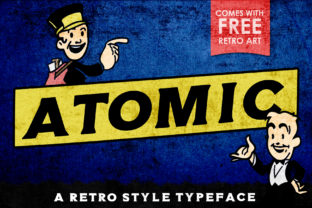
Atomic: A Handcrafted Serif with Retro Soul
If you’ve ever flipped through a 1950s magazine, admired vintage packaging on a shelf, or paused at a hand-lettered café sign—then Atomic will feel instantly familiar, yet refreshingly new. It’s not a revival or a digital reinterpretation. Atomic is a genuinely handcrafted serif font, drawn with intention and care, then meticulously digitized to preserve its warmth, irregularity, and quiet confidence. That slight variation in stroke weight, the gentle flare on terminals, the subtle asymmetry in letterforms—it’s all there by design, not accident. This isn’t a sterile, algorithmically smoothed typeface. It’s human-made typography with texture, rhythm, and personality.
More Than Just “Retro”—It’s Thoughtfully Anchored
Calling Atomic “retro” is accurate—but incomplete. Its charm lies in how it balances nostalgia with modern usability. The uppercase letters carry bold presence, ideal for headlines and logos; lowercase characters flow with relaxed readability, avoiding stiffness without slipping into informality. Numbers have distinct character—especially the slightly tilted ‘6’ and ‘9’, the open-loop ‘4’, and the sturdy, grounded ‘0’. Special characters (including punctuation, symbols, and diacritics) match the same hand-drawn ethos, so your copyright notice or price tag feels cohesive—not tacked on.
This isn’t a script font pretending to be handwritten, nor a sans serif masquerading as vintage. Atomic is confidently, unapologetically a serif—and that matters. Serifs convey authority, tradition, and craft. But Atomic’s serifs aren’t sharp or rigid like Times New Roman’s; they’re soft, tapered, and organic—like ink pressed gently into textured paper. That nuance shifts perception: it feels trustworthy *and* approachable, classic *and* contemporary.
Where Atomic Earns Its Place—Real Projects, Real Results
Atomic shines brightest where voice and visual tone carry equal weight. Think editorial design for independent magazines—its strong caps anchor pull quotes, while its lowercase supports readable body text at 14–16pt in print. In packaging design, it gives small-batch products (think artisanal coffee, handmade ceramics, or small-batch hot sauce) instant credibility and tactile appeal. On a product label, Atomic doesn’t shout—it invites closer looking.
For brand identity work, Atomic functions beautifully as a primary display font paired with a clean, neutral sans serif (like Inter, Poppins, or even a restrained Helvetica Neue) for supporting text. That contrast creates clear visual hierarchy without visual noise. In web design, it works exceptionally well for hero sections, testimonials, or feature headers—especially when set large with generous line height and subtle letter-spacing. And yes, it renders cleanly across modern browsers and devices, though avoid using it below 18px for body copy on screen.
Social media graphics benefit from Atomic’s expressive nature—particularly Instagram carousels or Pinterest pins where a single bold phrase needs to stop scrolling. Bloggers and content creators use it for newsletter headers or featured post titles, adding distinction without sacrificing legibility. Even hobbyists crafting wedding invitations or small-run zines find Atomic elevates their work with sincerity—not polish-for-polish’s-sake, but craft-for-craft’s-sake.
Testing Fit: Practical Checks Before You Commit
Before dropping Atomic into your next project, ask three quiet questions:
- Does the project need warmth over neutrality? If your goal is clinical precision or tech-forward minimalism, Atomic may soften the message too much. It thrives where authenticity, heritage, or craftsmanship are part of the story.
- Is legibility at scale part of the plan? Atomic includes full Latin character sets—uppercase, lowercase, numerals, punctuation, and common accented characters. But test it in your actual layout: paste real copy, not lorem ipsum. See how “W” and “M” hold up side-by-side in headings. Check how “a”, “e”, and “o” breathe in paragraph form at your intended size.
- What’s your pairing strategy? Atomic pairs best with understated sans serifs—not decorative ones. Avoid competing scripts or high-contrast fonts that clash with its gentle modulation. Try setting Atomic at 32px for a headline, then switch to a 16px sans serif with 1.5 line height for subtext. If the transition feels natural—not jarring—you’ve found balance.
Also note: Atomic is a single-weight display font. It doesn’t include bold, italic, or condensed variants. That’s intentional. Its strength is in focused application—not versatility. Use it where impact matters most, then lean on your secondary font for flexibility.
Licensing, Legibility, and Long-Term Use
Atomic is a commercial font—meaning it requires a license for business use, whether you’re a solo designer delivering files to a client, a publisher typesetting a book, or a small shop updating its website. Most reputable vendors offer straightforward perpetual licenses with clear terms for desktop, web, and app use. Always verify licensing scope before embedding it in a live site or distributing branded assets.
Readability-wise, Atomic performs reliably in print and high-resolution displays—but treat it like a tool with intent. It’s not built for dense UI menus or tiny mobile footers. Reserve it for moments where typography contributes meaning: a logo lockup, a chapter opener, a product name on a box, a signature line in a brochure. In those contexts, it doesn’t just look good—it deepens recognition. People remember how something *feels* before they remember how it looks. Atomic feels considered, unhurried, and human.
Finally, consider consistency. If you adopt Atomic for your brand’s primary headline treatment, use it consistently—not just once in a while. Repetition builds familiarity. Over time, that distinctive ‘A’, that softened ‘g’, that balanced ‘S’ become quiet signatures—part of your visual vocabulary, not just decoration.
Atomic won’t solve every design challenge. But when your goal is to communicate craft, warmth, and quiet confidence—without cliché or compromise—it’s a rare, reliable ally. It’s the kind of font you keep returning to, not because it’s trendy, but because it simply *works*—in print, online, on packaging, and in the hands of makers who care about how things look—and why.