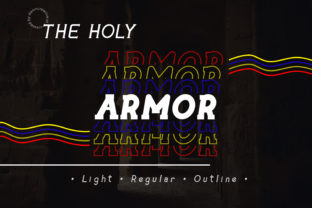
The Holy Armor: A Strategic Serif for Purpose-Driven Design
Typography is rarely neutral. Every font carries weight—not just visual, but psychological and strategic. The Holy Armor stands apart not because it’s ornate or flashy, but because it balances authority with approachability, tradition with clarity. It’s a serif font with three distinct styles—Regular, Light, and Outline—each calibrated for intentionality rather than decoration. When used deliberately, The Holy Armor supports decision-making, reinforces messaging discipline, and elevates how audiences perceive credibility, care, and craft.
Why This Serif Fits Real-World Goals—Not Just Aesthetics
Most designers reach for serifs when they want to signal trust, heritage, or refinement. But many classic serifs lack flexibility across formats—or demand high contrast to read well at small sizes. The Holy Armor avoids that trade-off. Its Regular style holds strong in print and digital interfaces alike; its Light variant preserves legibility without sacrificing presence; and the Outline version offers subtle emphasis without visual noise. That versatility isn’t accidental—it’s strategic. For entrepreneurs launching a product line, educators designing course materials, or freelancers building client-facing assets, having one type family that works across packaging, posters, flyers, web banners, and presentation decks reduces cognitive load and strengthens consistency.
Consider a small-batch skincare brand. They need typography that conveys both botanical authenticity and clinical precision. Using The Holy Armor Regular on labels grounds the brand in reliability; switching to Light for ingredient lists maintains hierarchy without clutter; and applying the Outline style sparingly—say, on a limited-edition stamp—creates tactile distinction without overdesigning. No font switch, no licensing friction, no mismatched x-heights. Just one system, serving multiple functional needs.
When Context Determines Which Style to Choose
Using The Holy Armor effectively begins with asking: *What outcome do I need this text to support?* Not “What looks nice?”—but “What must the reader believe, understand, or do after seeing this?”
- Regular is your default for primary messaging—product names, headlines, call-to-action buttons, and body copy where clarity and gravitas matter most. It performs especially well in physical contexts: embossed packaging, letterpress business cards, or large-format outdoor signage where durability of form translates to perceived quality.
- Light excels in secondary roles—captions, disclaimers, footnotes, or supporting text that must coexist without competing. It’s ideal when space is constrained (like mobile UI) or when tone leans toward quiet confidence rather than command. Use it to soften hierarchy—not erase it.
- Outline functions best as an accent, not a foundation. Reserve it for moments requiring symbolic resonance: a logo lockup, a chapter divider in a printed guide, or a watermark-style element reinforcing brand identity without obstructing content. Overuse dilutes its impact—and risks appearing decorative rather than deliberate.
Avoiding the “Just Because It Looks Good” Trap
One of the quietest risks in design isn’t poor execution—it’s undisciplined selection. Choosing The Holy Armor solely because it feels “elegant” or “vintage-inspired” can backfire. Without alignment to audience expectations, medium constraints, or brand values, even a well-crafted serif becomes background noise. For example, using the Outline style across an entire website navigation menu may look striking—but it sacrifices scannability and accessibility. Similarly, applying Light to long-form blog posts on low-resolution screens undermines readability before engagement begins.
This isn’t about rules—it’s about consequence awareness. Before deploying any style of The Holy Armor, ask:
- Does this choice serve the reader’s task—or my preference?
- Will this remain legible at the smallest size it will appear?
- Does it reinforce, rather than contradict, the message’s intent (e.g., urgency vs. contemplation, innovation vs. legacy)?
- Is there a clear visual reason to shift from Regular to Light—or is it arbitrary variation?
Practical Integration Across Workflows
Intentional use of The Holy Armor extends beyond design tools—it integrates into planning, collaboration, and delivery. Here’s how professionals apply it with operational discipline:
- Start with usage mapping. List every touchpoint where typography appears: email headers, Instagram story templates, invoice footers, workshop handouts. Then assign one The Holy Armor style per role—not per project. Consistency compounds recognition.
- Build lightweight style guides—not PDFs, but living references. A single Notion page or Figma library with real examples (e.g., “How we use Light for accessibility statements”) prevents drift across team members or contractors.
- Test early, test physically. Print a flyer at actual size. View a poster mockup on a phone screen in daylight. The Holy Armor’s strength lies in its adaptability—but only if tested where users actually engage.
- Pair with restraint. This serif thrives alongside clean sans-serifs (e.g., Inter, Poppins, or even system fonts) for contrast—not competition. Avoid stacking multiple display fonts. Let The Holy Armor carry voice; let supporting type handle function.
Long-Term Value Beyond First Impressions
Good typography pays compound interest. The Holy Armor supports longevity not through trendiness, but through structural soundness. Its proportions allow graceful scaling—from 8pt legal text to 120pt event banners—without distortion. Its character set includes robust OpenType features (ligatures, stylistic alternates, numeral variants), enabling nuanced expression as needs evolve. And because it’s available in three complementary weights—not six or eight—you avoid decision fatigue while retaining expressive range.
For educators developing curriculum materials, that means reusing the same font family across student handouts, slide decks, and assessment rubrics—reducing visual friction and reinforcing cognitive continuity. For publishers releasing both print and digital editions, it means fewer reflow issues and tighter control over pacing and emphasis. For service-based businesses, it means cohesive proposals, contracts, and social graphics that reflect the same level of attention to detail clients experience in person.
Final Thought: Typography as Decision Infrastructure
Choosing The Holy Armor isn’t about acquiring a tool—it’s about adopting a framework for clearer communication. It invites you to slow down the “what” to focus on the “why.” When you select Regular, you’re choosing authority. When you choose Light, you’re choosing breath. When you choose Outline, you’re choosing symbolism. Each decision ripples outward—in how quickly someone trusts your offer, how easily they absorb instructions, or how long they linger on your message.
That’s why the most effective users of The Holy Armor don’t treat it as decoration. They treat it as infrastructure—quiet, reliable, and always aligned with purpose. They know that in a world saturated with visual noise, the most powerful statement isn’t the loudest one. It’s the clearest. The most intentional. The one that makes the reader feel, without distraction, exactly what you meant them to feel.