Coffyan: A Thoughtful Choice for Warm, Expressive Typography
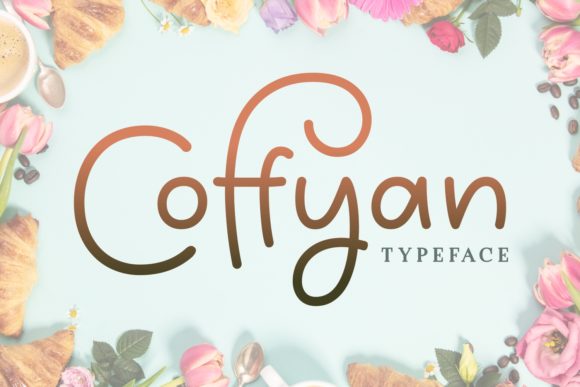
Coffyan is a hand-lettered script font designed with intention—not just aesthetics. Its soft, rounded forms and gentle curves evoke sincerity and approachability without sacrificing legibility or structure. Unlike many decorative scripts that prioritize flourish over function, Coffyan balances playfulness with practicality. It’s not a novelty font meant for one-off use; it’s a considered typographic tool built for repeated, meaningful application across print and digital contexts.
What Sets Coffyan Apart Visually and Functionally
At its core, Coffyan is a sweet, organic script—its characters avoid sharp angles and rigid geometry in favor of fluid, human-like motion. The letterforms are intentionally generous in spacing and weight distribution, which helps maintain readability even at smaller sizes (down to ~14–16pt in print or ~18px on screen, depending on context). This isn’t a font that demands attention through contrast or aggression; instead, it earns attention through warmth and consistency.
The inclusion of two distinct styles—regular and italic—adds flexibility without fragmentation. The italic isn’t merely slanted; it’s redrawn with subtle shifts in stroke emphasis and terminal treatment, giving designers real stylistic options rather than optical illusions. Both weights share the same underlying rhythm and x-height, ensuring visual cohesion when used together in headlines, subheads, or layered text elements.
Swashes, Alternates, and PUA Encoding: Usability Matters
Coffyan comes with PUA-encoded swashes and alternate glyphs—a detail that significantly impacts day-to-day workflow. For users working in Adobe Creative Cloud apps, Affinity Suite, or modern web design tools, this means accessing decorative flourishes doesn’t require digging through obscure character maps or installing additional files. A single keystroke (or glyph panel click) delivers a refined entry or exit swash, a contextual ligature, or an alternate ‘a’, ‘g’, or ‘y’—each thoughtfully drawn to complement the base character set.
This level of typographic control matters most when crafting materials where tone and nuance carry weight: wedding stationery, boutique packaging, educator-led classroom resources, or brand storytelling for wellness, nature, or family-focused businesses. Swashes aren’t just ornamentation here—they’re functional extensions of voice. Used sparingly, they reinforce personality; overused, they dilute clarity. Coffyan gives you the option—not the obligation—to elevate.
Where Coffyan Performs Best—And Where It Doesn’t
Coffyan excels in projects where emotional resonance matters more than neutral utility. Think greeting cards for baby showers or seasonal celebrations, illustrated children’s book covers, botanical-themed branding (think herbal apothecaries, eco-conscious apparel, or local farm stands), and invitation suites where elegance leans tender rather than formal. Its romantic yet unpretentious feel also supports thoughtful social media visuals—especially quote graphics, Instagram story headers, or Pinterest pins where softness reads as authenticity.
It’s less suited for dense body copy, technical documentation, UI labels, or any setting requiring high-speed scanning or strict accessibility compliance (e.g., WCAG AA contrast or screen reader predictability). While legible, its connected script form introduces natural ambiguity for certain character pairs (like “ll”, “fi”, or “st”)—though ligatures and alternates help mitigate this. Designers should test real content—not just lorem ipsum—at intended sizes and backgrounds before finalizing layouts.
Real-World Integration: Workflow and Compatibility
Coffyan works reliably across major platforms. It installs cleanly on macOS and Windows, renders consistently in Figma, Sketch, and Adobe apps, and functions well in CSS @font-face declarations when self-hosted (note: licensing terms must be verified for web use). OpenType features—including stylistic sets and contextual alternates—are accessible in applications that support them, though basic fallback behavior remains readable in environments where advanced features aren’t active.
One practical observation: because Coffyan’s spacing is optimized for expressive setting—not tight editorial grids—it benefits from slightly increased tracking in all-caps or short headline use. A 10–20 unit increase often improves air and balance without sacrificing impact. Likewise, pairing it with a clean, low-contrast sans serif (like Inter, Lato, or Manrope) creates effective hierarchy without visual competition.
Audience Fit: Who Benefits Most—and Why
Coffyan serves creators who value tone as much as typography. Small business owners launching a handmade goods shop or nature-based retreat will find it aligns naturally with their brand ethos—no forced styling required. Educators designing classroom posters or reading logs gain a friendly, inviting presence that supports engagement without infantilizing content. Freelance designers building identity systems for lifestyle brands appreciate having a script that feels intentional, not incidental.
Bloggers and content creators targeting audiences interested in mindfulness, parenting, sustainability, or creative living often report stronger connection metrics when using Coffyan in featured graphics or email headers. That’s not magic—it’s alignment. The font doesn’t shout; it invites. And in saturated digital spaces, that quiet confidence can be more effective than volume.
Quality and Long-Term Value
The craftsmanship behind Coffyan reflects careful attention to spacing, kerning pairs, and stroke consistency across weights. Characters retain their integrity whether scaled up for signage or down for embroidery digitizing (within reasonable limits). There are no jagged edges, inconsistent terminals, or awkward joins—common pitfalls in lower-tier script fonts. Glyph coverage is thorough: standard Latin A–Z, numerals, punctuation, and common diacritics are included. While extended language support (e.g., Cyrillic or Greek) isn’t present, the font’s scope matches its stated use cases.
Licensing is straightforward: desktop use is typically covered under a single-user license, with clear add-ons available for web, app, or e-commerce embedding. No hidden restrictions or usage caps appear in standard terms—but always verify the source, especially when purchasing from third-party marketplaces.
Final Considerations Before You Choose
Coffyan isn’t the right script for every project—but when your goal is warmth, humanity, and subtle sophistication, it’s worth evaluating seriously. It rewards thoughtful application: a well-placed swash, a deliberate italic shift, or a carefully tracked headline can elevate otherwise ordinary layouts. It also respects the user’s time—no complex setup, no broken features, no guesswork about how glyphs behave across software.
If your work regularly involves communicating care, growth, celebration, or calm—if your audience responds to sincerity over slickness—Coffyan offers reliable, repeatable value. It won’t solve conceptual problems, but it can strengthen execution. And in design, that kind of quiet reliability is rare, and genuinely useful.