Prince Crown: A Thoughtful Choice for Designers Seeking Balanced Typography
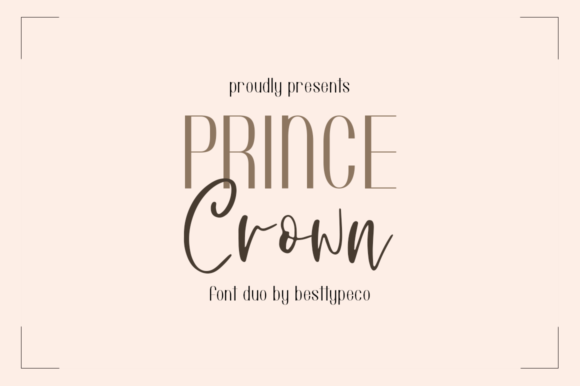
Prince Crown stands out as a carefully considered font duo—not a single typeface, but a pair designed to work in concert. It combines a fluid, expressive handmade calligraphy font with a clean, neutral modern sans serif. This intentional pairing reflects a growing need in contemporary design: the ability to convey both personality and clarity without visual conflict. Unlike standalone script fonts that can overwhelm body text—or minimalist sans serifs that lack warmth—Prince Crown offers a built-in typographic relationship. Its two components share proportional rhythm, spacing logic, and stylistic intent, making them interoperable across headings, subheads, quotes, and supporting copy.
What Makes Prince Crown Distinct Beyond Aesthetic Appeal
The distinction of Prince Crown lies less in novelty and more in execution fidelity. Many font duos rely on superficial contrast—bold vs. light, serif vs. sans—but Prince Crown achieves cohesion through shared design DNA. The calligraphy retains natural variation in stroke weight and terminal shape, yet avoids excessive flourishes that hinder legibility at smaller sizes. Meanwhile, the sans serif isn’t generic; it features subtle open apertures, balanced x-height, and gentle curve modulation that echo the calligraphy’s organic flow—without mimicking it. This harmony means designers spend less time adjusting tracking, kerning, or vertical alignment when layering the two.
It’s also purpose-built for digital and print versatility. Both fonts include full Latin character sets, standard ligatures, and OpenType features like discretionary ligatures and stylistic alternates—particularly useful in the calligraphy variant for avoiding repetitive letterforms in longer headlines. Neither font sacrifices functional robustness for style: the sans serif remains highly readable in UI elements and captions, while the calligraphy holds up well in logos, invitations, and hero banners where moderate size and controlled context are assumed.
How Prince Crown Fits Within Broader Typographic Strategies
Designers often choose between three broad approaches when balancing expressive and functional typography: using a single versatile typeface (e.g., a humanist sans with strong personality), mixing unrelated fonts from different foundries (a common but risky tactic), or selecting a pre-vetted duo like Prince Crown. Each has tradeoffs.
A single expressive typeface simplifies licensing and file management but may struggle across contexts—too decorative for body text, too restrained for impact. Mixing fonts independently offers maximum flexibility but demands deep typographic judgment; mismatched proportions, competing x-heights, or clashing contrast ratios can undermine hierarchy and tone. Prince Crown sits in the middle ground: it removes guesswork around compatibility while preserving expressive range. It doesn’t eliminate design decisions—it shifts focus from “Will these work together?” to “How should I deploy them?”
Practical Use Cases Where Prince Crown Excels
Prince Crown shines in projects where voice and structure must coexist without compromise. Consider a boutique brand identity: the calligraphy lends authenticity and craft to a logo or tagline, while the sans serif handles product names, feature lists, and website navigation with quiet authority. In editorial design—say, a lifestyle magazine’s cover story—the calligraphy introduces emotional resonance in the headline, and the sans serif anchors pull quotes, bylines, and body text with consistent readability.
Wedding stationery is another strong fit. The calligraphy evokes tradition and personal touch in names and dates; the sans serif ensures RSVP instructions, venue details, and timelines remain unambiguous. Similarly, in digital contexts like portfolio websites or SaaS landing pages, Prince Crown supports clear information architecture: the calligraphy draws attention to value propositions or testimonials, while the sans serif maintains scannability in feature grids and form labels.
Situations Where Prince Crown May Require Additional Consideration
Prince Crown is not optimized for every scenario. Its calligraphy variant is intentionally crafted for display use—not extended reading. Attempting to set full paragraphs in the script version will strain legibility, especially at smaller sizes or on lower-resolution screens. Likewise, its sans serif, while highly functional, isn’t engineered for extreme typographic demands: think dense financial reports, multilingual interfaces requiring extensive diacritic support beyond Latin, or environments where ultra-narrow widths or variable font axes (like optical sizing or weight interpolation) are essential.
Projects requiring strict accessibility compliance should also evaluate Prince Crown with care. While the sans serif meets WCAG AA contrast thresholds at standard sizes, the calligraphy’s thinner strokes and variable contrast mean it’s best reserved for large, high-contrast applications—not interface elements like buttons or error messages where consistent visual weight matters for cognitive processing.
Comparing Integration Effort and Long-Term Flexibility
Adopting Prince Crown typically involves less upfront testing than assembling a custom pairing. Because the fonts ship with matched metrics—including consistent baseline alignment and similar cap heights—designers avoid common pitfalls like uneven line heights or awkward vertical spacing when switching between typefaces. That consistency extends to development: CSS font stacks using Prince Crown require fewer overrides for line-height, letter-spacing, or vertical-align adjustments compared to manually paired fonts.
However, long-term flexibility differs from broad compatibility. If a project evolves to require additional weights (e.g., a bold sans for data tables or a light calligraphy for delicate accents), Prince Crown’s current offering—two complementary fonts, each in one primary weight—means supplementing with external typefaces. That reintroduces compatibility considerations later in the design lifecycle. Teams planning for multi-phase rollouts or evolving brand systems may want to assess whether Prince Crown serves their immediate needs while allowing graceful expansion.
Making an Informed Decision: Key Questions to Guide Your Choice
Before selecting Prince Crown—or any typographic system—consider these practical questions:
- What’s the primary communication goal? If establishing warmth, craftsmanship, or individuality is central—and readability in supporting text remains equally important—Prince Crown aligns well.
- Where will the type appear? If usage spans large-format signage, responsive web layouts, and printed collateral, test how both fonts render across devices and output methods. Prince Crown’s sans serif scales predictably; the calligraphy benefits from generous sizing and ample whitespace.
- Who’s maintaining the design system? For solo designers or small teams, Prince Crown reduces decision fatigue. For larger organizations with dedicated type strategy, ensure it integrates with existing guidelines around hierarchy, color contrast, and responsive behavior.
- What’s the timeline and resource scope? Projects with tight deadlines benefit from Prince Crown’s ready-made synergy. Those with extended R&D phases might explore broader typographic ecosystems to future-proof against shifting requirements.
Prince Crown doesn’t promise universal applicability—but it delivers reliably where its design rationale matches real-world constraints. It’s a tool suited to intentionality: not for designers seeking endless options, but those who value thoughtful constraints, balanced contrast, and typographic integrity across mediums. When your aim is clarity with character—without sacrificing function—Prince Crown offers a grounded, cohesive path forward.