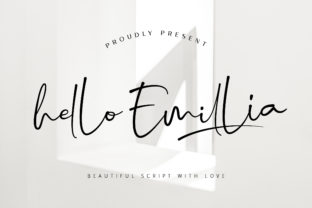
Hello Emillia: The Strategic Choice for Luxury Typography
Typography isn’t decoration—it’s decision-making made visible. When you choose Hello Emillia, you’re not selecting a font; you’re aligning your visual language with intention, audience perception, and long-term brand coherence. Designed with refined contrast, graceful terminals, and subtle calligraphic rhythm, Hello Emillia delivers sophistication without sacrificing readability or versatility. It works where many luxury fonts fail: in body copy at 14–16px, on mobile screens, in print brochures, and across digital interfaces—provided it’s used with clarity of purpose.
Why Hello Emillia Fits Real-World Strategy—Not Just Aesthetics
Luxury isn’t defined by ornamentation alone. It’s signaled through consistency, restraint, and contextual intelligence. Hello Emillia supports this because its letterforms carry weight without heaviness—its lowercase g and a have quiet distinction, its capitals command presence without shouting, and its spacing encourages measured reading. That makes it unusually effective for audiences who value substance: educators crafting premium course materials, consultants designing client-facing decks, small business owners launching high-trust service offerings, or publishers building editorial brands that prioritize credibility over trend-chasing.
Unlike display fonts that demand attention at the expense of function, Hello Emillia operates at the intersection of elegance and utility. It doesn’t require justification—it earns its place through performance. When used in a financial advisor’s client onboarding kit, for example, it subtly reinforces stability and discretion. In a boutique skincare brand’s email sequence, it conveys care without cliché. These aren’t stylistic accidents—they’re outcomes of deliberate typographic alignment.
When Hello Emillia Delivers Measurable Value
Strategic typography pays dividends in three key areas: perception, retention, and efficiency. Hello Emillia strengthens all three—but only when matched to the right context. Consider these grounded use cases:
- Brand Launches & Positioning: If your offering competes on trust, craftsmanship, or timelessness—not speed or scale—Hello Emillia anchors messaging in quiet authority. It pairs well with neutral palettes and generous whitespace, avoiding visual competition that dilutes message clarity.
- High-Value Content Delivery: Whitepapers, strategy guides, or subscription newsletters benefit from Hello Emillia’s legibility at extended lengths. Its open counters and balanced x-height reduce eye fatigue during sustained reading—critical for professionals consuming complex information.
- Client-Facing Collateral: Proposals, contracts, and presentation decks gain gravitas without formality overload. Unlike overly rigid serif fonts, Hello Emillia retains approachability—important when balancing professionalism with human connection.
- Digital Interfaces (Judiciously): As a heading font in dashboards, member portals, or SaaS landing pages, it signals premium positioning. But avoid using it for UI labels or navigation menus unless paired with a highly legible sans-serif for body text—typographic hierarchy must remain functional first.
How to Use Hello Emillia Intentionally—Not Automatically
Adopting Hello Emillia without strategy risks aesthetic drift: beautiful but disconnected from goals. Before applying it, ask three questions:
- What outcome do I want the reader to feel—not just see? If the goal is urgency or informality, Hello Emillia may misfire. It excels at evoking calm confidence, thoughtful expertise, or understated refinement—not energy, playfulness, or disruption.
- Where will this appear—and how much control do I have over surrounding elements? Hello Emillia shines when supported by clean layouts, appropriate line heights (1.5–1.6 for body), and sufficient contrast (at least 4.5:1 against background). On cluttered templates or low-resolution displays, its subtlety can vanish.
- Does it serve the audience—or my preference? Test it with real users. Ask a freelancer reviewing your website copy: “What kind of company would use this font?” Compare responses to your intended positioning. If answers skew toward “expensive but distant” when you aim for “trusted and accessible,” recalibrate.
Practical planning tip: Start with one high-impact application—not full-site rollout. Try Hello Emillia in your next investor update header, your lead magnet title, or your service page subheadings. Measure engagement time, scroll depth, or conversion lift against previous versions. Let data—not instinct—guide expansion.
Risks of Misaligned Usage
Using Hello Emillia without grounding in audience or objective introduces tangible risk—not just visual mismatch, but strategic friction. For instance:
- A tech startup emphasizing agility and iteration may unintentionally signal rigidity if Hello Emillia dominates its homepage. Visitors expecting innovation cues might subconsciously question authenticity.
- An educator using Hello Emillia across dense slide decks without adjusting line spacing or font size could compromise accessibility—undermining inclusivity goals despite aesthetic intent.
- A small business owner licensing Hello Emillia for web use without verifying licensing scope (e.g., variable font support, CDN delivery, or commercial embedding rights) may face compliance gaps or unexpected costs down the line.
These aren’t hypotheticals—they’re operational realities. Hello Emillia requires the same due diligence as any strategic tool: understanding constraints, testing assumptions, and validating impact.
Pairing and Hierarchy: Where Hello Emillia Gains Leverage
Its strength multiplies when paired thoughtfully. Hello Emillia performs best alongside typefaces that provide structural contrast—not visual competition. Consider these pairings based on real projects:
- With Inter or Public Sans: For digital dashboards where Hello Emillia handles section headers and Inter manages data tables and interface labels. The combination balances warmth and precision.
- With Freight Text Pro or GT Pressura: In long-form editorial work, where Hello Emillia sets pull quotes or chapter titles while a robust text serif carries narrative flow.
- With a restrained mono like IBM Plex Mono: In technical documentation or developer-facing resources, where Hello Emillia introduces brand voice in introductions or summaries without compromising code-block legibility.
The rule isn’t contrast for contrast’s sake—it’s contrast that serves function. Hello Emillia should never compete with content. It should elevate it.
Long-Term Value: Beyond First Impressions
Fonts influence memory. Studies in cognitive psychology suggest that moderately distinctive yet readable typefaces improve recall—especially when aligned with message tone. Hello Emillia fits that profile: distinct enough to register, familiar enough to process effortlessly. That supports long-term brand recognition without demanding constant novelty.
More importantly, it scales ethically. Because it avoids extreme stylistic flourishes, Hello Emillia adapts across mediums and eras without requiring redesign. A brand that launched with Hello Emillia in 2023 remains coherent in 2028—not because trends held, but because the choice was rooted in enduring principles: clarity, consistency, and respect for the reader’s attention.
That’s the quiet power of Hello Emillia: it doesn’t chase attention. It earns it—through restraint, reliability, and resonance.
Final Guidance: Choose With Purpose, Not Preference
Before downloading Hello Emillia—or any typeface—pause and define the job it must do. Is it reinforcing credibility in a proposal? Differentiating a premium tier? Humanizing a technical subject? Each answer shapes how, where, and how much you deploy it. There’s no universal “best” font—only the best choice for a specific outcome, audience, and environment.
Hello Emillia earns its place when those conditions align. Use it to signal that what follows matters—not because it looks expensive, but because it reflects careful thinking, clear priorities, and respect for the person reading. That’s not luxury as ornament. That’s luxury as discipline.