Friday Good: A Sweet, Chubby Serif That Stands Out
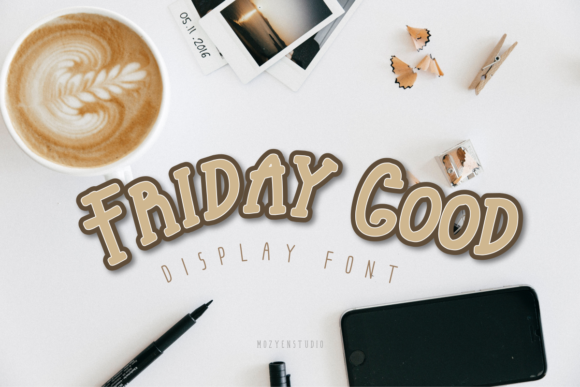
Friday Good isn’t just another font—it’s a confident, warm presence on the page. Designed as a sweet and chubby slab serif, it balances boldness with approachability. Its generous letterforms, rounded terminals, and sturdy vertical stress give it weight without stiffness. Unlike many display serifs that lean dramatic or retro, Friday Good feels grounded, friendly, and quietly memorable. It doesn’t shout—it invites attention with sincerity.
Why Designers Reach for Friday Good
Its charm lies in its consistency and character. Every uppercase “A”, “B”, and “R” carries the same soft confidence. The lowercase “a”, “g”, and “e” are open and legible, even at smaller sizes—unusual for a slab with this much personality. That means Friday Good works where many display fonts falter: on product labels, social banners, workshop handouts, and even short-form video captions.
It’s not meant to be invisible background typography. It’s meant to anchor a message—to make “Open Now”, “New Recipe”, or “You’re Invited” feel both joyful and trustworthy. That duality is rare. Many playful fonts sacrifice clarity; many serious fonts lack warmth. Friday Good holds both.
Ideas You Can Use—Today
Start simple. Try Friday Good for:
- Small business signage: A café chalkboard menu, a boutique window decal, or a farmers’ market stall banner. Its chunky forms hold up well in print and vinyl cutouts—even at arm’s length.
- Workshop and class materials: Use it for headers in PDF handouts or slide decks. Pair it with a clean sans-serif (like Inter or Open Sans) for body text—this contrast keeps information scannable while keeping tone inviting.
- Social media visuals: On Instagram or Pinterest, Friday Good shines in quote graphics, event announcements, or limited-edition drops. Its rhythm guides the eye naturally, especially when centered over muted or textured backgrounds.
- Printed packaging: Think jam jars, candle boxes, or handmade soap tags. Its friendliness reinforces craft and care—no need for extra illustration or embellishment.
One designer used Friday Good across a full rebrand for a neighborhood pottery studio: on ceramic stamps, website hero text, and workshop schedule posters. Because the font has consistent spacing and strong x-height, all formats felt unified—even when printed on kraft paper or screen-printed on tote bags.
How Different Creators Make It Work
Bloggers and educators use Friday Good sparingly but strategically—only for post titles, section dividers, or key takeaways. That restraint keeps their content accessible while adding visual punctuation. One science educator uses it for “Key Concept” callouts in her newsletter; readers tell her those lines “stick in their mind.”
Freelancers and small studios often pair Friday Good with free, web-safe fonts to keep client projects lightweight and fast-loading. For example: Friday Good for logo lockups or presentation slides, then system fonts (like Georgia or Segoe UI) for email copy or documentation. It adds distinction without technical overhead.
Marketers and publishers appreciate how well it scales—from tiny app notification badges to large-format trade show backdrops. Its stroke contrast is low enough to avoid pixelation on screens, yet high enough to retain impact in print. One indie magazine uses it exclusively for issue titles and contributor credits—readers now recognize the font as part of the publication’s voice.
Keeping It Clear and Consistent
Like any strong personality, Friday Good thrives with thoughtful boundaries. Here’s what helps:
- Limited hierarchy: Use it for one primary level only—usually headlines or logos. Avoid layering multiple weights unless the design demands clear visual separation (e.g., “FRIDAY” in Bold, “Good” in Regular).
- Generous spacing: Its chubbiness benefits from extra letter-spacing (tracking) in all-caps settings—especially in digital ads or signage. Try +40–+80 in design tools to keep letters breathing.
- Background contrast matters: It reads best against solid, light, or desaturated backgrounds. Avoid busy patterns or low-contrast gradients directly behind it—clarity always comes first.
- Test real usage: Before finalizing, view it on the actual medium—whether that’s a printed label under store lighting or a mobile screen in daylight. What looks great on your monitor may need slight size or spacing tweaks elsewhere.
Variations and Stylistic Flexibility
Friday Good includes multiple weights (Light, Regular, Bold, Black) and true italics—not slanted fakes. That means you can build nuance without switching type families. Try:
- Using Regular italic for pull quotes or subtle emphasis within body copy set in a neutral sans-serif.
- Layering Bold over a photo background with a subtle drop shadow—ideal for Instagram Stories or landing page banners.
- Setting Light for delicate subheads or captions where you want elegance without fragility.
It also supports Latin Extended-A characters, so it handles common accented letters (é, ñ, ü) cleanly—useful for bilingual brands, educators, or global creators.
When Friday Good Isn’t the Right Fit
It’s honest about its strengths—and limits. Avoid it for dense paragraphs, legal disclaimers, data tables, or interfaces requiring rapid scanning (like dashboards or forms). Its charm lives in moments of pause, invitation, or celebration—not speed or neutrality.
If your project needs quiet authority (think law firm brochures or academic journals), a more restrained serif may serve better. If you need maximum readability at tiny sizes (like app interface labels), stick with tested UI fonts. Friday Good earns its place by standing out—not fading in.
Your Next Step Is Simple
Download Friday Good and try it in one real project this week—even if it’s small. Add it to a Canva template. Swap it into a Google Slide title. Print a test label. See how it changes the tone of a phrase you’ve used a hundred times.
You don’t need permission to experiment. You don’t need perfection on the first try. You just need to notice how a well-chosen typeface can shift perception—making “new” feel welcoming, “limited” feel special, and “yours” feel unmistakably yours.