Hiyotori: A Strategic Choice for Clarity, Consistency, and Quiet Authority
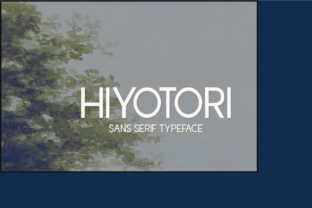
Hiyotori isn’t just another sans serif font—it’s a deliberate tool for visual communication with measurable impact on perception, comprehension, and trust. Designed with precision and restraint, Hiyotori delivers a refined, uncluttered aesthetic across three distinct yet harmonized styles: Regular, Medium, and Bold. Its balanced proportions, open counters, and subtle stroke modulation support readability at small sizes and presence at large ones—making it unusually adaptable without sacrificing sophistication.
Why Hiyotori Fits Real-World Decision-Making
When you choose a typeface, you’re not selecting decoration—you’re assigning tone, signaling intent, and shaping how your audience processes information. Hiyotori supports strategic goals because it avoids extremes: it’s neither coldly technical nor overtly expressive. That neutrality is its strength. It doesn’t compete with content; it elevates it. For professionals managing brand consistency across websites, presentations, reports, or printed materials, Hiyotori offers predictability without monotony. Its three weights allow clear typographic hierarchy—no need to layer multiple unrelated fonts to distinguish headings from body text or captions from callouts.
Consider a small business owner launching a new service page. Using Hiyotori Bold for section headers, Medium for subheads, and Regular for body copy creates an intuitive reading path—guiding attention without visual noise. That same logic applies to educators designing course handouts, marketers building email templates, or freelancers crafting client proposals. In each case, the goal isn’t novelty—it’s clarity, credibility, and coherence. Hiyotori serves those goals by reducing cognitive load, not adding to it.
Where Hiyotori Delivers Measurable Value
Hiyotori excels where legibility, tone control, and cross-platform reliability matter most:
- Branding systems that require scalability—from mobile app interfaces to trade show banners—benefit from Hiyotori’s consistent rendering across devices and operating systems.
- Long-form content, like whitepapers, newsletters, or learning modules, gains from its even texture and generous x-height, which sustain reader engagement over extended passages.
- Internal documentation and operational dashboards gain professionalism without formality—supporting both clarity in execution and alignment in team communication.
- Customer-facing touchpoints, including invoices, support emails, and product packaging, project competence and care when using Hiyotori thoughtfully—not as background filler, but as intentional framing.
These aren’t theoretical advantages. They reflect how typography functions in practice: as infrastructure. Like choosing the right paper stock or file format, selecting Hiyotori is part of operational hygiene—not creative indulgence.
Using Hiyotori Intentionally, Not Automatically
Adopting Hiyotori without context carries quiet risk. Its elegance can unintentionally signal distance if misaligned with voice or audience. A startup targeting Gen Z creators might find Hiyotori’s refinement reads as overly formal next to dynamic, variable fonts—unless paired deliberately with warmer color palettes, generous spacing, or human-centered imagery. Similarly, pairing Hiyotori with low-contrast text or cramped line heights undermines its core strength: readability.
Before deploying Hiyotori across your digital or print assets, ask:
- What outcome do I want this piece of communication to drive? (e.g., faster comprehension, longer dwell time, stronger recall)
- Does the weight I’ve chosen reinforce—or contradict—the importance of this message?
- How does Hiyotori interact with surrounding elements? Does it breathe alongside ample whitespace, or get lost in cluttered layouts?
- Is the contrast ratio sufficient for accessibility? (Test with tools like WebAIM’s Contrast Checker—Hiyotori performs well, but only when used with appropriate foreground/background combinations.)
These questions shift focus from “Does it look nice?” to “Does it serve the objective?” That distinction separates aesthetic preference from strategic typography.
Planning for Long-Term Typography Consistency
Hiyotori’s value compounds over time—not because it’s trendy, but because it resists obsolescence. Unlike fonts designed around fleeting stylistic quirks, Hiyotori follows enduring principles of letterform construction: balanced rhythm, predictable spacing, and restrained contrast. That makes it easier to maintain visual continuity across evolving platforms, team members, and project timelines.
For teams adopting Hiyotori, start small. Define one primary use case—say, all client-facing PDFs—and standardize weight usage: Bold for titles, Medium for section breaks, Regular for body text. Document that rule. Then expand gradually: apply the same logic to slide decks, then web headers, then email subject lines. This phased approach builds muscle memory, surfaces edge cases early (e.g., how Hiyotori renders in Outlook vs. Gmail), and prevents inconsistency from creeping in through ad-hoc decisions.
Also consider fallbacks. While Hiyotori works flawlessly as a web font via modern hosting services, always specify system-safe fallbacks (e.g., -apple-system, BlinkMacSystemFont, "Segoe UI", Roboto, Helvetica, Arial, sans-serif). This ensures your typographic intent remains legible—even if the font fails to load.
Hiyotori in Context: Practical Pairing Principles
Hiyotori doesn’t require pairing—but when combined intentionally, it gains dimension. Its neutral character means it pairs well with typefaces that introduce controlled contrast: a warm, slightly organic serif for body text in print publications; a compact monospace for code snippets or data tables; or even a restrained handwritten style for signature accents—used sparingly, never as dominant text.
The key is asymmetry with purpose. If Hiyotori provides structure, the companion font should offer warmth, texture, or specificity—not competition. Avoid pairing it with other high-contrast sans serifs (e.g., Montserrat or Inter) unless you have a clear rationale—like distinguishing UI controls from content labels. More often, simplicity wins: Hiyotori alone, with intelligent spacing and thoughtful color, communicates more than layered fonts ever could.
When Hiyotori May Not Be the Right Fit
No font solves every problem—and recognizing Hiyotori’s limits is part of using it wisely. It’s less suited for contexts demanding strong personality, irony, or immediate emotional resonance. A music festival poster, a children’s book cover, or a protest banner may benefit more from expressive, irregular, or historically grounded typefaces. Likewise, highly technical environments requiring extreme legibility at tiny sizes—think medical device interfaces or aviation dashboards—may prioritize fonts engineered specifically for those constraints (e.g., Frutiger Aero or IBM Plex Sans).
Hiyotori also assumes a baseline level of design awareness. Without attention to line length, paragraph spacing, and alignment, even the most refined font can feel sterile or alienating. Its sophistication reveals poor layout choices—not hides them. So before licensing Hiyotori, audit your current implementation habits. Are your paragraphs consistently too wide? Is your leading too tight? Fix those first. Then let Hiyotori amplify the improvement.
Ultimately, Hiyotori rewards intention. It won’t compensate for unclear messaging, inconsistent branding, or rushed execution. But when matched with disciplined planning, audience awareness, and respect for how people read and process visual information, it becomes a quiet lever for better outcomes—across presentations, products, publications, and platforms.
That’s why seasoned designers, educators, and operators return to Hiyotori: not for novelty, but for reliability; not for flair, but for fidelity—to message, to audience, and to long-term goals.